We all like to sing in the shower and play “Heart And Soul” on the piano, but did you know that playing musical instruments long-term can also make you smarter? Practicing an instrument not only improves your musical ability; it also works out your brain!
Performing and practicing music is no easy task. Musicians take in musical notation and possibly conductor cues and spontaneously output sound (Miendlarzewska and Trost, 2014). To produce the desired sounds, the correct fingering, tone, and pitch are required. Additionally, musicians must coordinate with other musicians and add expression and emotion. This all adds up to a lot, leaving the brain with many cognitive functions to juggle at once. These skills include processing speed, hand-eye coordination, episodic and verbal memory, visuospatial awareness, and executive functions (Román-Caballero et al., 2022). It has been observed that these cognitive abilities that musicians constantly exercise are stronger in tasks unrelated to music (Rahman et al., 2022). Additionally, students who participate in music seem to have higher academic performance (Rahman et al., 2022).
Constantly learning and utilizing cognitive abilities, as you do when practicing an instrument over long periods, can stimulate neuroplasticity in the brain (Miendlarzewska and Trost, 2014). Neuroplasticity is the process in which the brain adapts to stimuli (Puderbaugh and Emmady, 2023). The nervous system can learn and change its response based on past behaviour and environments. More specifically, structural neuroplasticity is the ability of the brain’s nerve cells to change its physical structure by reorganizing its structure, connections, or functions (Cherry, 2022).
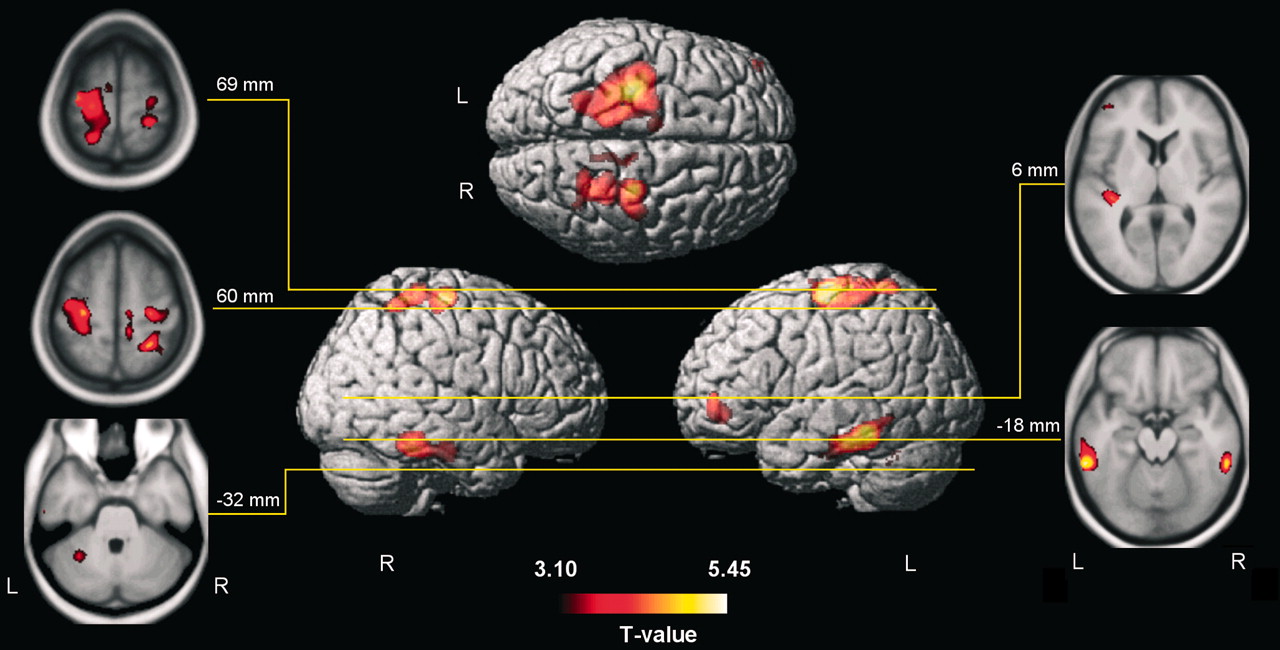
Many studies using Magnetic Resonance Imaging (MRI) scans of the brain have shown evidence of this increased neuroplasticity (Miendlarzewska and Trost, 2014). Such MRI scans have shown anatomical and structural differences between the brains of professional musicians versus non-professional musicians. In many areas of the brain correlated with cognitive functions, there is increased grey matter volume in the musicians, as seen in Figure 1. Grey matter is areas dense in neurons, which allows that section of the brain to process and release information faster (Mercadante and Tadi, 2023). This increased grey matter is likely a result of the increased neuroplasticity in musicians.

A study by Gaser and Schlaug (2023) looked at professional keyboard players with at least one hour of practice time per day and professions in music, then compared scans of their brains to non-musicians. Using a voxel-by-voxel morphometric technique with MRI scans, they could determine quantitative amounts of grey and white matter within brains (Martinkovic et al., 2014). Voxel-by-voxel morphometric technique is especially effective at this, as by overlaying multiple MRI scans, the differences in structures of brains are emphasized. These quantitative differences can then be analyzed and interpreted, as seen in and Figure 2.

From these comparisons, the study concluded that the keyboard players had higher volumes of grey matter in auditory, visual, and motor brain regions (Gaser and Schlaug, 2003). These results support the hypothesis that there are structural adaptions in the brain from long-term rehearsal of instruments.
The combination of many skills simultaneously needed to play an instrument can be daunting, but your brain enjoys the challenge. So, if you are ever looking for a fun hobby to pick up, but also want to become smarter in the process, pick up an instrument!
References
Cherry, K., 2022. What is Neuroplasticity? [online] Verywell Mind. Available at: <https://www.verywellmind.com/what-is-brain-plasticity-2794886> [Accessed 23 November 2023].
Gaser, C. and Schlaug, G., 2003. Brain Structures Differ between Musicians and Non-Musicians. Journal of Neuroscience, [e-journal] 23(27), pp.9240–9245. https://doi.org/10.1523/JNEUROSCI.23-27-09240.2003.
Martinkovic, L., Hecimovic, H., Sulc, V., Marecek, R. and Marusic, P., 2014. Chapter Ten – Modern Techniques of Epileptic Focus Localization. In: P. Jiruska, M. de Curtis and J.G.R. Jefferys, eds. International Review of Neurobiology, Modern Concepts of Focal Epileptic Networks. [online] Academic Press. pp.245–278. https://doi.org/10.1016/B978-0-12-418693-4.00010-8.
Mercadante, A.A. and Tadi, P., 2023. Neuroanatomy, Gray Matter. In: StatPearls. [online] Treasure Island (FL): StatPearls Publishing. Available at: <http://www.ncbi.nlm.nih.gov/books/NBK553239/> [Accessed 29 November 2023].
Miendlarzewska, E.A. and Trost, W.J., 2014. How musical training affects cognitive development: rhythm, reward and other modulating variables. Frontiers in Neuroscience, [e-journal] 7, p.279. https://doi.org/10.3389/fnins.2013.00279.
Puderbaugh, M. and Emmady, P.D., 2023. Neuroplasticity. In: StatPearls. [online] Treasure Island (FL): StatPearls Publishing. Available at: <http://www.ncbi.nlm.nih.gov/books/NBK557811/> [Accessed 23 November 2023].
Rahman, J.S., Caldwell, S., Jones, R. and Gedeon, T., 2022. Brain Melody Interaction: Understanding Effects of Music on Cerebral Hemodynamic Responses. Multimodal Technologies and Interaction, [e-journal] 6(5), p.35. https://doi.org/10.3390/mti6050035.
Román-Caballero, R., Vadillo, M.A., Trainor, L.J. and Lupiáñez, J., 2022. Please don’t stop the music: A meta-analysis of the cognitive and academic benefits of instrumental musical training in childhood and adolescence. Educational Research Review, [e-journal] 35, p.100436. https://doi.org/10.1016/j.edurev.2022.100436.