For many, food allergies are a daily nuisance. Treatments such as EpiPens exist, and preventative measures can be taken, but this often means people without allergies must swap out some delicious foods for alternatives. Scientists have recently taken a new approach to this problem by trying to fix the problem in the food – or more specifically the genes, using CRISPR (NIH, 2023).
Allergies are caused when an allergen, which is the specific proteins that cause a reaction, enters the body and is recognized as antigens (NIH, 2023). Although scientists cannot identify new allergens without an allergic reaction, they have some characteristics. Most allergens are stable at high temperatures, typically water soluble, and resistant to protein catabolism (Breiteneder and Mills, 2005).
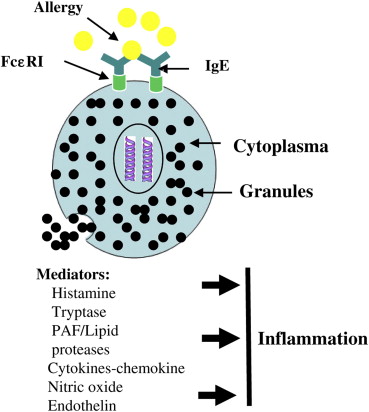
Typically, the body balances the production of type I T helper (TH1) and type II T helper (TH2) cells, which create a balanced immune response (Janeway et al., 2001). TH1 cells assist in dealing with intercellular infections, and TH2 cells respond to extracellular threats, but both do their job by releasing signalling molecules called cytokines. Antigens, however, favour the production of TH2, which produces cytokines interleukin 3 and interleukin 4, that then signal for B-cells to produce immunoglobin E (IgE). The increased TH2 activity leads to a large increase in IgE molecules binding to mast cells, which contain the chemicals that cause an allergic reaction (Amin, 2012). When someone is reintroduced to the same allergen molecules, the allergens will bind to the many IgE molecules waiting on mast cells, triggering the release of the chemicals, as seen in Figure 1.

Clustered Regularly Interspaced Short Palindromic Repeats (CRISPR) is a newer form of gene editing technology that works by using RNA molecules to target specific genes to then edit. CRISPR is not new to the food industry but removing allergens has only recently been added to the lengthy list of uses. By designing sequence RNA in a lab that directs Cas-9 proteins to the DNA that codes for allergen proteins, they can be cut and edited (Goodman et al., 2017). By editing the allergen genes, the immune system will not recognize the protein, and TH2 production will decrease. The dilemma that sometimes arises in cutting and removing genes, is that they may be required for organism function (Singh and Bhalla, 2008). This can be compensated for by instead repressing some of the allergen genes to decrease their expression. By lowering the levels of allergens, they can travel undetected through the body, meaning no allergic reaction takes place.
This process has already started being tested and explored around the world. In the Netherlands, they were able to modify gluten DNA in wheat to make it edible for people with celiac disease (Tuncel et al., 2023). β-lactoglobulin in goat milk has also been repressed so that undetectable amounts of the protein is produced, making it safe for allergenic people to drink!
As with all gene editing projects, CRISPR for editing allergens poses an ethical dilemma. People have varying opinions on genetically modified organisms (GMOs), and countries around the world have different policies. Here in Canada, along with the United States, we are considered GMO-friendly, while the European Union has strict regulations on GMO use (Idris et al., 2023).
It is hard to draw a line on when gene editing goes too far, making the advancement of technology like CRISPR slow. However, as technology advances and society progresses, we are bound to dive deeper into gene editing for safety and health issues, such as eliminating allergies.
References
Amin, K., 2012. The role of mast cells in allergic inflammation. Respiratory Medicine, 106(1), pp.9–14. https://doi.org/10.1016/j.rmed.2011.09.007.
Breiteneder, H. and Mills, E.N.C., 2005. Molecular properties of food allergens. The Journal of Allergy and Clinical Immunology, 115(1), pp.14–23; quiz 24. https://doi.org/10.1016/j.jaci.2004.10.022.
Janeway, C.A., Jr., Travers, P., Walport, M. and Shlomchik, M.J., 2001. The production of IgE. In: Immunobiology: The Immune System in Health and Disease. 5th edition. [online] Garland Science. Available at: <https://www.ncbi.nlm.nih.gov/books/NBK27117/> [Accessed 22 January 2024].
Goodman, M.A., Manesh, D.M., Malik, P. and Rothenberg, M.E., 2017. CRISPR/Cas and the Future of Gene Editing in Allergic and Immunologic Diseases. Expert review of clinical immunology, 13(1), pp.5–9. https://doi.org/10.1080/1744666X.2017.1241711.
Idris, S.H., Nurzatil Sharleeza, M.J., Lee Wei, C. and 曾, 2023. Ethical and legal implications of gene editing in plant breeding: a systematic literature review. Journal of Zhejiang University. Science. B, 24(12), pp.1093–1105. https://doi.org/10.1631/jzus.B2200601.
NIH, 2023. Causes and Prevention of Food Allergy | NIAID: National Institute of Allergy and Infectious Diseases. [online] NIH. Available at: <https://www.niaid.nih.gov/diseases-conditions/food-allergy-causes-prevention> [Accessed 22 January 2024].
Singh, M.B. and Bhalla, P.L., 2008. Genetic engineering for removing food allergens from plants. Trends in Plant Science, 13(6), pp.257–260. https://doi.org/10.1016/j.tplants.2008.04.004.
Tuncel, A., Pan, C., Sprink, T., Wilhelm, R., Barrangou, R., Li, L., Shih, P.M., Varshney, R.K., Tripathi, L., Van Eck, J., Mandadi, K. and Qi, Y., 2023. Genome-edited foods. Nature Reviews Bioengineering, 1(11), pp.799–816. https://doi.org/10.1038/s44222-023-00115-8.