Imagine a world without bees. Of the myriad insects, bees are indispensable for pollinating crops worldwide, as insect pollination represents 9.5% of the total economic value of agricultural production of human produce. Bees in particular can increase the yield of crops such as cotton by up to 62% (Khalifa et al., 2021). Despite their importance, bee populations worldwide are starting to decline (McCabe, Aslan and Cobb, 2022). Bees are subject to many stressors such as habitat loss, pesticides and invasive species, with climate change emerging as a new threat to their winter survival.
Many people are familiar with the eusocial European honey bee (Apis mellifera) who builds hives and nests in large colonies. Less known are the many species of solitary bee. Rather than build hives, these species build individual nests in plant stems, logs and underground tunnels (MacIvor, Cabral and Packer, 2014). These bees will create brood cells separated by mud or plant walls, each containing a larva and pollen provisions (MacIvor, Cabral and Packer, 2014). During the winter, the bee larvae pupate and enter diapause, a state of reduced metabolic activity associated with increased cold hardiness (Bale and Hayward, 2010). As this is an essential part of their life cycle, changes caused by climate change may impact their survival and ability to emerge in the spring.
For example, warmer winters may decrease solitary bee emergence. McCabe et al., (2021) studied how overwintering temperature affects emergence of bees in the family Megachilidae (cavity nesting bees). They did this by moving bee nests to either higher (colder temperature) or lower (hotter temperature) elevations. There was a 30% decrease in bee emergence at lower elevations when compared to the control, while emergence increased when nests were moved to higher elevations. This implies that these cavity nesting bees are more tolerant to colder temperatures, and global warming may be more damaging to them (McCabe, Aslan and Cobb, 2022).
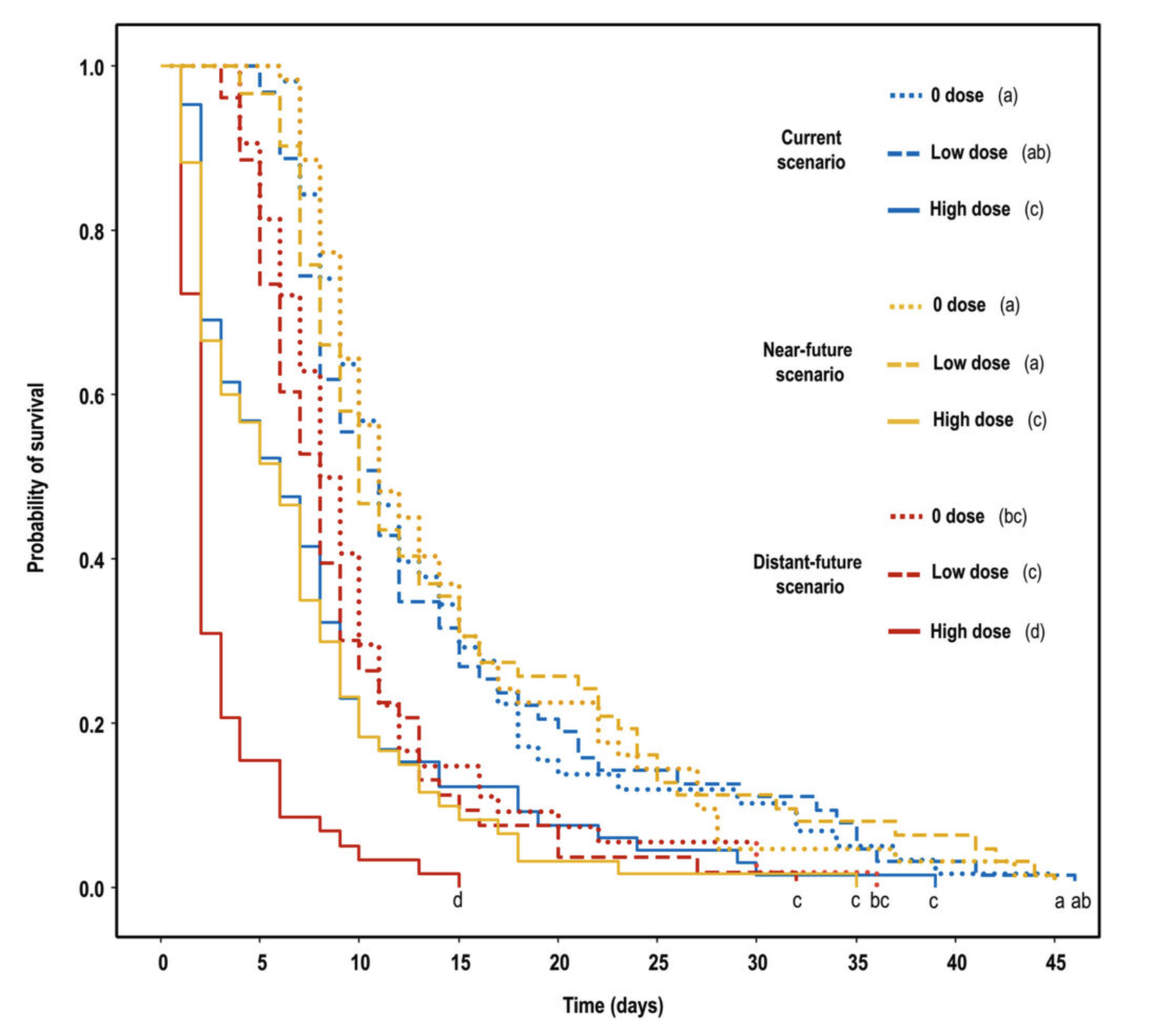
Climate change may also increase bee sensitivity to pesticides. A study conducted on the solitary bee Osmia cornuta, showed that pesticide exposure after warmer winters more negatively impacted bees via feeding depression and impaired cognition (Albacete et al., 2023). Overwintering bees were subject to present winter conditions as well as near future and distant future winter conditions which were predicted by the Intergovernmental Panel on Climate Change (IPCC) to be 0.6°C and 2.9°C warmer respectively. After the bees emerged from diapause, they were exposed to sublethal insecticide treatments. They found that the pesticide survival of bees in the distant future scenario declined more rapidly than the other two treatments (Figure 1) (Albacete et al., 2023).

Figure 1: Survival of Osmia cornuta females after undergoing different overwintering treatments and pesticide exposure. Bees were overwintered at different temperatures depending on the scenario. Current scenario: 9.4 ± 0.3 (2.6–20.1°C), near-future scenario: 10.0 ± 0.4 (3.2–22.5°C), distant-future scenario: 12.3 ± 0.4 (4.4–25.3°C). After overwintering, the bees were given oral doses of the commercial pesticide sulfoxaflor in either low, high or zero doses. Curves with different letters are significantly different (Albacete et al., 2023).
Additionally, some bee species underwent increased weight loss following diapause in warmer winter climates (Fründ, Zieger and Tscharntke, 2013). Bee species such as Osmia rufa, were found to have lower body fat content and lower body weight when overwintering under warmer conditions compared to colder ones (Fliszkiewicz et al., 2012). This loss in weight is problematic as it reduces longevity and overall fitness. However, these negative effects of warmer winters do not affect all bee species equally. Post winter weight and temperature are positively correlated in some species such as Hylaeus communis and Heriades truncorum (Fründ, Zieger and Tscharntke, 2013). These differences between species can be partially explained by the life-history stage during overwintering, as well as species physiology. For example, some bees produce cryoprotectants independently of temperatures which can end up being more costly during warmer winters. Therefore, a better understanding of each unique physiology is needed to determine the effects that climate change may have.
Climate change is threatening bees, one of the words most essential pollinators. Warmer winters can reduce their probability of emergence and increase pesticide sensitivity which lowers their overall survival. Given their prominent role in agriculture, the loss of bees has the potential to negatively affect crop yield and human food production. While not all bee species are affected in the same way, it is crucial for researchers to learn more about their unique morphologies in order to preserve this indispensable insect.
References
Albacete, S., Sancho, G., Azpiazu, C., Rodrigo, A., Molowny-Horas, R., Sgolastra, F. and Bosch, J., 2023. Bees exposed to climate change are more sensitive to pesticides. Global Change Biology, 29(22), pp.6248–6260. https://doi.org/10.1111/gcb.16928.
Bale, J.S. and Hayward, S.A.L., 2010. Insect overwintering in a changing climate. Journal of Experimental Biology, 213(6), pp.980–994. https://doi.org/10.1242/jeb.037911.
Fliszkiewicz, M., Giejdasz, K., Wasielewski, O. and Krishnan, N., 2012. Influence of Winter Temperature and Simulated Climate Change on Body Mass and Fat Body Depletion During Diapause in Adults of the Solitary Bee, Osmia rufa (Hymenoptera: Megachilidae). Environmental Entomology, 41(6), pp.1621–1630. https://doi.org/10.1603/EN12004.
Fründ, J., Zieger, S.L. and Tscharntke, T., 2013. Response diversity of wild bees to overwintering temperatures. Oecologia, 173(4), pp.1639–1648. https://doi.org/10.1007/s00442-013-2729-1.
Khalifa, S.A.M., Elshafiey, E.H., Shetaia, A.A., El-Wahed, A.A.A., Algethami, A.F., Musharraf, S.G., AlAjmi, M.F., Zhao, C., Masry, S.H.D., Abdel-Daim, M.M., Halabi, M.F., Kai, G., Al Naggar, Y., Bishr, M., Diab, M.A.M. and El-Seedi, H.R., 2021. Overview of Bee Pollination and Its Economic Value for Crop Production. Insects, 12(8), p.688. https://doi.org/10.3390/insects12080688.
MacIvor, J.S., Cabral, J.M. and Packer, L., 2014. Pollen specialization by solitary bees in an urban landscape. Urban Ecosystems, 17(1), pp.139–147. https://doi.org/10.1007/s11252-013-0321-4.
McCabe, L.M., Aslan, C.E. and Cobb, N.S., 2022. Decreased bee emergence along an elevation gradient: Implications for climate change revealed by a transplant experiment. Ecology, 103(2), p.e03598. https://doi.org/10.1002/ecy.3598.