Which is better for the human diet: animal protein or plant protein? This is a highly debated topic given that diet plays a large role in human health, especially bone health. Some argue that animal-based proteins are detrimental to bone health and plant proteins should be consumed instead. Others believe that plant proteins are not nutritionally sufficient. While there are many factors that can lead a person to choose one or the other, from a health perspective, does the source matter?
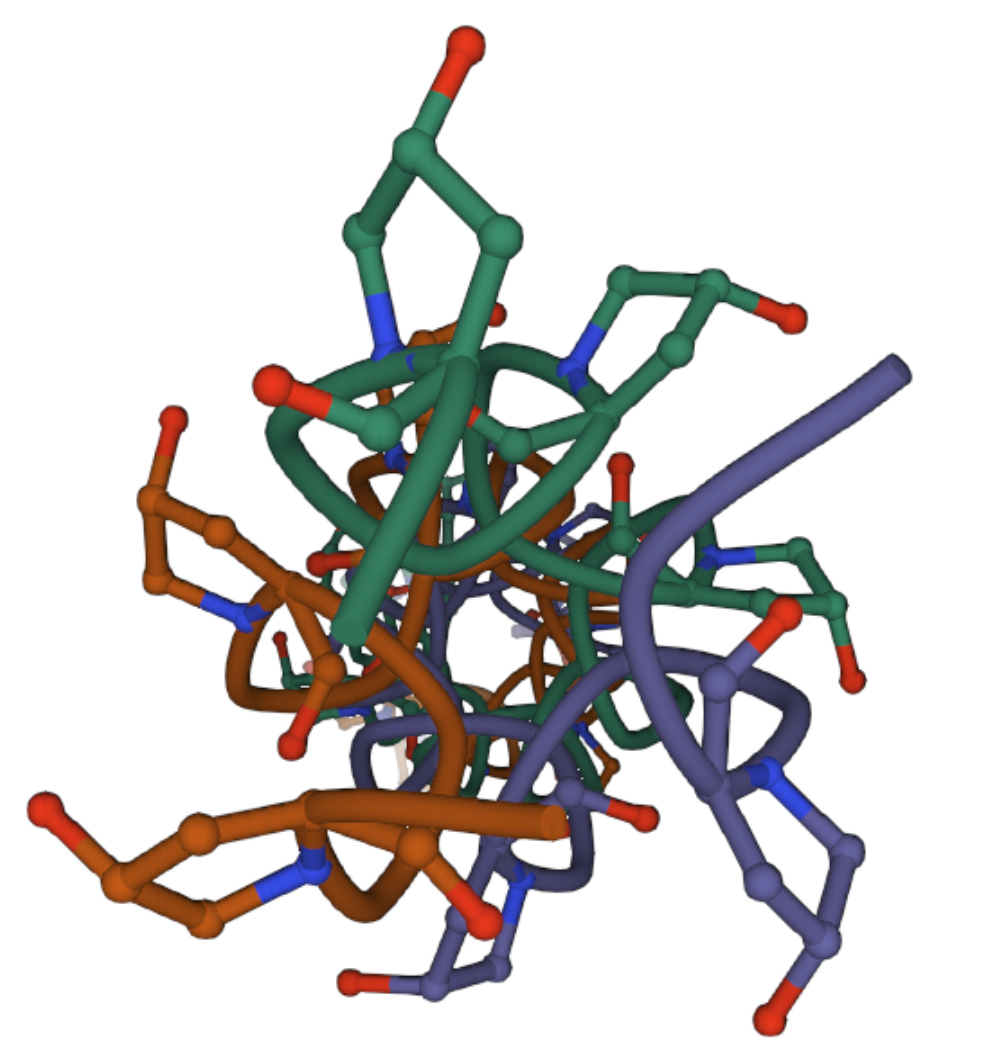
Protein plays an influential role in the development of bone mass as it is approximately 50% of bone volume and 33% of bone mass (Heaney and Layman, 2008). The primary protein produced by osteoblasts (bone cells) are type-1 collagens, making up about 90% of the protein in bones. Collagens not only make up the extracellular matrix of the bone but are also involved in ossification (bone formation). They polymerize into fibrils to form a lattice structure for minerals to deposit onto, thus giving the brittle minerals tensile strength (Zylberberg, 2004). Collagen itself is a fibrous protein, made up of three polypeptide chains that are wound together into a triple helix structure (Figure 1). These triple helices provide structural support by lining up side-by-side to form fibrils (Goodsell, 2000).

Figure 1: A top-down 3D image of type-1 collagen found in Homo sapiens (PDB, 2023). It is composed of three polypeptide chains that form a triple helix. The respective chains are coloured green purple and orange in the image. Each chain is over 1400 amino acids long and is mainly composed of three amino acids. Every third amino acid is glycine, as it allows for flexibility. The remaining two are proline and hydroxyproline, a modified proline (Goodsell, 2000).
When it comes to dietary protein, there are claims that high protein intake is associated with osteoporosis or bone fractures. High protein intake affects calcium homeostasis by leading to higher calcium excretion, which in turn negatively impacts bone growth as it requires calcium phosphate (Heaney and Layman, 2008). However, low protein diets also lead to the release of calcium from bones, as it decreases the intestine’s ability to absorb calcium from food. While it is generally agreed upon that a moderate amount of dietary protein is essential for human bone health, the claim that high protein intake is deleterious to bones is disputed (Heaney and Layman, 2008).
Furthermore, there are claims that animal proteins are worse for bone health than plant proteins, as they may cause metabolic acidosis (acid build-up) which leads to poor bone health. (Bonjour, 2011). The premise of this argument is that animal proteins have more sulfur-containing amino acids than plant proteins, leading to the increased excretion of calcium in urine which eventually leads to the loss of bone mass. However, there is evidence to refute this claim. Firstly, an increase in excreted calcium does not necessarily indicate a deficit. Rather, it indicates that the net input of calcium from the bones into the extracellular space is increased (Bonjour, 2011). This relationship has been further tested by an experiment by Antonio et al., 2018, involving 24 women. Half were asked to increase their dietary protein intake to 2.2 g of protein per kilogram body weight daily (87% higher intake when compared to the control), while the other half kept a regular diet. After a six month period, there was no change in whole-body bone mineral density or lumbar bone mineral density (Antonio et al., 2018). There is no solid scientific evidence that supports that protein intake is detrimental to bone health (Evans, Mekhail and Antonio, 2022). This claim originated from studies that reported increases in hip fractures in people who consumed western diets which are generally higher in protein. However, these studies were limited as they were not able to accurately measure protein intake or account for other lifestyle factors (Evans, Mekhail and Antonio, 2022).
Plant-based diets have also been found to be non-detrimental to bone health as long as calcium and vitamin D intakes are sufficient (Hsu, 2020). A study by Itkonen et al., 2021, compared the effect of plant and animal-based diets on bone health by conducting a clinical trial where three equal groups were put on three distinct intervention diets (Itkonen et al., 2021). The diets were as follows: the animal diet which contained 70% animal and 30% plant-based protein, the 50/50 diet which contained 50% of both animal and plant proteins, and the plant diet, which was the reverse of the animal diet. When analyzing bone turnover rate, they found that it was higher in those that had the plant diet (Figure 2). This is presumably due to the lower intake of calcium and vitamin D, as the subgroup that had no history of using vitamin D supplements additionally had higher parathyroid hormone levels, which is another contributor to bone loss. Overall, the study showed that animal proteins may be substituted with plant proteins as long as vitamin D and calcium intakes are adequate (Itkonen et al., 2021).

Figure 2: Circulating levels of intact parathyroid hormone (iPTH) after a 12 week period, in clinical trial participants on different intervention diets. The circle represents participants on the animal diet, the square represents those on the 50/50 diet and the triangle is for those on the plant diet. Low vitamin D levels lead to increased concentrations of iPTH concentrations in the blood, as shown for those on the plant and 50/50 diet participants. The asterisk (*) represents significant difference (P < 0.05) from week 0 (Itkonen et al., 2021).
In conclusion, neither plant nor animal proteins are detrimental to bone health, and neither is superior to the other in terms of nutrition. Wether a person primarily consumes one or the other is up to their discretion and dependent on circumstance. Given that bones are made of collagen, protein is essential for maintaining bone health no matter the source.
References
Antonio, J., Ellerbroek, A., Evans, C., Silver, T. and Peacock, C.A., 2018. High protein consumption in trained women: bad to the bone? Journal of the International Society of Sports Nutrition, 15(1), p.6. https://doi.org/10.1186/s12970-018-0210-6.
RCSB Protein Data Bank, 2023. 3D PFV: 7CWK. [online] Available at: <https://www.rcsb.org/3d-sequence/7CWK?assemblyId=1> [Accessed 21 January 2023].
Bonjour, J.-P., 2011. Protein Intake and Bone Health. International Journal for Vitamin and Nutrition Research, 81(23), pp.134–142. https://doi.org/10.1024/0300-9831/a000063.
Evans, C., Mekhail, V. and Antonio, J., 2022. Common Misconceptions Regarding Dietary Protein Intake in Active Individuals: A Narrative Review. Journal of Exercise Physiology Online, 25(1), pp.25–39.
Goodsell, D., 2000. PDB101: Molecule of the Month: Collagen. [online] RCSB: PDB-101. Available at: <http://pdb101.rcsb.org/motm/4> [Accessed 21 January 2023].
Heaney, R.P. and Layman, D.K., 2008. Amount and type of protein influences bone health. The American Journal of Clinical Nutrition, 87(5), pp.1567S-1570S. https://doi.org/10.1093/ajcn/87.5.1567S.
Hsu, E., 2020. Plant-based diets and bone health: sorting through the evidence. Current Opinion in Endocrinology, Diabetes and Obesity, 27(4), p.248. https://doi.org/10.1097/MED.0000000000000552.
Itkonen, S.T., Päivärinta, E., Pellinen, T., Viitakangas, H., Risteli, J., Erkkola, M., Lamberg-Allardt, C. and Pajari, A.-M., 2021. Partial Replacement of Animal Proteins with Plant Proteins for 12 Weeks Accelerates Bone Turnover Among Healthy Adults: A Randomized Clinical Trial. The Journal of Nutrition, 151(1), pp.11–19. https://doi.org/10.1093/jn/nxaa264.
Zylberberg, L., 2004. New data on bone matrix and its proteins. Comptes Rendus Palevol, 3(6), pp.591–604. https://doi.org/10.1016/j.crpv.2004.07.012.