With a reported cell mortality of roughly 60 billion every day, it’s a miracle organisms like humans continue to exist, often living to ages above 80 years (Liu et al., 2018). Nonetheless, despite these absurd numbers, babies grow into adults, and adults age until they ultimately pass away. The primary reason for this cycle of life is cell proliferation, where children have a higher cell proliferation than cell mortality, explaining their growth (Yang et al., 2011). Eventually, cell proliferation drops lower than cell mortality, causing the body to deteriorate slowly and age (Yang et al., 2011). However, the details of cell proliferation are very intricate, so where do these cells originate from? The answer is stem cells.
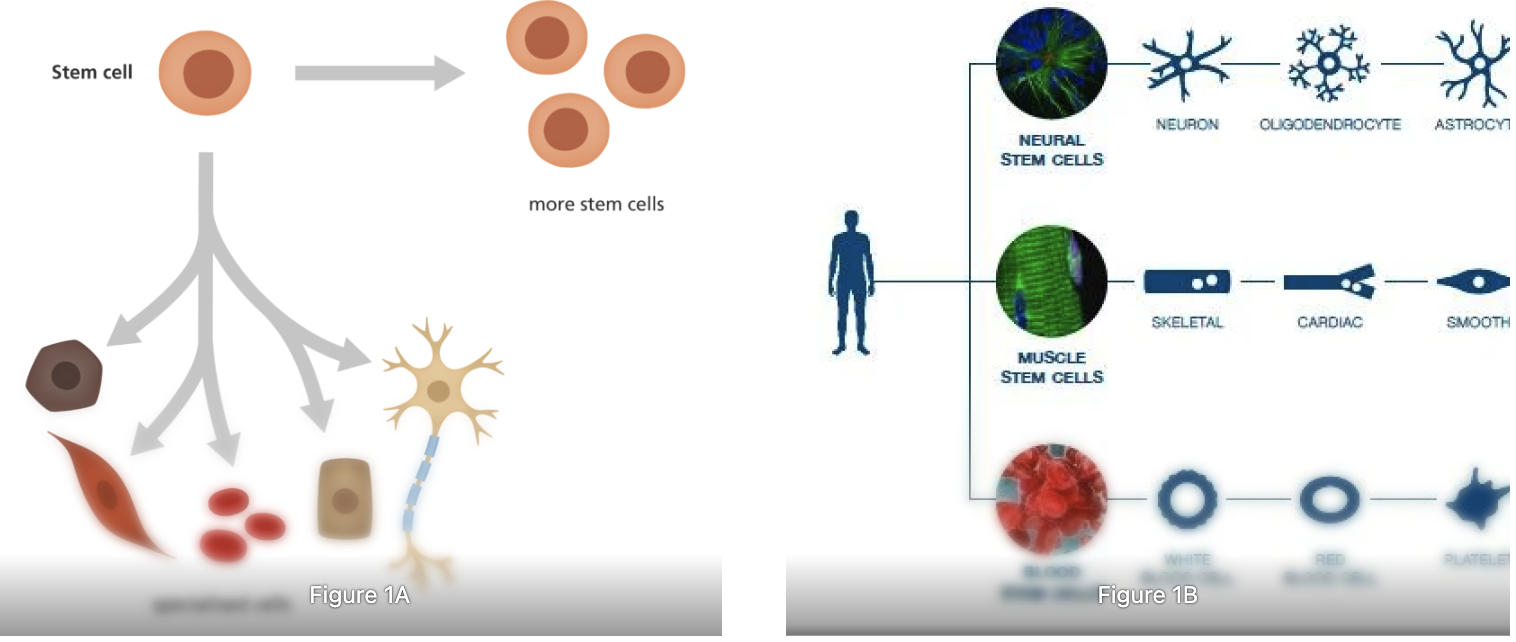
Stem cells are immature cells that, up to this point in time, are undifferentiated. In other words, these cells don’t have a specific role or function (Fu et al., 2021). There are two main types of stem cells: embryonic stem cells and adult/tissue-specific stem cells (2010). Embryonic stem cells have the ability to develop into any tissue of the fetus, making them very versatile (Aguilar-Gallardo & Simón, 2013). Similarly, tissue-specific stem cells can form into any tissue, but only for the specific system they were made for, which is determined by where they’re made and reside (Fu et al., 2021). For example, hematopoietic stem cells can become any type of blood cell but cannot become neurons.


Coming back to the hard reality of life, many diseases and conditions people face in their lives are caused or result from cell mortality, often with the inability to replace these cells (Mayo Clinic, 2024). Stem cell research is of key interest primarily because these undifferentiated cells can be targeted in areas that lack a certain type of cell (Mayo Clinic, 2024). In cases of cardiac arrest, stroke, liver damage and many types of cancer, stem cell regeneration is quite useful in facilitating and replacing dead cells with new ones (Aguilar-Gallardo & Simón, 2013). This unique regeneration ability can be externally induced as a form of treatment, especially when the body is unable to or struggles with replacing the dying cells itself.
Currently, a predominant and very familiar technique within the biomedical community is bone marrow stem cell transplants. This practice is often done for patients who experience extreme trauma accidents, chemotherapy, and other immune-compromising illnesses where new blood cells can save their life (Aguilar-Gallardo & Simón, 2013). Bone marrow is the factory for new blood cells via stem cells, so transplanting bone marrow stem cells can allow patients to recover blood cells they require to survive (Gajewski et al., 2002). Often, bone marrow itself may be transplanted.

Figure 2: The visual depiction above demonstrates how bone marrow, a soft tissue, produces stem cells, which can then become any type of blood cell, including red/white blood cells and platelets. If need be, bone marrow or stem cells can be transferred from a healthy patient to one that needs them (Lymphoma Action).
Moreover, the extent to what stem cells can accomplish is endless. For example, when someone experiences a heart attack, blood flow in one or more coronary arteries supplying blood to the heart is cut off, often resulting in the death of heart tissue (Tran & Tran, 2021). There are countless trials taking place in using stem cells to replace these dead cardiac cells with living ones, which is expected to drastically improve a patient’s lifestyle and cardiac function (Liau et al., 2012). Human trials up to this point have shown promise but are still in an extremely early stage (Liau et al., 2012).
Stem cells are truly fascinating, and with such a unique function and yet such versatile applications, their ceiling is tremendously high. As research in this field continues, breakthroughs, treatments and healthcare advancements will be implemented to improve patient lives in unthinkable ways.
Bibliography
Aguilar-Gallardo, Cristóbal, and Carlos Simón. 2013. “Cells, Stem Cells, and Cancer Stem Cells.” Seminars in Reproductive Medicine 31 (01): 005–013. https://doi.org/10.1055/s-0032-1331792.
“Answers to Your Questions about Stem Cell Research.” 2024. Mayo Clinic. Mayo Foundation for Medical Education and Research. March 23, 2024. https://www.mayoclinic.org/tests-procedures/bone-marrow-transplant/in-depth/stem-cells/art-20048117.
Boldú, Laura Olivares. n.d. What Is a Stem Cell? Your Genome. Accessed September 12, 2024. https://www.yourgenome.org/theme/what-is-a-stem-cell/.
A Bone Marrow Stem Cell Can Produce Different Types of Blood Cells. n.d. Lymphoma Action. Accessed September 12, 2024. https://lymphoma-action.org.uk/sites/default/files/styles/wysiwyg_small/public/media/images/media-1447.png?itok=H3TsJYTY.
Fu, Xin, Qiang He, Yu Tao, Mengdi Wang, Wei Wang, Yalong Wang, Qing Cissy Yu, et al. 2021. “Recent Advances in Tissue Stem Cells.” Science China Life Sciences 64 (12): 1998–2029. https://doi.org/10.1007/s11427-021-2007-8.
Gajewski, James L., Cindy Ippoliti, Yan Ma, and Richard Champlin. 2002. “Discontinuation of Immunosuppression for Prevention of Kidney Graft Rejection after Receiving a Bone Marrow Transplant from the Same HLA Identical Sibling Donor.” American Journal of Hematology 71 (4): 311–13. https://doi.org/10.1002/ajh.10206.
“Irv Weissman Talks about the Difference between Adult and Embryonic Stem Cells.” 2010. CIRM. 2010. https://www.cirm.ca.gov/our-progress/video/irv-weissman-talks-about-difference-between-adult-and-embryonic-stem-cells/#:~:text=The%20tissue%2Dspecific%20stem%20cells,disease%20based%20on%20these%20cells.
Liau, Brian, Donghui Zhang, and Nenad Bursac. 2012. “Functional Cardiac Tissue Engineering.” Regenerative Medicine 7 (2): 187–206. https://doi.org/10.2217/rme.11.122.
Liu, Xingde, Wenxiu Yang, Zhizhong Guan, Wenfeng Yu, Bin Fan, Ningzhi Xu, and D. Joshua Liao. 2018. “There Are Only Four Basic Modes of Cell Death, Although There Are Many Ad-Hoc Variants Adapted to Different Situations.” Cell & Bioscience 8 (1). https://doi.org/10.1186/s13578-018-0206-6.
Tran, Phoebe, and Lam Tran. 2021. “Stroke and Heart Attack Symptom Recognition in Older US Adults by Cognitive Impairment Status.” Neuroepidemiology 55 (3): 245–52. https://doi.org/10.1159/000516343.
Understanding Stem Cell Research. n.d. UCLA Broad Stem Cell Research Center. Accessed September 12, 2024. https://stemcell.ucla.edu/understanding-stem-cell-research.Yang, Jingye, Huzefa Dungrawala, Hui Hua, Arkadi Manukyan, Lesley Abraham, Wesley Lane, Holly Mead, Jill Wright, and Brandt L. Schneider. 2011. “Cell Size and Growth Rate Are Major Determinants of Replicative Lifespan.” Cell Cycle 10 (1): 144–55. https://doi.org/10.4161/cc.10.1.14455.