Studying things we cannot see has always been a challenge in science. Places like space, the deep ocean, and underground have always been lacking in research, simply because we cannot access them. One of these systems that we quite literally live and breathe is plants. Roots are the hidden half plants that biologists often disregard, though their role in the plant spans far beyond water and nutrient uptake.
Beneath the earth, surrounding the roots of plants is a microbiome filled with microorganisms including fungi, bacteria, protists, nematodes, and invertebrates (Venturi and Keel 2016). This area, known as the rhizosphere, is chemically controlled by the secretion of primary and secondary metabolites by plant roots (Bardgett and Van Der Putten 2014). A symbiotic relationship exists between the microbes and the plants. The plants receive various benefits that aid survival, while the microorganisms get nutrients. The microorganisms in the area can enhance plants growth through signalling, assist with water and nutrient retention, and deter pathogenic organisms by outcompeting them for the niche (McNear Jr. 2013). For example, certain bacteria strains have been shown to increase cluster roots. This is an effective method for a plant to increase phosphorous uptake in deficient conditions by increasing root surface area (Ryan et al. 2016). In return for their work, microorganisms receive nutrients from the plant. These carbon and nitrogen-rich expulsions by the plant are costly, but the benefits they receive are much greater (Venturi and Keel 2016).
The concealment of these complex interactions, along with the microscopic scale makes it a very difficult system to study. Most study methods, such as digging up the roots are destructive, making it hard to understand how plants organically respond to changes. (Venturi and Keel 2016). This calls for a solution that allows the rhizosphere to be studied while remaining untouched.
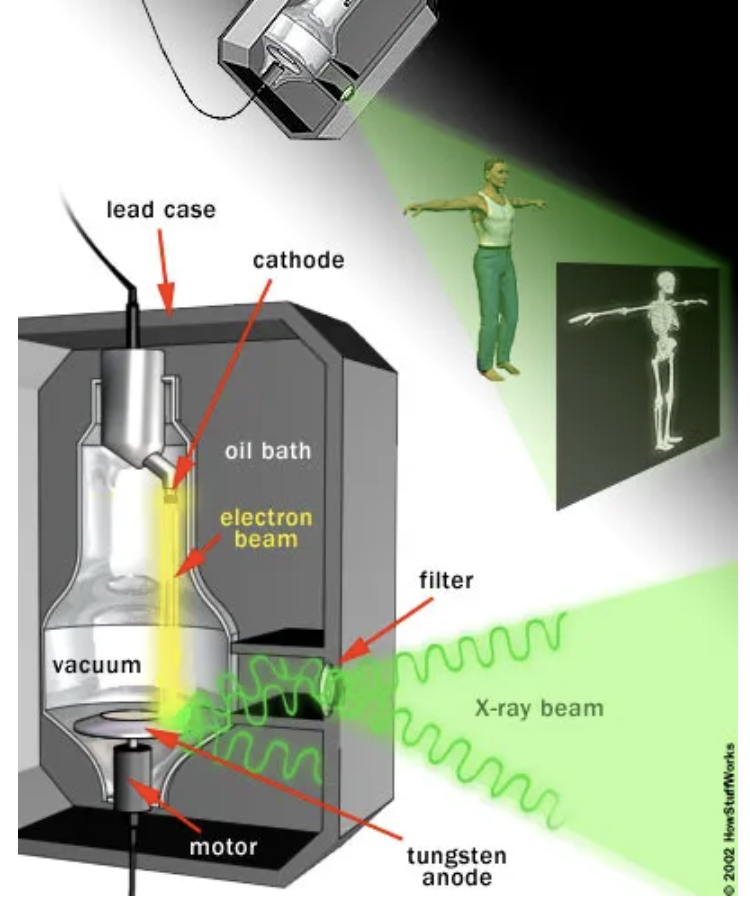
X-ray computed tomography (CT) is currently the most popular way to do this. Unlike magnetic resonance imaging, it works in soils with magnetic properties such as iron (Hou et al. 2022). When the anode in an X-ray CT machine heats up, the electrons gain enough energy to leave the surface (Tafti and Maani 2023). They are then accelerated through a vacuum over a potential difference to the cathode, where collisions occur. This sudden change in speed and direction converts the kinetic energy into photons, generating electromagnetic radiation (Figure 1).

As the electromagnetic waves pass through the subject – in this case, the roots of plants – a cross-sectional 2D image is captured (Hou et al. 2022). Many of these can then be combined to create a 3D rendering of the root architecture (Figure 2). These images can be used to analyze root growth angle, lateral branching length and density, and root hair length, which can all change from environmental factors.

As X-ray methods continue to evolve, biologists will be able to have a better understanding of roots. Uncovering these intricate interactions between roots and microorganisms will lead to a better grasp on plant growth and health, which has many applications in a world trying to improve agricultural practices.
References
Bardgett, Richard D., and Wim H. Van Der Putten. 2014. “Belowground Biodiversity and Ecosystem Functioning.” Nature 515 (7528): 505–11. https://doi.org/10.1038/nature13855.
Harris, Tom. 2024. “How X-Rays Work.” HowStuffWorks. 2024. https://science.howstuffworks.com/x-ray.htm.
Hou, Lei (Helen), Wei Gao, Frederik der Bom, Zhe (Han) Weng, Casey L. Doolette, Anton Maksimenko, Daniel Hausermann, et al. 2022. “Use of X-Ray Tomography for Examining Root Architecture in Soils.” Geoderma 405 (January):115405. https://doi.org/10.1016/j.geoderma.2021.115405.
Oburger, Eva, and Hannes Schmidt. 2016. “New Methods To Unravel Rhizosphere Processes.” Trends in Plant Science, Special Issue: Unravelling the Secrets of the Rhizosphere, 21 (3): 243–55. https://doi.org/10.1016/j.tplants.2015.12.005.
Ryan, Peter R., Emmanuel Delhaize, Michelle Watt, and Alan E. Richardson. 2016. “Plant Roots: Understanding Structure and Function in an Ocean of Complexity.” Annals of Botany 118 (4): 555–59. https://doi.org/10.1093/aob/mcw192.
Tafti, Dawood, and Christopher V. Maani. 2023. “X-Ray Production.” In StatPearls. Treasure Island (FL): StatPearls Publishing. http://www.ncbi.nlm.nih.gov/books/NBK537046/.
McNear Jr., David H. 2013. “The Rhizosphere – Roots, Soil and Everything In Between” Nature Education Knowledge 4(3):1. https://www.nature.com/scitable/knowledge/library/the-rhizosphere-roots-soil-and-67500617/.
Venturi, Vittorio, and Christoph Keel. 2016. “Signaling in the Rhizosphere.” Trends in Plant Science, Special Issue: Unravelling the Secrets of the Rhizosphere, 21 (3): 187–98. https://doi.org/10.1016/j.tplants.2016.01.005.