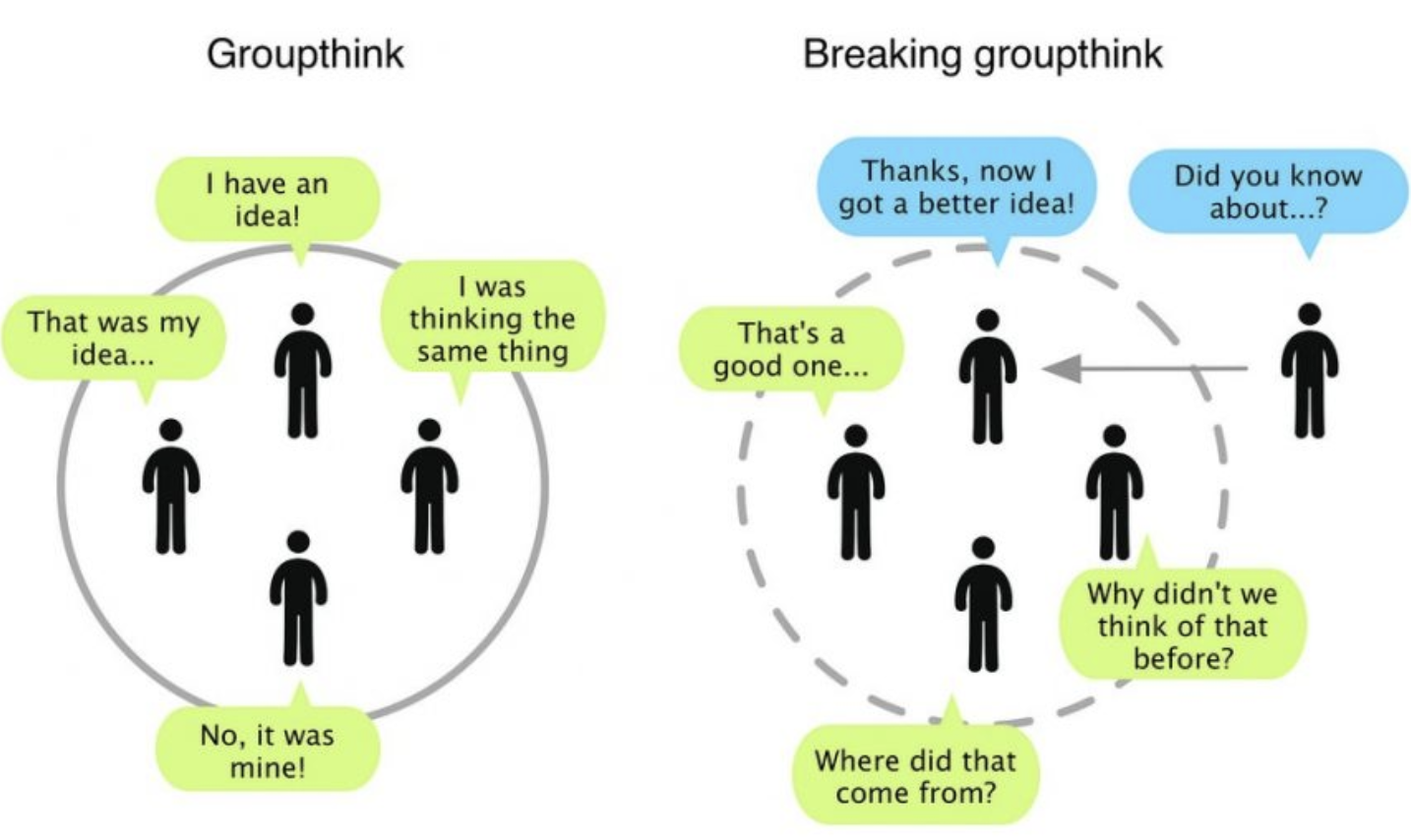
“Sometimes it’s the little things that turn the world inside out,” says science writer David Quammen, in his essay, “Thinking About Earthworms” (1998). According to Quammen, with the rise of technologies like television and radio, the human population is made to think about the same things at the same time. Because of this, he believes small things that lead to big scientific discoveries are overlooked. This begs the question, what is this unanimous thought, and is it as bad for science as Quammen makes it out to be?
Humans have evolved to be social creatures, seen in how they show empathy and can easily know what others are thinking. It is theorized that human ancestors became adept at reading the thoughts of others in order to help them hunt in groups. The way in which humans coordinated and made group decisions led some to think of them as a sort of “superorganism,” many individuals which function as one whole (Whiten, 2013). More recently, some have referred to his phenomenon as groupthink, which causes individual thought to be sacrificed to support the opinion of the group. People can be pressured into this conformity, as they are given feelings of security, morality, and unity when acting as a group (Henningsen et al., 2006).
Human groupthink can be compared to the honey bee. Being social insects, they work together to make group decisions about where to live, collect nectar, and what places to avoid (Borofsky et al., 2020). Bees perform waggle dances in favor of a location. If a bee tries to indicate a dangerous, or faulty location, other bees may give a stop signal by headbutting the dancing bee. This form of negative feedback is comparable to neurons in the brain, leading some to think of bees as one being (Borofsky et al., 2020).
Thinking of humanity as one collective hive mind seems like an idea out of science fiction. However, as we become more connected with technology, it becomes easier for people all over the world to become fixated on one idea. Quammen believes this groupthink can negatively affect scientific discovery and gives the example of Darwin thinking about earthworms. While many think of earthworms as insignificant, they contribute a lot to the quality of our soil, something that would have never been discovered if it weren’t for deviation from common thought (Quammen,1998). This isn’t the only time when popular opinion has slowed scientific understanding. For a long time, scientists did not want to believe that DNA was the molecule responsible for carrying genes. With only 4 base pairs, DNA seemed too simple, and scientists much-preferred proteins as they were much more complex and interesting (Maddox, 2013). Groupthink in particular causes people to suppress their opinion if it differs from the group, shutting down any potentially innovative ideas (Henningsen et al., 2006).

Perhaps collective thinking isn’t all bad. After all, it was group work that led to humanity’s success. As long as everyone in the group has different ideas, thinking about the same subject combines many different perspectives. Everyone may collectively think about the release of a new movie, however, each person will have their own thoughts about that subject. Less popular subjects, like earthworms, may be left out, but by focusing on one subject, it’s possible that problems may resolve themselves faster and that a better decision can be made. Just like honey bees, maybe humans are meant to function as one.
Individual and collective thought both have their merits. Collectively thinking about one thing allows us to connect with each other and exchange perspectives. However, by only thinking about the popular, we limit the breadth of possibility and we may miss out on the little big things in life.
Works Cited
Borofsky, T., Barranca, V.J., Zhou, R., von Trentini, D., Broadrup, R.L. and Mayack, C., 2020. Hive minded: like neurons, honey bees collectively integrate negative feedback to regulate decisions. Animal Behaviour, 168, pp.33–44. https://doi.org/10.1016/j.anbehav.2020.07.023.
Henningsen, D.D., Henningsen, M.L.M., Eden, J. and Cruz, M.G., 2006. Examining the Symptoms of Groupthink and Retrospective Sensemaking. Small Group Research, 37(1), pp.36–64. https://doi.org/10.1177/1046496405281772.
Maddox, B., 2021. Before Watson and Crick. [online] PBS. Available at: <https://www.pbs.org/wgbh/nova/article/before-watson-crick/> [Accessed 25 Oct. 2021].
Quammen, D.,1998. Thinking About Earthworms. 1998. Flight of the Iguana. Scribner. pp.10-15.
Whiten, A., 2013. Culture and the evolution of interconnected minds. In: Understanding Other Minds, 3rd ed. [online] Oxford: Oxford University Press. https://doi.org/10.1093/acprof:oso/9780199692972.003.0024.