The introduction of plant medicines from Indigenous cultures into the West by ethnobotanists drives the development of novel medical and research tools (Heinrich and Gibbons, 2001). This was the case in the 18th and 19th century when explorers and pharmacologists set out to understand curare, an arrow poison used by Amazonian tribes in regions of Central and South America for hunting (Plotkin, 1994). Explorers repeatedly reported observing the near-instant effects of a curare arrow shot at prey: a quick death with no indication of pain or resistance.
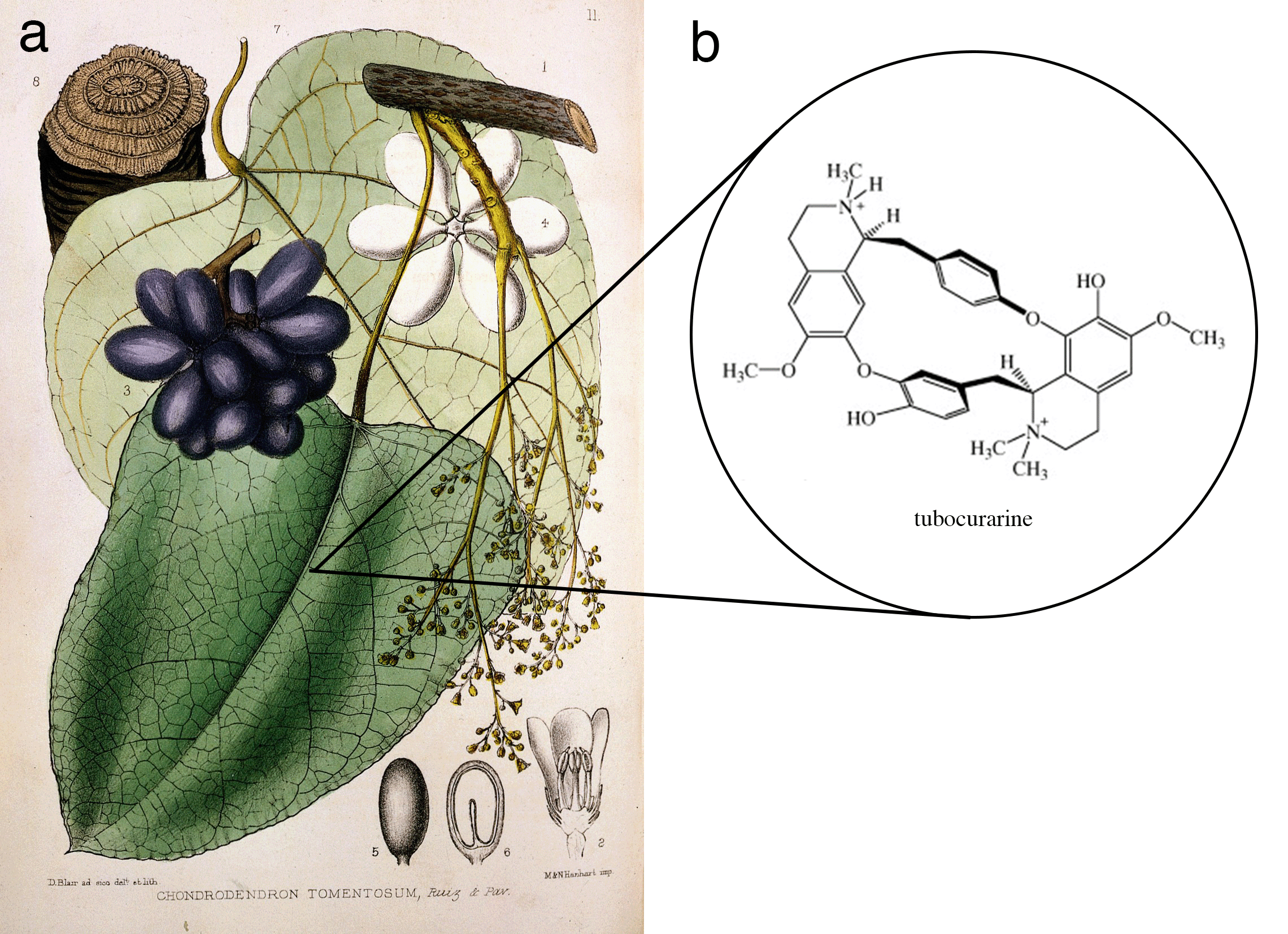
Curare source plants, and their associated alkaloids, vary across Indigenous groups and are generally associated with the two types of storage containers used: tubes and gourds (King, 1968). Tube curare preparations are mainly sourced from the plant Chondrodendron tomentosum (Heinrich and Gibbons, 2001) (Figure 1a). The active alkaloid in tube curare, d-tubocurarine is the best-studied curare alkaloid due to its strength and availability (King, 1968) (Figure 1b).

Figure 1b: D-tubocurarine is the active compound in Chondrodendron tomentosum. It is a bisquaternary alkaloid, containing two nitrogen groups with four substituents, which are commonly attributed to be antagonists of nicotinic acetylcholine receptors (Iturriaga-Vásquez et al., 2007).
In 19th to 20th century Britain, curare was popular in animal physiology research (Plotkin, 1994). Curare can render an animal fully paralysed, and artificial respiration can be maintained using a valve delivering air pulses (Moens, 2013). This allowed for convenient experimentation on live animals, and appeared to be painless, but this practice was not readily accepted by all scientists (Shmuely, 2020).
The mechanism of d-tubocurarine was partially discovered by physiologist Claude Bernard in 1857 through experimentation using frogs (Shmuely, 2020). Bernard isolated a limb from the rest of the body by preventing curare from entering. When stimulated, the affected part of the body showed no response, but the unaffected limb reflexively moved. This showed curare created some change in motor nerve action, but sensory nerves and the spinal cord were still functioning.
Sir Henry Dale and Otto Lowei won the 1936 Nobel Prize in Physiology or Medicine by discovering the first neurotransmitter, acetylcholine, and its role in transmission at the neuromuscular junction (Tansey, 2006). D-tubocurarine is a competitive nicotinic acetylcholine receptor (nAChR) antagonist, blocking the receptor from binding acetylcholine, (ACh) which is responsible for transmission at the neuromuscular junction (Tassonyi et al., 2002) (Figure 2). By preventing signal transmission from motor neurons to muscle fibres, muscle movement is suppressed. Modern knowledge confirms that the use of d-tubocurarine does not suppress sentience.

It was, for a time, thought that curare was an effective and painless anaesthetic, and was even used in conjunction with chloroform or ether in human surgeries (Neff, Mayer and Perales, 1947). Due to the amnesia induced by these hypnotic agents patients did not recall the pain experienced during their procedure (Neff, Mayer and Perales, 1947). Bernard’s discovery fuelled an ongoing debate in Britain about animal welfare, which in 1875 formed a Royal Commission on animal experimentation ethics (Shmuely, 2020). The resulting 1876 Cruelty to Animals bill required licensing and the use of an anaesthetic for painful animal experiments, and curare was deemed to be an inadequate anaesthetic agent (Balls, 1984).
Though curare is seldom used today due to the development of modern anaesthetics, its influence on the development of basic neuroscience and animal research ethics must be noted. Without the study of curare, the discovery of acetylcholine and policies regarding ethical anaesthetic agents may not have developed as quickly.
References
Balls, M., 1984. Scientific Procedures on Living Animals: Proposals for Reform of the 1876 Cruelty to Animals Act. Alternatives to Laboratory Animals, 12(4), pp.225–242. https://doi.org/10.1177/026119298401200404.
Bentley, R. and Trimen, H., 1880. Medicinal plants : being descriptions with original figures of the principal plants employed in medicine and an account of the characters, properties and uses of their parts and products of medicinal value. [online] Available at: <http://jstor.org/stable/community.24738349> [Accessed 1 November 2022].
Heinrich, M. and Gibbons, S., 2001. Ethnopharmacology in drug discovery: an analysis of its role and potential contribution. Journal of Pharmacy and Pharmacology, 53(4), pp.425–432. https://doi.org/10.1211/0022357011775712.
Iturriaga-Vásquez, P., Pérez, E.G., Slater, E.Y., Bermúdez, I. and Cassels, B.K., 2007. Aporphine metho salts as neuronal nicotinic acetylcholine receptor blockers. Bioorganic & Medicinal Chemistry, 15(10), pp.3368–3372. https://doi.org/10.1016/j.bmc.2007.03.023.
King, H., 1968. Curare alkaloids. Part I. Tubocurarine. International Anesthesiology Clinics, 6(2), pp.518–530.
Moens, Y., 2013. Mechanical Ventilation and Respiratory Mechanics During Equine Anesthesia. Veterinary Clinics: Equine Practice, 29(1), pp.51–67. https://doi.org/10.1016/j.cveq.2012.12.002.
Neff, W., Mayer, E.C. and Perales, M.D.L.L., 1947. Nitrous Oxide and Oxygen Anesthesia With Curare Relaxation. California Medicine, 66(2), pp.67–69.
Plotkin, M.J., 1994. Tales of a Shaman’s Apprentice: An Ethnobotanist Searches for New Medicines in the Rain Forest. Penguin.
Shmuely, S., 2020. Curare: The Poisoned Arrow that Entered the Laboratory and Sparked a Moral Debate. Social History of Medicine, 33(3), pp.881–897. https://doi.org/10.1093/shm/hky124.
Sturgill, E.L. and Campbell, N.F., 2015. Neuromuscular Blocking and Reversal Agents. In: P.K. Sikka, S.T. Beaman and J.A. Street, eds. Basic Clinical Anesthesia. [online] New York, NY: Springer. pp.151–158. https://doi.org/10.1007/978-1-4939-1737-2_13.
Tansey, E.M., 2006. Henry Dale and the discovery of acetylcholine. Comptes Rendus Biologies, 329(5–6), pp.419–425. https://doi.org/10.1016/j.crvi.2006.03.012.
Tassonyi, E., Charpantier, E., Muller, D., Dumont, L. and Bertrand, D., 2002. The role of nicotinic acetylcholine receptors in the mechanisms of anesthesia. Brain Research Bulletin, 57(2), pp.133–150. https://doi.org/10.1016/S0361-9230(01)00740-7.