Table salt, or sodium chloride, is a mineral which is extensively used not only as a culinary seasoning, but also as a preservative, in road safety, and for numerous industrial purposes. It can be obtained through mining and from the evaporation of brines and seawater (National Center for Biotechnology Information, 2024). It may also be formed through a neutralization reaction between hydrochloric acid and sodium hydroxide.
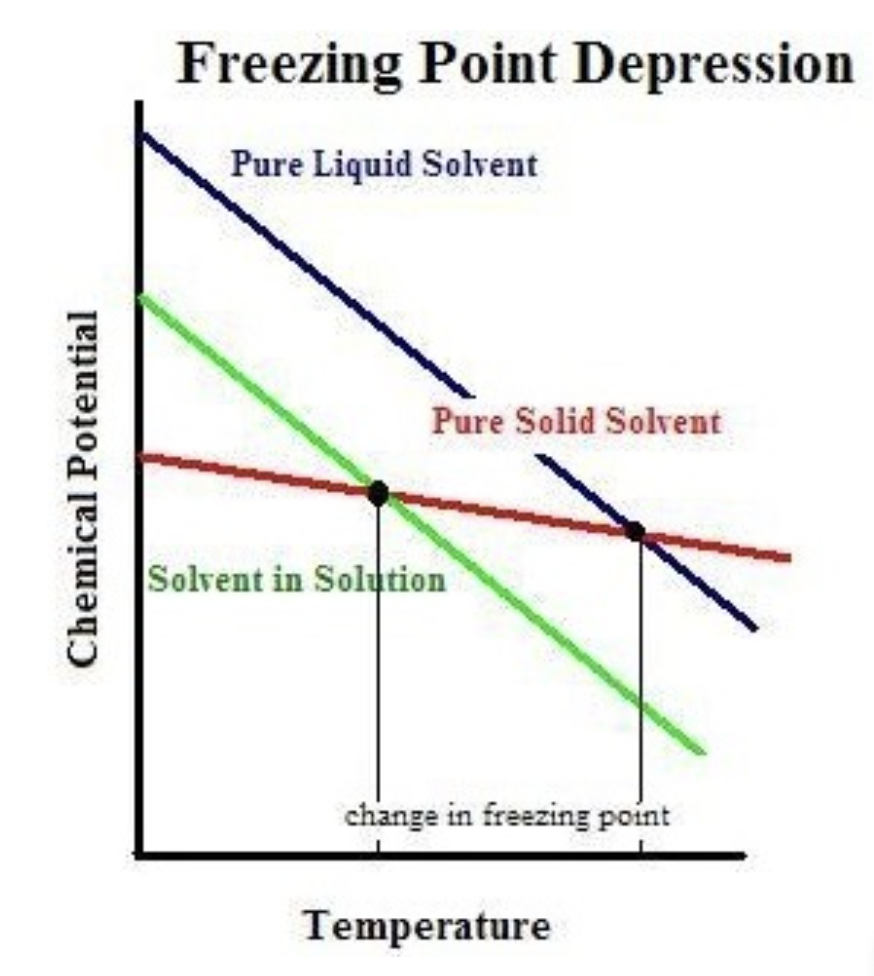
An interesting property of salt is that it plays a part in freezing point depression. This property describes the phenomenon where when a solute is added to a solvent, the freezing point of the solvent decreases (Fink, 2015). This is explained through the theory of phase equilibria in thermodynamics. At equilibrium, the chemical potential must be equal in different states. So, the chemical potential in the solid state is equal to that of the liquid state. It is assumed that the potential of the solid state pertains only to the pure substance. However, when a solute is dissolved in a liquid that is able to reduce the freezing point, the chemical potential of the solvent in the liquid state is lowered (Figure 1).

Figure 1. The graph depicts the freezing point depression of a solvent (LibreTexts Chemistry, 2023). Temperature is shown on the x-axis and chemical potential on the y-axis. The freezing point is reached when the chemical potential of the pure liquid solvent reaches that of the pure solid solvent, shown in blue and red respectively. The green line depicts the solvent with a solute shown in it. The graph shows that the chemical potential of the solvent with the solution reaches the chemical potential of the pure solid solvent at a lower temperature, compared to the pure liquid solvent. There is a change in the freezing point, as the solution freezes at a lower temperature than the pure liquid.
Salt is able to lower the freezing point of many substances. This explains why it is commonly used as a de-icer in winter, as it lowers the temperature at which ice can form (Terry, et al., 2020). Although useful as a de-icer, the usage of salt on roads has caused notable pollution of waterways. In Ontario, sodium chloride accounts for 97% of all salt usage in Canada (Canadian Council of Ministers of the Environment, 2011). The concentration of chloride ions (Cl–) in the Great Lakes Basin has increased due to anthropogenic factors such as road salt (Chapra, Dove, and Rockwell, 2009). Across Canada, Cl– is naturally in near-surface aquifers in concentrations of less than 15–20 mg/L (Howard and Beck, 1993).
Studies conducted by Eyles and Howard (1988) and Howard and Beck (1993) found that Cl– concentrations in many regions of Canada greatly surpass this normal range. Along the Scarborough Bluffs, concentrations of 400 mg/L were measured in springs (Eyles and Howard, 1988). Another study which monitored groundwater wells across Ontario found concentrations ranging up to 700 mg/L in domestic wells, 2,840 mg/L in urban springs, and 13,700 mg/L in shallow glacial sediment porewaters (Howard and Beck, 1993). There are programs that monitor concentrations of Cl–, but they are often inconsistent and do not provide a comprehensive view of groundwater quality.
Increased Cl– concentrations can have disastrous impacts on the environment. Elevated salinity in freshwater ecosystems from groundwater discharge can alter the functions of communities and impact the species living in the area (Mackie, et al., 2022). This can decrease species abundance and richness, and may also modify maturation and reproduction in certain organisms. There may also be an invasion of saltwater species. Affecting one organism disrupts ecosystem integrity.
Salt is a helpful tool when looking to de-ice roads, but it may not be the best. There are some alternatives, such as agro-based products, acetates, formates, glycols, and succinates (Terry, et al., 2020). Acetates, formates, and glycols present similar environmental challenges as salt, and there is limited information on succinates. Agro-based products have shown the most potential for an alternative and they are typically used as an additive to salt, but additional research is required.
It is essential to protect the function and stability of aquatic ecosystems, thus other avenues for road safety can be taken. Salt can have detrimental impacts on the environment which must be considered. As humans, individuals should be working towards securing the health of ecosystems.
References
Canadian Council of Ministers of the Environment, 2011. Canadian Water Quality Guidelines for the Protection of Aquatic Life – Chloride. Available at: <https://mde.maryland.gov/programs/Marylander/Documents/canadian_WQ_Chloride_(en)[1].pdf> [Accessed 18 March 2024].
Chapra, S.C., Dove, A. and Rockwell, D.C., 2009. Great Lakes chloride trends: Long-term mass balance and loading analysis. Journal of Great Lakes Research, 35(2), pp.272–284. https://doi.org/10.1016/j.jglr.2008.11.013.
Eyles, N., and Howard, K.W.F., 1988. A hydrochemical study of urban landslides caused by heavy rain: Scarborough Bluffs, Ontario, Canada. Canadian Geotechnical Journal, 25(3), pp.455–466. https://doi.org/10.1139/t88-051.
Fink, J.K., 2015. Chapter V – Additives for General Uses. In: Water-Based Chemicals and Technology for Drilling, Completion, and Workover Fluids, 1st ed. Gulf Professional Publishing. pp.209–250.
Howard, K.W.F. and Beck, P.J., 1993. Hydrogeochemical implications of groundwater contamination by road de-icing chemicals. Journal of Contaminant Hydrology, 12(3), pp.245–268. https://doi.org/10.1016/0169-7722(93)90010-P.
LibreTexts Chemistry, 2023. Freezing Point Depression. Available at: https://chem.libretexts.org/@go/page/1592 [Accessed March 21, 2024].
Mackie, C., Lackey, R., Levison, J. and Rodrigues, L., 2022. Groundwater as a source and pathway for road salt contamination of surface water in the Lake Ontario Basin: A review. Journal of Great Lakes Research, 48(1), pp.24–36. https://doi.org/10.1016/j.jglr.2021.11.015.
National Center for Biotechnology Information, 2024. PubChem Compound Summary for CID 5234, Sodium Chloride. [online] PubChem. Available at: <https://pubchem.ncbi.nlm.nih.gov/compound/Sodium-Chloride.> [Accessed 19 March 2024].
Terry, L.G., Conaway, K., Rebar, J. and Graettinger, A.J., 2020. Alternative Deicers for Winter Road Maintenance—A Review. Water, Air, & Soil Pollution, 231(8), p.394. https://doi.org/10.1007/s11270-020-04773-x.