Mind Control on Drugs: Cold War Paranoia and Project MKUltra

The Cold War was a period of ideological and geopolitical conflict led by the United States and the Soviet Union between 1947 and 1991 (Haslam 2001). It created a competitive atmosphere between the two superpowers and was a breeding ground for anti-communist sentiment and Cold War paranoia (Lai 2021). The Americans felt that the Soviet-allied government invented new ways in which to brainwash their citizens. In 1953, the appointed director of the Central Intelligence Agency (CIA), Allen Dulles, said that the ‘Communist enemy had invented new ‘brain perversion techniques’” (Dunne 2013, 14). In the United States, federal support for science increased dramatically, with studies often politically or militaristically motivated, including that of Project MKUltra, which was designed to find substances that could be used to discredit spies or make it difficult for them to maintain a fabrication under questioning  (Oreskes 2014; CIA 2018; Alvarez-Cruz 2025).

Many of the studies within MKUltra involved the use of the psychotropic drug LSD. It is a chemical alkaloid derivative from the fungus Claviceps purpurea (Alvarez-Cruz 2025). Psychological symptoms include pseudohallucinations, mood swings, reduced attention span, and changes in perception, such as increased empathy, as seen in Figure 1 (Passie et al. 2008). LSD alters the expression of serotonin (5-HT) neurons by acting as a 5-HT2A agonist. This property is common amongst other psychedelics such as mescaline, psilocybin, and DMT, and is thought to be the reason for the drug’s behavioural changes and hallucinatory effects (Passie et al. 2008; Alvarez-Cruz 2025).
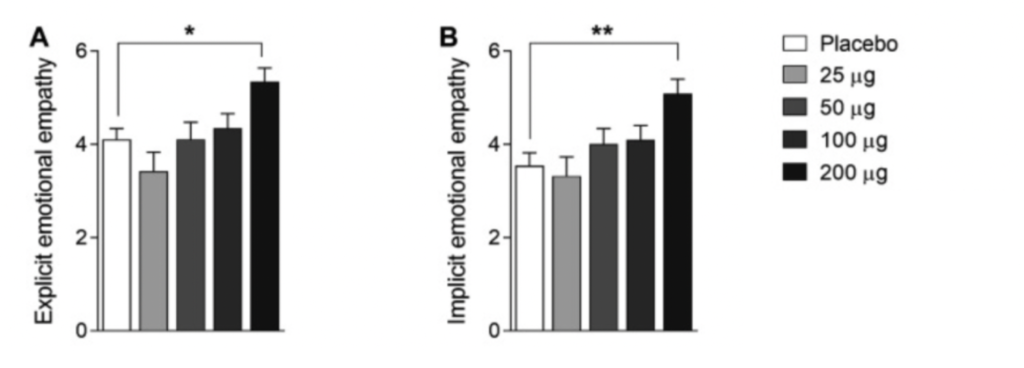
Figure 1: Effects of LSD on emotional empathy. LSD increased explicit (A) and implicit (B) emotional empathy compared with placebo, with the 200 µg LSD dose producing significant effects (Holze et al. 2021)(Modified from Article).

MKUltra was divided into various “subprojects”, with one project, known as “Subproject 68”, crossing the border. This project was conducted by Dr. Donald Ewen Cameron at the Allan Memorial Institute in Montréal. (CIA 2018; Torbay 2023). Dr. Donald Ewen Cameron was of interest to the CIA due to his previous experiments looking into his proposed theory of psychic driving, where he proposed that one would be able to unlock another’s subconscious through sensory deprivation and drugs (Torbay 2023). The goal of Subproject 68 was to find a method to break down personality structures and then implement new behavioural patterns through psychic driving. Subproject 68 was done on subjects who had mental health conditions, as well as people with passive-aggressive behaviour, or who fell into the broad category of having “inadequate” personality traits. Patients were subjected to prolonged drug-induced sleep, intensive electroconvulsive therapy, and sensory deprivation to disrupt their cognitive stability. Once patients were disoriented, they would undergo “psychic driving,” where repetitive verbal messages were played for hours to days to implant new behavioural patterns (Torbay 2023).

As a result, many patients suffered from traumatic responses. A class-action lawsuit was filed in the Superior Court, District of Montréal: J. Tanny vs. Royal Victoria Hospital et al. (Torbay 2023). This case was filed by the daughter of a victim of the MKUltra experiments, J. Tanny, with her father initially undergoing treatment for trigeminal neuralgia. After his time in the hospital, which included 50 days of insulin-induced sleep therapy and a cocktail of antipsychotics and barbiturates, Tanny experienced near total memory loss and disorientation (Torbay 2023). 

MKUltra is a grave reminder of what can happen despite regulations. Before MKUltra began, Dr. Cameron was present at the Nuremberg trials, which had the goal of stopping the very experiments he performed (Torbay 2023). MKUltra serves as a stark reminder of how political power and authority shape scientific trajectories, and of the responsibility that scientists have to ensure the safety of those involved.

References

Alvarez-Cruz, Antonio. “The US Intelligence Agencies’ Search for the ‘Truth Serum’, 1941-1973.” Revista de Historia de La Psicología 46, no. 3 (2025): 12–22. https://doi.org/10.5093/rhp2025a19.

Dunne, Matthew W. “The Origins of Brainwashing.” In A Cold War State of Mind: Brainwashing and Postwar American Society, 13–51. University of Massachusetts Press, 2013. http://www.jstor.org/stable/j.ctt5vkbcz.5.

Haslam, Jonathan. “The Cold War as History.” Annual Review of Political Science 6, no. 1 (2003): 77–98. https://doi.org/10.1146/annurev.polisci.6.121901.085556.

Holze, Friederike, Isidora Avedisian, Nimmy Varghese, Anne Eckert, and Matthias E. Liechti. “Role of the 5-HT2A Receptor in Acute Effects of LSD on Empathy and Circulating Oxytocin.” Frontiers in Pharmacology 12 (July 2021): 711255. https://doi.org/10.3389/fphar.2021.711255.

Lai, Albert K. The Cold War, the Space Race, and the Law of Outer Space: Space for Peace. Routledge Studies in Modern History. Routledge, 2021. https://doi.org/10.4324/9781003162308.

Oreskes, Naomi, and John Krige. Science and Technology in the Global Cold War. Transformations. The MIT press, 2014.

Passie, Torsten, John H. Halpern, Dirk O. Stichtenoth, Hinderk M. Emrich, and Annelie Hintzen. “The Pharmacology of Lysergic Acid Diethylamide: A Review.” CNS Neuroscience & Therapeutics 14, no. 4 (2008): 295–314. https://doi.org/10.1111/j.1755-5949.2008.00059.x.

Torbay, Jordan. “The Work of Donald Ewen Cameron: From Psychic Driving to MK Ultra.” History of Psychiatry 34, no. 3 (2023): 320–30. https://doi.org/10.1177/0957154X231163763.

“(U) Project MKULTRA.” Central Intelligence Agency, December 12, 2018. https://www.cia.gov/readingroom/docs/project%20mk-ultra%5B15545700%5D.pdf.

Comments

12 Responses to “Mind Control on Drugs: Cold War Paranoia and Project MKUltra”

  1. Griffin Suk Avatar
    Griffin Suk

    Hello iSci!
    In conjunction with the topics within History of the Earth and Drug Discovery, I wanted to deepen my understanding of how political events, such as the Cold War, change the way science is conducted and what studies are performed. I found a study called MK Ultra, in which American and Canadian scientists performed unethical experiments to test the effects of LSD as a “truth serum”. My blog post will focus on LSD’s function and also the clinical trial implications, similar to what we have been discussing in Drug Discovery. Hopefully, you find this read fascinating, and please comment on any suggestions you may have for the final draft!
    Take care,
    Griffin Suk

  2. Maria Konstantinovski Avatar
    Maria Konstantinovski

    Hi Griffin!!

    Your blog post was super intriguing, as the majority of our blogs don’t touch on interesting political history, so it caught my eye! Here are a few points to help with your editing:

    – P1S2 – I believe you meant to say “anti-communist,” but you just misspelled it!!
    – P1S4 – This is a little nitty-gritty, but I think some of the grammar can be improved to the following: “In 1953, the appointed director of the Central Intelligence Agency (CIA), Allen Dulles, said that the ‘Communist enemy had invented new ‘brain perversion techniques’”. It isn’t much different, so I don’t think it is a top priority, but just a tip!
    – P3S2 – There is a missing space at the beginning of the phrase!!
    -P3S4 – Your writing may flow nicer if you were to replace “one’s” with “another’s”
    – I really like your conclusion as it ties everything together very nicely!!

    Overall, great work! I enjoyed reading about this topic, and it’s definitely not something one thinks about every day, making it that much more interesting!

    Happy editing,

    Masha K.

    1. Griffin Suk Avatar
      Griffin Suk

      Hello Masha,

      Thank you very much for your comment! I have implemented all changes.

      Take care,
      Griffin Suk

  3. Rhyana Martin Avatar
    Rhyana Martin

    Hi Griffin,

    Really great blog post! It is incredibly well-written and I have yet to read a blog post of a similar topic on synopsis.

    Here are a few very small things to consider during your editing stage:

    1. Figure 1: you clearly explained most of the components presented in the figure. The only thing you did not touch on is the presence of “ketanserin” at 200 μg of LSD. Consider adding a sentence to your figure caption explaining what “ketanserin” is and why it was used.

    2. P3S5: you mention “inadequate” personality traits. Consider elaborating on what that meant during the specific time period.

    3. P4S2: you write “Montreal” without an accented e, but you write it with an accented e earlier in the post. Make sure this is consistent.

    Overall, really great work!

    Happy editing,

    Rhyana 🙂

    1. Griffin Suk Avatar
      Griffin Suk

      Hello Rhyana,

      Thank you for your comment.
      1. I removed the usage of “ketanserin”, as it wasn’t used in the two graphs which I showed, and was a part of a different trial.
      2. The “inadequate” personality traits were in the original article, without a proper reference. I will explain how this is broadly applicable; anyone could be subjected to these trials.
      3. I updated Montréal to include the accent!

      Take care,
      Griffin

  4. Siya Sood Avatar
    Siya Sood

    Hi Griffin,

    Great blog post! I learned a lot and definitely found this a creative and educational blog post. With that in mind, I had a few suggestions:

    – I really like your connection to DD, and this was super evident. It may be beneficial to connect a second scientific discipline/RP in order to make the ‘scientific interdisciplinary’ nature of your blog post stronger. I think neuroscience could be an easy one to tie in, if you have the space to add a couple of points in relation to this.

    – Paragraph 3 is very informational, but is definitely on the lengthier side, which can make it difficult for the reader to get through. I would recommend splitting this however you see fit. A suggestion is splitting it into a new paragraph at: “The goal of Subproject 68…”

    – For your Figure 1 caption, I was a bit confused about what ketanserin is in the dose that includes it alongside 200ug of LSD. I would recommend explaining this so your figure is clearer.

    Overall, great job! I look forward to reading the final copy.

    Happy editing,
    Siya

  5. Maya Kumar Kumar Avatar
    Maya Kumar Kumar

    Hi Griffin, great job on your blog post. Here are a few pieces of feedback:

    – P1S4:I believe you misspelled project
    – P3 add a space between you sentence 1 and sentence 2
    – P3S5: Consider changing “Subproject 68 was done on subjects” to “Subproject 68 was conducted on subjects”

    Overall great job! Happy editing!
    Maya Kumar

  6. Arham Saeed Avatar
    Arham Saeed

    Hi Griffen,

    I enjoyed your blog post on the ethical implications of MKUltra and how Cold War paranoia shaped scientific research. I have a couple of suggestions below:

    1. Fix the spelling of “anti-communist” in your 1st paragraph.
    2. Your use of “behavioural” and “behavioral” is inconsistent.
    3. The use of a comma in the following sentence abrupts flow: “It created a competitive atmosphere between the two superpowers, and was a breeding ground.”

    Overall, great work! Good luck editing!

  7. Jaden Chiang Avatar
    Jaden Chiang

    Hi Griffin,

    Great blog post! The topic blends drug discovery and the history of science seamlessly and makes for a very interesting post. Below are a few suggestions to take into consideration:

    – Consider creating a small introductory paragraph to share the topic of your blog post before giving a small background on the Cold War. A few sentences to catch the reader’s attention will give new meaning and understanding to the background information you provide—which is written very nicely nonetheless.

    – In your figure 1 caption try to include a p-value when stating that the effects of LSD are significant!

    – P3S2: you can remove the commas after “Cameron” and “Institute”

    – P3S3: remove the first “proposed” of the sentence

    – P3S5: consider changing “was done on” to “involved” or “enlisted” to make the sentence flow better gramatically

    – P4S3: consider revising this sentence to “The case was filed by the daughter of J. Tanny, a victim of the MKUltra experiments who initially underwent treatment for trigeminal neuralgia.” for readability

    Overall your post was very well-written and engaging! You did a good job of blending both the science and societal aspects of this topic.

    Jaden

  8. Fiona Duyu Avatar
    Fiona Duyu

    Hi Griffin, this was an interesting topic to look into the science of! Here are some comments for your consideration:
    P1S4: I think you’re missing an initial “ mark prior to the quote.
    P1S5: You could split this sentence as it’s quite long. The section ‘including that of Project MKUltra’ could be changed to emphasize it as the topic of the blog by saying: “Including the notorious Project MKUltra designed to find…”
    P2S1: Since you included the expanded version of ‘CIA’, you could include the same for ‘LSD’: Lysergic acid diethylamide.
    P2S1: You should also cite something for this as it’s the intro sentence.
    P3S1: You could emphasize the relevance of subproject 68 by reorganizing the sentence: “…with one of the most well known being Subproject 68 that crossed the Canada-US border.”
    P3S5: Just a note on citations, since the gap is quite large from another/the same citation (at the end), you could bring it up to here where you transition slightly to the next subject.
    P4: I also recommend diversifying your resources/citations as this is the bulk of the writing and overall topic.
    Gen: I appreciate the narrative aspect of this post that sets up its context, but to make it more integrated you could go into the science of one of the therapy forms or go more specific into the neurological and biochemical impacts.
    Overall, this was an engaging blog post. Looking forward to the final post!
    Fiona
    Hi Griffin, this was an interesting topic to look into the science of! Here are some comments for your consideration:

    P1S4: I think you’re missing an initial “ mark prior to the quote.
    P1S5: You could split this sentence as it’s quite long. The section ‘including that of Project MKUltra’ could be changed to emphasize it as the topic of the blog by saying: “Including the notorious Project MKUltra designed to find…”
    P2S1: Since you included the expanded version of ‘CIA’, you could include the same for ‘LSD’: Lysergic acid diethylamide.
    P2S1: You should also cite something for this as it’s the intro sentence.
    P3S1: You could emphasize the relevance of subproject 68 by reorganizing the sentence: “…with one of the most well known being Subproject 68 that crossed the Canada-US border.”
    P3S5: Just a note on citations, since the gap is quite large from another/the same citation (at the end), you could bring it up to here where you transition slightly to the next subject.
    P4: I also recommend diversifying your resources/citations as this is the bulk of the writing and overall topic.
    Gen: I appreciate the narrative aspect of this post that sets up its context, but to make it more integrated you could go into the science of one of the therapy forms or go more specific into the neurological and biochemical impacts.

    Overall, this was an engaging blog post. Looking forward to the final post!
    Fiona

    1. Fiona Duyu Avatar
      Fiona Duyu

      Sorry, pasted it in twice and I can’t edit it 🙁

  9. Cassie Ephrem Avatar
    Cassie Ephrem

    Hey Griffin!

    Super cool blog post combining history, narcotics, and psychology – so interesting! Here are some tips for improving your blog post to the final draft:

    1. Perhaps shrink your image and have the figure caption in a smaller font than the text.

    2. Make sure to address your figures in text before the figure. Example: LSD and it’s effect on empathy (figure 1),…….”

    Happy editing,
    Cassie

Leave a Reply