Could Your Cousin Have Early Human DNA? Click Here to Find Out

In today’s society, when we are curious about our family lineage, we can upload our DNA to genetic testing platforms to provide insight into our ancestral origins. These platforms can estimate where an individual’s ancestors may have lived and can identify genetic connections to populations around the world. However, an important question remains: how far back can these methods realistically trace human ancestry, and what limitations prevent us from fully connecting modern populations to early humans?

A common method of learning about ancestral ties is by analyzing variants in an individual’s genetic code and where they occur most commonly in the world. This is done by comparing a large subset of an individual’s DNA code variants (most commonly single-nucleotide variants (SNVs)) frequencies to then be matched to a geographic region in the world (Jorde and Bamshad 2020). The identification of the geographic location with the highest frequency of a certain variant defines the area to be the most likely location of an ancestor with said variant. To assess these variants, methods involving assays using DNA microarray and DNA sequencing is used to analyze these variants. When the SNV is found, it is then matched to the location with the highest frequency of this variant. As seen in Figure 1, the overall percentage of said variants in the sample DNA can then determine the percentage of an individual’s ancestry from different regions across the world (Jorde and Bamshad 2020).
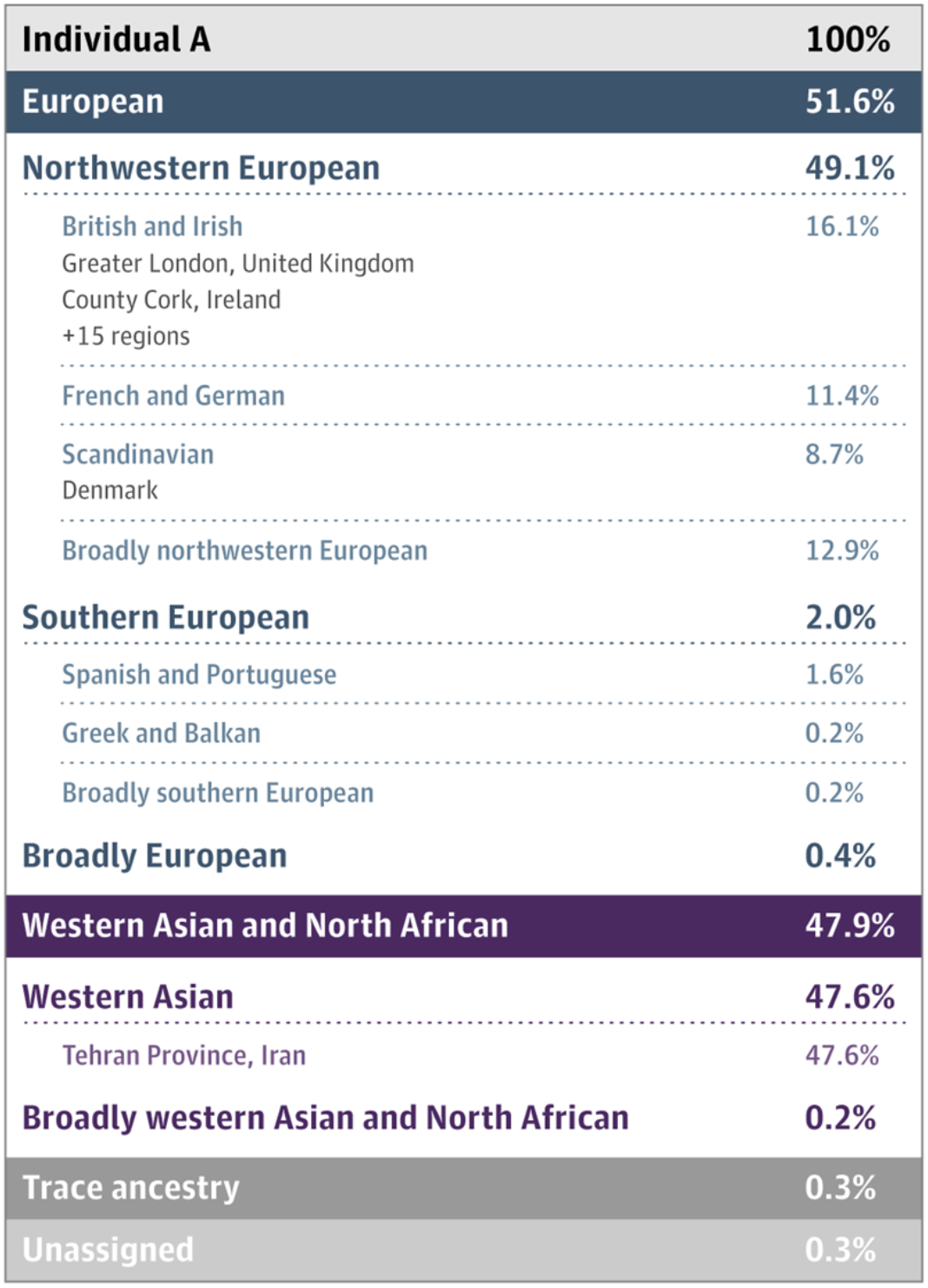
Figure 1. Hypothetical ancestral results of an individual who sampled their DNA to be studied. The different percentages of geographic origin can be seen, and through the results, the highest percentage is found in Northwestern and southern Europe, whereas the rest of the identifiable region is Western Asia and North Africa (Jorde and Bamshad 2020).

While relatively accurate to finish local family portraits, ancestral tracking through DNA has several limitations when looking at ancestral heritage to early humans. Certain problematic areas consist of time duration, record accuracy, as well as regional and socioeconomic bias. When attempting to connect an individual back to early human populations, it can be highly inaccurate as genealogical records decay with each generation. This makes DNA insufficient for studying deep ancestral roots (Bird et al 2025). In addition to their decaying accuracy through time, they are not neutral sources as they are reflections of individual understandings, which are vulnerable to bias. The information is also input by individuals, meaning there is large room for error due to misspellings, incorrect data, and incomplete documentation (Hatton 2021). Along with these flaws that impact results, the differences of socioeconomic status can also be a factor in the recognition of ancestry in certain regions of the world, leaving many communities unrepresented (Nelson 2008).

Overall, the reconstruction of ancestral linkage is used across the world to provide answers to those with questions about lineage and genetic diseases. These methods allow for the reconnections between lost relatives and provide the opportunity to learn more about family history and culture. However, when attempting to connect today’s population with early humans, we are greeted with several challenges, time being the main factor. Since records decay with time, an accurate depiction of a family tree throughout the entire human timeline is highly unlikely. These flaws, however, have the potential to lead to newer methods in the future, so maybe we will all have a framed portrait of an extensive family tree hanging on our walls one day.

References

Bird, Nancy et al. “Power and Limitations of Inferring Genetic Ancestry.” Annals of human genetics vol. 89,5 (2025): 264-273. doi:10.1111/ahg.70007

Hatton, Stephen B. “Genealogy’S Assumptions about Written Records and Originality.” Genealogy, vol. 5, no. 1, 2021, https://doi.org/10.3390/genealogy5010021.

Jorde, Lynn B, and Michael J Bamshad. “Genetic Ancestry Testing: What Is It and Why Is It Important?” JAMA vol. 323,11 (2020): 1089-1090. doi:10.1001/jama.2020.0517

Nelson, Alondra. “Bio science: genetic genealogy testing and the pursuit of African ancestry.” Social studies of science vol. 38,5 (2008): 759-83. doi:10.1177/0306312708091929

Comments

12 Responses to “Could Your Cousin Have Early Human DNA? Click Here to Find Out”

  1. Nour Al-Sakka Avatar
    Nour Al-Sakka

    Hi Masha,
    Great job on your blog post! This was such an interesting read.
    Some suggestions to consider:

    – Make sure to leave a comment explaining why you chose this topic
    – Don’t forget to reference your figure in-text
    – I believe this in-text reference (Jorde, L., Bamshad, M., 2020) should instead be (Jorde and Bamshad 2020)

    Overall, amazing job and can’t wait to see the final post
    -Nour

    1. Maria Konstantinovski Avatar
      Maria Konstantinovski

      Hi Nour!

      Thank you for reading and for giving some feedback; I’ve applied ur comments to my post!!

      Masha

  2. Maria Konstantinovski Avatar
    Maria Konstantinovski

    Hi iSci!!

    With HotE going on this semester (and freshly ending), I was really intrigued by how far back one could trace their lineage. We didn’t talk too much about it throughout our project so I thought it would be cool to mention. Please mention any edits or suggestions you may have so I can polish this post!!

    Happy reading

    Maria K.

  3. Emma Esau Avatar
    Emma Esau

    Hi Maria,

    This was an awesome blog! I think you connected very well to HotE and lifesci topics.

    Here’s my feedback:
    -Consider clearly and briefly defining what DNA variants and single-nucleotide variants specifically are. I’m not sure this is common knowledge and this could help to make sure readers are on the same page with their unerstanding.
    -Your figure is a little bit blurry. Do you think it would be possible to increase the resolution of it?
    -Consider adding a sentence or two about why it would be useful to be able to connect today’s population back to early humans. What could this help us learn?

    Overall, really great job!

    Happy editing,
    Emma

    1. Maria Konstantinovski Avatar
      Maria Konstantinovski

      Hi Emma!!

      Thank you so much for your feedback ive applied your comments!!

      Masha k

  4. Brianna Ankoma Avatar
    Brianna Ankoma

    Hey Masha,
    Interesting blog post! I loved reading about how we can reconstruct our lineage and how ancestral tracking is done. Here are some things I would suggest to help improve your blog post
    In P3S2 I would take out the slash and maybe replace it with “record accuracy, as well as regional and socioeconomic bias”
    In P3S6 I would consider taking out the “a” in between “is” and “large”
    Small note on your citations, seems as if the intext citation in P1 is written wrong. I think it should be (Jorder and Bamshad 2020)
    Besides that this blog post was extremely well written!
    Happy editing,
    Brianna

    1. Maria Konstantinovski Avatar
      Maria Konstantinovski

      Hi Brianna!!

      Thank you for your feedback I’ve applied it to my post!

      Masha K.

  5. Heer Upadhyay Avatar
    Heer Upadhyay

    Hi Maria,
    Awesome blog post, the topic of DNA tests is so interesting and I loved learning more about it!
    Some quick suggestions:
    – This is just a small thing, but your title mentions knowing if you are part neanderthal, and I think you did mention early humans in your post but did not expand as much on neanderthals, saying that it was insufficient to truly connect us to those populations. I think if you added some more explanation to that it would help complete the idea and tie it in more with your title.
    -In P1S1, you end off with “what we may be a part of”, which is a bit unclear and a slightly awkward end to the sentence. I think just ending it with “our ancestral origins” may be sufficient as you do specify in the next sentence what exactly you are referring to.

    Overall, amazing blog post and happy editing!
    Heer

    1. Maria Konstantinovski Avatar
      Maria Konstantinovski

      Hi Heer!!

      Thank you for your feedback, I’ve applied it to my post!!

      Masha K.

  6. Bohmie Song Avatar
    Bohmie Song

    Hi Masha,
    I loved your blog post! It was a
    A few suggestions for your edits:
    – In P2S4 I suggest rewriting the sentence to improve readability. Maybe something to the effect of: Assays using DNA microarray and DNA sequencing is used to analyze these variants’
    – I also suggest, (if possible), maybe swap out your figure for a less blurry copy.
    – P3S1 I would streamline the sentence to something along the lines of ‘While relatively accurate to finish local family portraits, ancestral tracking through DNA has several limitations when looking at ancestral heritage to early humans.’ and I would follow up that sentence with ‘some problematic areas are:…’
    – P3S3 I would also swap them for DNA

    Overall, lovely job! It was a really fun blog post to read.

    Bohmie

    1. Bohmie Song Avatar
      Bohmie Song

      SORRY my comment copied wrong, I meant to say that it was a really fun read!

    2. Maria Konstantinovski Avatar
      Maria Konstantinovski

      Hi Bohmie!!

      Thank you so much for your feedback, I’ve applied them to my post!!

      Masha K.

Leave a Reply