During the winter months, you might see northern fur seals (Callorhinus Ursinus) a few hundred kilometers off the coast of British Columbia (Baird & Hanson 1997). These semi-aquatic mammals spend the majority of the year in the water and swim 1000s of kilometers from the Bering Sea towards the southern US each year. Along this migration journey, the seals exhibit a sleep pattern that may resemble human sleep in a new environment (Lyamin et al. 2017).
The seals rest near the surface of the water through unihemispheric slow-wave sleep (USWS) (Kendall-Barr et al. 2019). One hemisphere of their brain displays a higher voltage of slow-wave oscillations, a type of non-rapid eye movement sleep. The highly active brain hemisphere controls the flipper on the opposite side of the body (Figure 1). This flipper makes small paddling motions while the other three flippers remain stationary in the air. Not only does this sleeping position minimize the heat loss as air has a lower thermal conductivity than water, but the increased muscle activity generates heat through thermogenesis (Lyamin et al. 2008). At the same time, the paddling movement provides stability, allowing the seal to breathe through its nostrils without water entering the respiratory system.
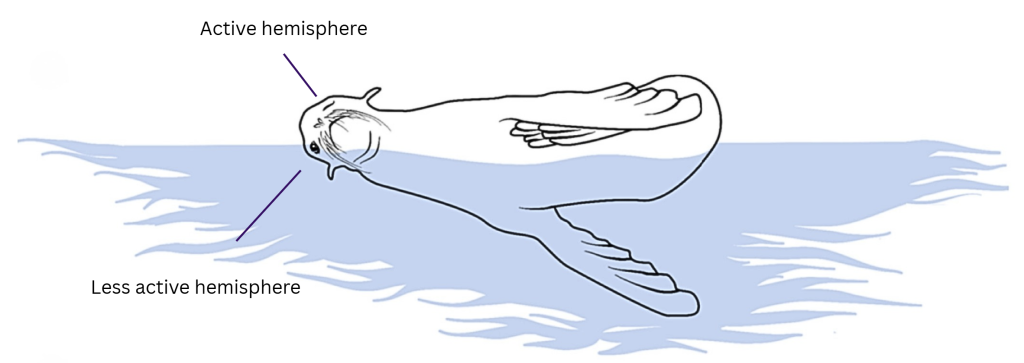
Beyond these physiological concerns, unihemispheric slow-wave sleep (USWS) addresses the threat of predators. Steller Sea Lions (Eumetopias jubatus) and Killer Whales (Orcinus orca) swim near the surface of the water (Kendall-Barr et al. 2019). They approach silently and no auditory cues can provide warning. Instead, the seals rely on their more active brain hemisphere to process visual information from the open eye (Figure 1). This eye scans the surroundings for threats about 8 times per minute and is open for about 1.9 seconds each time (Kendall-Barr et al. 2019). Such vigilance is not unique to northern fur seals; many other mammals including humans monitor surroundings for threats while asleep.
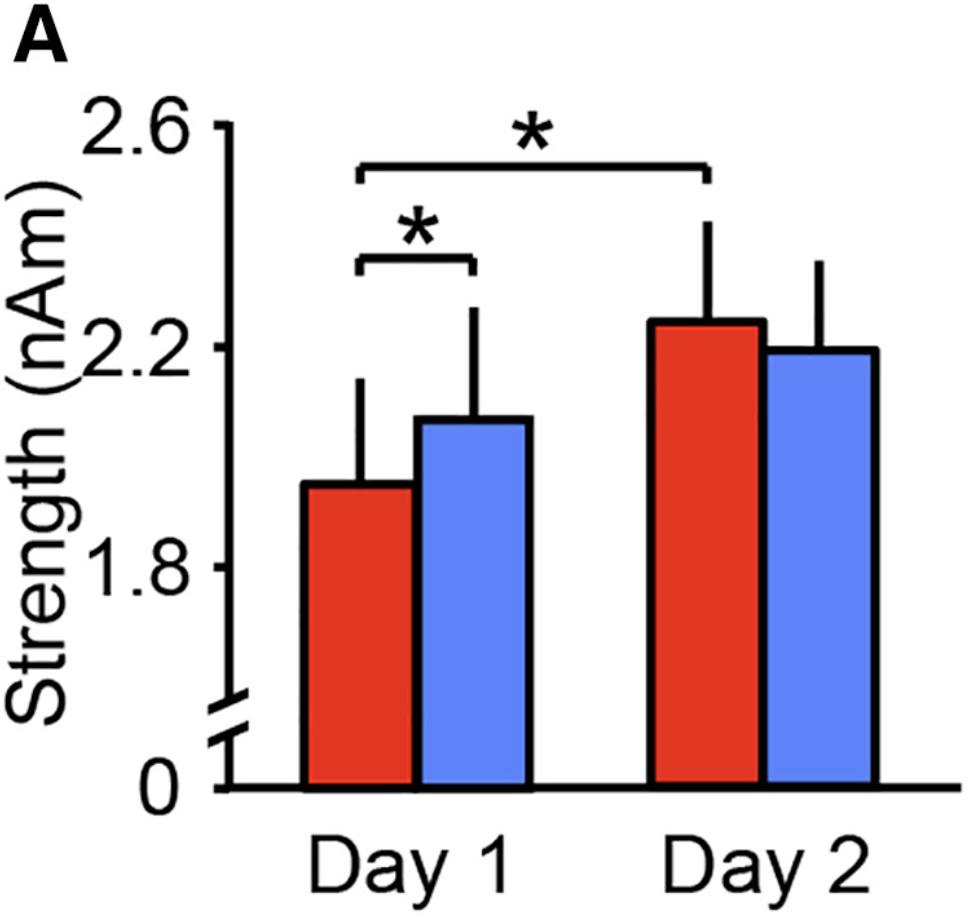
Humans experience the first-night effect where it can be difficult to fall asleep or remain asleep in a new environment (Tamaki et al. 2016). When participants slept in a laboratory for two nights, they displayed reduced strength of slow-wave activity in the left hemisphere in the first sleep cycle on the first night (Figure 2). Slow-wave oscillations around 1-4 Hz serve as an indicator of sleep depth (Nobili et al. 2011) and this suggests that shallower sleep in one hemisphere leads to the overall poor sleep quality.
Furthermore, the first night reflects a period of increased vigilance (Manoach & Stickgold 2016; Tamaki et al. 2016). When participants heard alarm tones amongst standard tones while asleep, they expressed a greater amplitude of slow-wave activity in the left hemisphere. They were also more easily awakened by the alarm tones and responded faster to a tapping task.
The asymmetry in the slow-wave activity between hemispheres in the human first-night effect resembles the slow-wave sleep in northern fur seals. Whether sleeping in the open ocean or in a sleep laboratory, these adaptive mechanisms balance the monitoring of external threats with physiological needs for rest.
References
Baird, Robin, and Bradley Hanson. 1997. “Status of the Northern Fur Seal, Callorhinus Ursinus, in Canada.” Canadian Field-Naturalist 111 (2): 263–69.
Kendall-Bar, Jessica M., Alexei L. Vyssotski, Lev M. Mukhametov, Jerome M. Siegel, and Oleg I. Lyamin. 2019. “Eye State Asymmetry during Aquatic Unihemispheric Slow Wave Sleep in Northern Fur Seals (Callorhinus Ursinus).” PLOS ONE 14 (5): e0217025. https://doi.org/10.1371/journal.pone.0217025.
Lyamin, Oleg I., Paul R. Manger, Sam H. Ridgway, Lev M. Mukhametov, and Jerome M. Siegel. 2008. “Cetacean Sleep: An Unusual Form of Mammalian Sleep.” Neuroscience & Biobehavioral Reviews 32 (8): 1451–84. https://doi.org/10.1016/j.neubiorev.2008.05.023.
Lyamin, Oleg I., Lev M. Mukhametov, and Jerome M. Siegel. 2017. “Sleep in the Northern Fur Seal.” Current Opinion in Neurobiology 44 (June): 144–51. https://doi.org/10.1016/j.conb.2017.04.009.
Manoach, Dara S., and Robert Stickgold. 2016. “Sleep: Keeping One Eye Open.” Current Biology 26 (9): R360–61. https://doi.org/10.1016/j.cub.2016.03.041.
Nobili, Lino, Michele Ferrara, Fabio Moroni, et al. 2011. “Dissociated Wake-like and Sleep-like Electro-Cortical Activity during Sleep.” NeuroImage 58 (2): 612–19. https://doi.org/10.1016/j.neuroimage.2011.06.032.
Tamaki, Masako, Ji Won Bang, Takeo Watanabe, and Yuka Sasaki. 2016. “Night Watch in One Brain Hemisphere during Sleep Associated with the First-Night Effect in Humans.” Current Biology 26 (9): 1190–94. https://doi.org/10.1016/j.cub.2016.02.063.
Tashjian, Sarah M., Diane Goldenberg, Martin M. Monti, and Adriana Galván. 2018. “Sleep Quality and Adolescent Default Mode Network Connectivity.” Social Cognitive and Affective Neuroscience 13 (3): 290–99. https://doi.org/10.1093/scan/nsy009.


Leave a Reply
You must be logged in to post a comment.