Hallucinations, described as the perception of something that is not present, are a universal experience, whether they stem from a migraine, high fever, or psychedelics (Chaudhury 2010). Being a universal experience, hallucinations have been experienced by people all over the world. Interestingly, all those who describe hallucinations tend to see the same set of shapes: spirals, tunnels, lattices, and cobwebs, no matter their background or experiences (Bressloff et al. 2002). This leads us to ask why? Why is it that different people, from different cultures, and even across centuries, see the exact same geometry in hallucinations? The answer to this lies not in what you are seeing, but instead the hardware of your eyes and brain. Hallucinations are a visual of the architecture of one’s visual cortex.
Heinrich Klüver, a psychologist in the 1920s, decided that he wanted to categorize the shapes of hallucinations (Nahm 1997). To do this, he experimented on himself, using mescaline which is a naturally occurring psychedelic found in cacti (Vamvakopoulou et al. 2022). Through his testing, he categorized the hallucinations into four shapes, more technically called form constants: lattices, cobwebs, tunnels, and spirals (Figure 1).
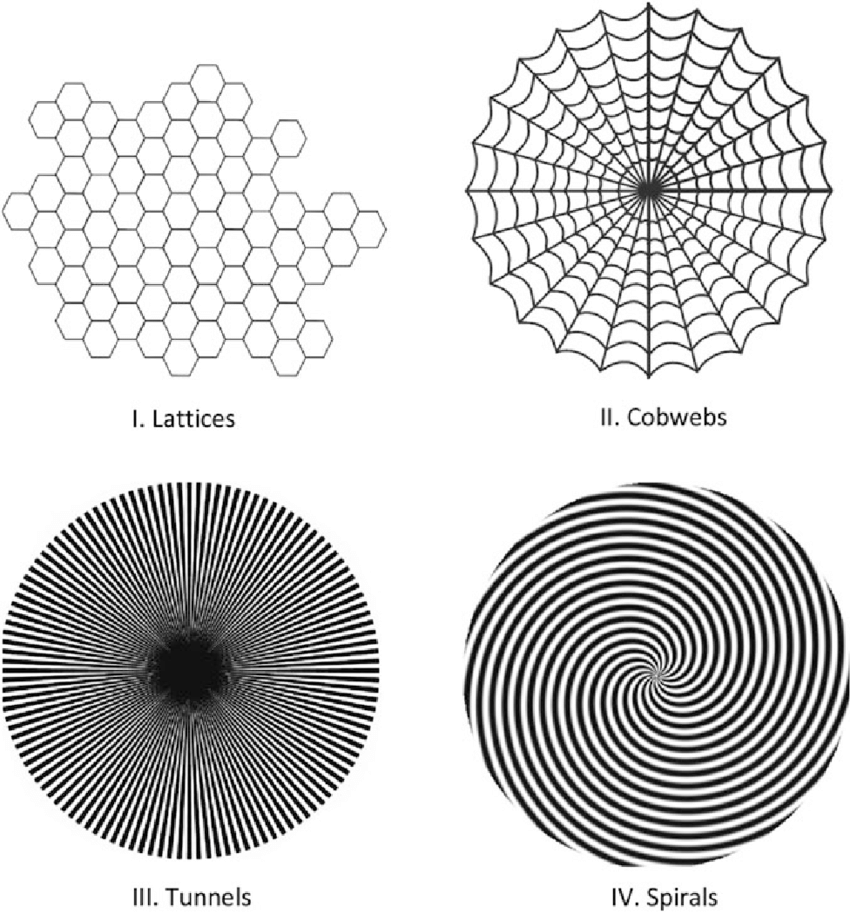
Figure 1. Visual representation of the four form constants classified by Heinrich Klüver. I. lattices, II. cobwebs, III. tunnels, and IV. spirals (Kometer and Vollenweider 2016).
The human retina is a dish-like shape, and is a layer of tissue at the back of the eyeball made up of photoreceptor cells (Hanes 2024) (Figure 2). When the eye is perceiving the world, it maps images on polar grids (using circles, and angles). Signals travel from the retina to the V1 visual cortex, at the back of the brain (Huff and Prasanna Tadi 2023). But, the brain isn’t circular, it’s actually a rectangular strip of tissue (Doctrow 2024)! So, to get the image from the circular retina to the rectangular brain, the brain performs a mathematical transformation called a complex logarithmic map (Ruelle 2007). To understand this transformation, think of it as drawing a straight line on the rectangular brain, this translates to a spiral in circular vision.
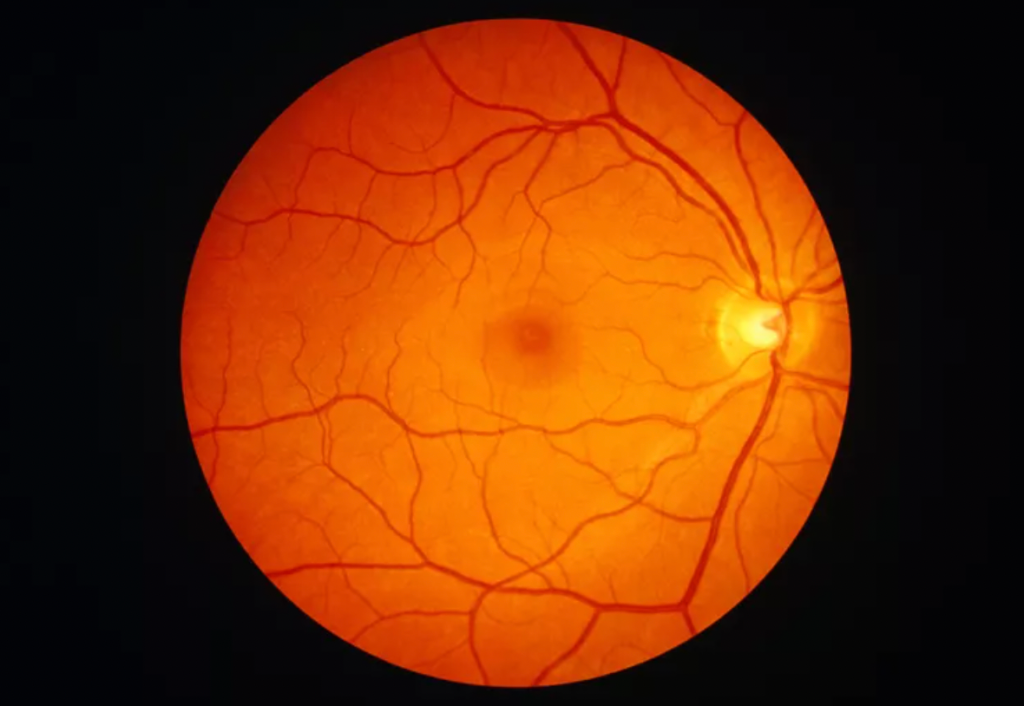
Figure 2. Image of a healthy human retina (Hanes 2024).
The fundamental math behind this was discovered by Alan Turing, who explained how patterns emerge in nature (Cooper and Maini 2012). In the brain, when neurons get over excited, whether that be due to drugs or a lack of oxygen, the noise in the brain spontaneously organises into what are referred to as tuning patterns (Shao et al. 2021). These tuning patterns output the geometric form constants because the V1 visual cortex detects edges and contours, and when it misfires it creates an edge that is detected as a repeating geometric pattern- one of the four form constants (Yafim Beiderman and Zeev Zalevsky 2025).
Looking back into human history, we can see that these patterns are everpresent. Anthropologists have found striking similarities between Klüver’s “form constants” and geometric patterns found in ancient art all across the globe (Luke 2020). All the way from the petroglyphs in the paleolithic caves to the infinite tessellations of Islamic mosaic tiles, these patterns appear over and over again (Mujzel 2024).
It’s easy for us to dismiss hallucinations, but the math suggests to us that hallucinations are actually the structure of our perception that reveals itself. When the brain is pushed to its limit, for a very brief moment, we get to see the raw way that our brain processes visual information. So, when we hallucinate, we’re not seeing things that aren’t there, we’re actually seeing the machinery that allows us to see our whole world.
Bibliography
Bressloff, Paul C., Jack D. Cowan, Martin Golubitsky, Peter J. Thomas, and Matthew C. Wiener. 2002. “What Geometric Visual Hallucinations Tell Us about the Visual Cortex.” Neural Computation 14 (3): 473–91. https://doi.org/10.1162/089976602317250861.
Chaudhury, Suprakash. 2010. “Hallucinations: Clinical Aspects and Management.” Industrial Psychiatry Journal 19 (1): 5–12. https://doi.org/10.4103/0972-6748.77625.
Cooper, S. Barry, and Philip K. Maini. 2012. “The Mathematics of Nature at the Alan Turing Centenary.” Interface Focus 2 (4): 393–96. https://doi.org/10.1098/rsfs.2012.0018.
Doctrow, Brian. 2024. “Unseen Details of Human Brain Structure Revealed.” National Institutes of Health (NIH). May 20, 2024. https://www.nih.gov/news-events/nih-research-matters/study-reveals-unseen-details-human-brain-structure.
Hanes, Elizabeth. 2024. “Retina: Anatomy, Function, and Treatment.” Verywell Health. October 29, 2024. https://www.verywellhealth.com/retina-anatomy-4800793.
Huff, Trevor, and Prasanna Tadi. 2023. “Neuroanatomy, Visual Cortex.” Nih.gov. StatPearls Publishing. August 14, 2023. https://www.ncbi.nlm.nih.gov/books/NBK482504/.
Kometer, Michael, and Franz X. Vollenweider. 2016. “Serotonergic Hallucinogen-Induced Visual Perceptual Alterations.” Behavioral Neurobiology of Psychedelic Drugs, 257–82. https://doi.org/10.1007/7854_2016_461.
Luke, David. 2020. “Anomalous Psychedelic Experiences: At the Neurochemical Juncture of the Humanistic and Parapsychological.” Journal of Humanistic Psychology, May, 002216782091776. https://doi.org/10.1177/0022167820917767.
Mujzel, Julia. 2024. “Sacred Geometry: The Universal Patterns in Art and Architecture.” HOME ART HAVEN. June 18, 2024. https://homearthaven.com/blogs/news/sacred-geometry-the-universal-patterns-in-art-and-architecture.
Nahm, Frederick K.D. 1997. “Heinrich Klüver and the Temporal Lobe Syndrome*.” Journal of the History of the Neurosciences 6 (2): 193–208. https://doi.org/10.1080/09647049709525702.
Ruelle, David. 2007. “The Mathematician’s Brain.” https://abel.math.harvard.edu/~knill/teaching/mathe320_2014/blog/butterfly.pdf.
Shao, Jie, Yunhui Liu, Dashuang Gao, Jie Tu, and Fan Yang. 2021. “Neural Burst Firing and Its Roles in Mental and Neurological Disorders.” Frontiers in Cellular Neuroscience 15 (September). https://doi.org/10.3389/fncel.2021.741292.
Vamvakopoulou, Ioanna A., Kelly A.D. Narine, Ian Campbell, Jason R.B. Dyck, and David J. Nutt. 2022. “Mescaline: The Forgotten Psychedelic.” Neuropharmacology 222 (October): 109294. https://doi.org/10.1016/j.neuropharm.2022.109294.
Yafim Beiderman, and Zeev Zalevsky. 2025. “Visual Cortex Speckle Imaging for Shape Recognition.” Scientific Reports 15 (1): 42690–90. https://doi.org/10.1038/s41598-025-26723-5.


Leave a Reply
You must be logged in to post a comment.