When casting your votes for an election, how often are you influenced by your electoral district’s past sedimentology? You might say “never”, but the world around you is actually a mosaic of historic and prehistoric events that have shaped so much of our health, trade and political demographics. One of the most notable and obvious occurrences of this phenomenon can be seen in the United States of America. The region encompassing the modern southern states of South Carolina, Georgia, Alabama, Mississippi and Arkansas is referred to as the ‘Black Belt’ because of its extremely fertile Blackland Prairie soil (Wilson 2017). Soil fertility here can be attributed to the proceedings of the Cretaceous Period (145-66 Ma) (Frazier and Schwimmer 2013).
During the Late Cretaceous, the epeiric Western Interior Seaway covered much of N. America and extended across parts of present-day southeastern United States. As plankton and shellfish died in these seas, their carbonate skeletons accumulated on the seafloor and formed thick deposits of chalk and limestone sediments (Becker 2022). Over tens of millions of years, these sediments lithified and were later uplifted and exposed at the surface. Weathering of these carbonate-rich rocks produced the dark, nutrient-rich soils that characterize the Blackland Prairie region today (Frazier and Schwimmer 2013). The resulting crescent-shaped band of fertile soil across Mississippi, Alabama, and Georgia marks the approximate position of an ancient Cretaceous coastline that existed nearly 100 million years ago (McClain 2012; Wilson 2017).
The agricultural potential of this soil has since greatly shaped the social and economic history of the region. In the 19th century, settlers capitalised on the Black Belt’s exceptional fertility and swiftly established cotton plantations across the region (Bressan 2020). Cotton cultivation at the time required enormous amounts of labour, so plantation owners relied heavily on enslaved African Americans to work these lands. As a result, these areas developed the highest concentrations of pre-Civil War black slaves, and the descendants of the enslaved families now make up over 50%-85% of the population in counties across the Black Belt (Bressan 2020; McClain 2012). When comparing Cretaceous sediments, Blackland Prairie soils, slave population density in 1860, and modern voting results as in Figure 1, there is undeniable spatial overlap along this same curved geological belt (Starkey 2021).
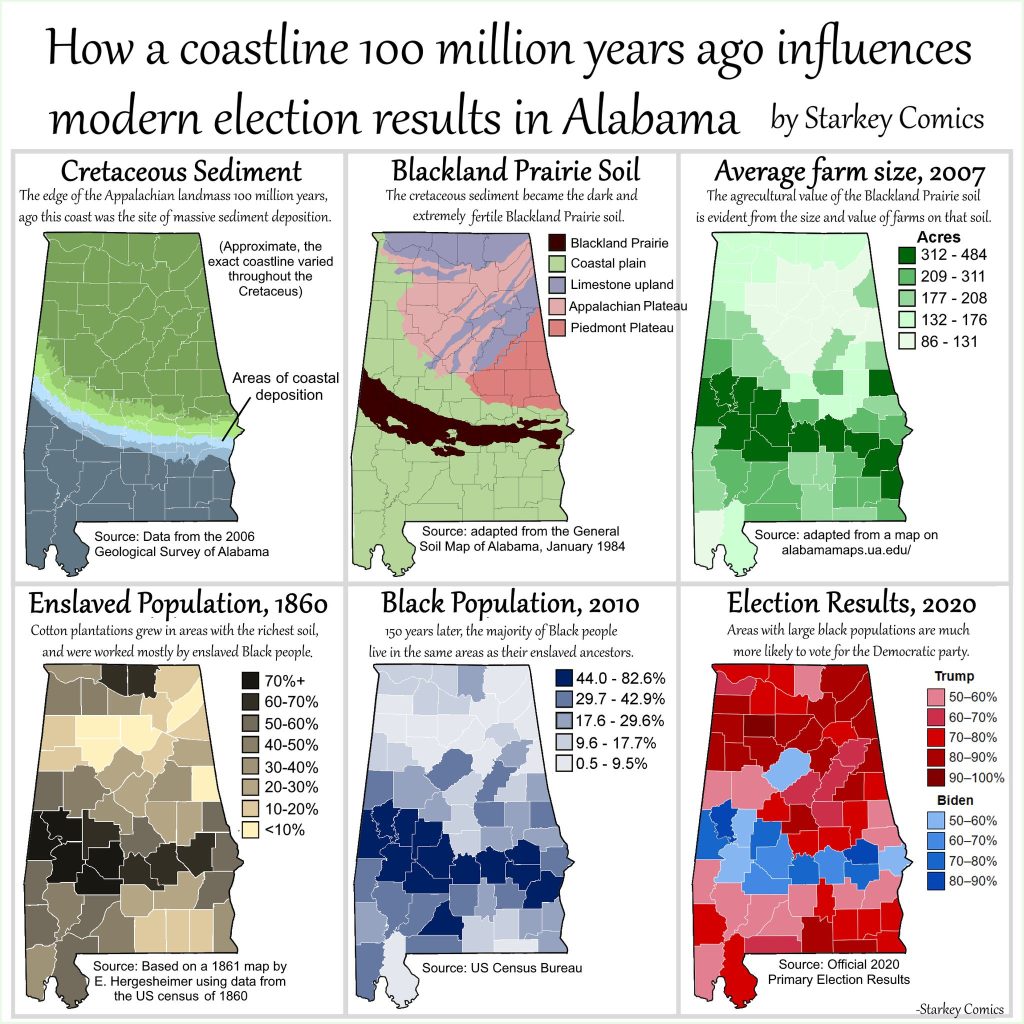
Unsurprisingly, these patterns have shaped the US’ political geography. In recent elections, counties across the Black Belt have shown stronger support for the Democratic Party compared to surrounding regions, especially in years when a Republican candidate was elected President, like 2000, 2004 and even 2020 (McClain 2012; Starkey 2021). If geological maps are paired with electoral data, it is evident that the ancient (eastern) Appalachian coastline closely mirrors the “blue belt” seen in modern voting results across parts of Alabama, Mississippi, and Georgia (Bressan 2020; Dutch 2002; Elving 2014). Thus, we have a cascade of historical consequences triggered by geology: marine sediments → fertile soils → plantation agriculture → concentrated enslaved populations → present-day political determinism.
Geology has influenced electoral outcomes in other parts of the US as well. In Appalachia, coal-bearing formations led to strong mining-linked economies in Ohio, West Virginia, Pennsylvania and Maryland, but the discovery of more notable international coal-rich regions, and Donald Trump’s subsequent 2016 support towards American coal mining, have both been linked to his garnered support and eventual presidency (Bressan 2020). Akin to the Black Belt, these fossil fuel deposits show how ancient geology has influenced modern economic and political trends.
The Black Belt-blue belt phenomenon therefore shows how the history of the Earth continues to impact our lives today, and while voters probably don’t think about sedimentary rocks while casting their ballot, the quiet legacy of those rocks will play a subtle role in shaping political landscapes for generations to come.
Works Cited
Becker, Branson. 2022. “Cretaceous Coastlines and Modern Voting Patterns.” Teach the Earth. SERC. February 11, 2022. https://serc.carleton.edu/teachearth/geocontext/collection/coastlines_voting.html.
Bressan, David. 2020. “How US Presidential Elections Are Impacted by Geology.” Forbes. November 3, 2020. https://www.forbes.com/sites/davidbressan/2020/11/03/how-us-presidential-elections-are-impacted-by-geology/.
Wilson, Charles Reagan. 2017. “Black Belt/Prairie.” Mississippi Encyclopedia. Center for Study of Southern Culture. October 10, 2017. https://mississippiencyclopedia.org/entries/black-belt-prairie/.
Dutch, Steven. 2002. “Geology and Election 2000 – Returns.” Stevedutch.net. University of Wisconsin – Green Bay. January 23, 2002. https://stevedutch.net/research/elec2000/ge2000returns.htm.
Elving, Ron. 2024. “The Color of Politics: How Did Red and Blue States Come to Be?” NPR.org. November 13, 2024. https://www.npr.org/2014/11/13/363762677/the-color-of-politics-how-did-red-and-blue-states-come-to-be.
McClain, Craig. 2012. “How Presidential Elections Are Impacted by a 100 Million Year Old Coastline | Deep Sea News.” Deepseanews.com. June 27, 2012. https://deepseanews.com/2012/06/how-presidential-elections-are-impacted-by-a-100-million-year-old-coastline/.
Schwimmer, David, and William Frazier. 2013. “Cretaceous Period in Alabama.” Encyclopedia of Alabama. June 13, 2013. https://encyclopediaofalabama.org/article/cretaceous-period-in-alabama/?utm_source=chatgpt.com.
Starkey, Ryan. 2021. “How a Coastline 100 Million Years Ago Influences Modern Election Results in Alabama.” Starkey Comics. June 11, 2021. https://starkeycomics.com/2021/06/11/how-a-coastline-100-million-years-ago-influences-modern-election-results-in-alabama/.

Leave a Reply
You must be logged in to post a comment.