Polymers, both natural and synthetic, consist of large linkages of monomer units (Namazi 2017). Anywhere from DNA to polyester and nylon, polymers play a consistent role in our lives, including through plastic (Young and Lovell 2011). Plastic degrades in the same way as other natural polymers do with the environment; thermal, photo-oxidation, chemical degradation and biodegradation, however given a longer time frame (Enuh 2023). Plastics take an approximate 20 to 500 years for degradation to microplastics, but never actually go away. Microplastics are plastic fragments created from decomposition of larger molecules, which are then released into the environment (Savchuk 2025). These infinitely small particles can then work their way up the food chain and contaminate the water humans drink, food we eat and even air we breathe.
The plastic epidemic has been ongoing for centuries, with almost 460 million tonnes of plastic being produced every year but only less than 10% of that being recycled (Vasarhelyi 2023). As the years go on, the increase in environmental and injurious effects are detrimental, with growing accumulations on ocean surfaces in the past 60 years (MacLeod et al. 2021). However, after much growth in technology and science, surely there must be a solution for this crisis. Although eliminating plastics as a whole would be the ultimate resolution, what if there was a way to mitigate this issue?
One of the hardest discoveries in science include making something that is strong enough to use, but weak enough to break down, however as of November 2025, researchers from Rutgers’ University have discovered a new way to decompose these stubborn tools (MacPherson 2025).
With the help of biomimicry, copying nature to solve human problems, the scientists found that as biological polymers, such as our genetic material, contain helping groups that assist with bond-breakage when needed. Therefore, with a simple chemistry alteration, human-made plastics would be able to do the same. The research conducted focused on maintaining structural integrity while in-use and weakening the bonds after serving its purpose, allowing for smooth degradation without harsh chemicals (Figure 1).
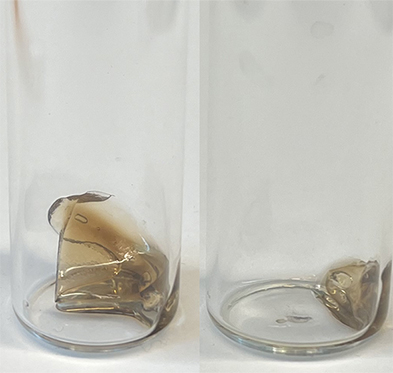
Considering this research is still relatively novice, this breakthrough for plastics’ programmable breakdown allows for a glimpse into the cleaner future that scientists have been talking about for decades. Until this level of technology hits the market for mass utility, the best tool for plastic prevention remains reduction and advocacy. Although using a plastic water bottle for 30 minutes is quite accessible, this leaves the cleanup to our descendants for the next five centuries.
References
Enuh, Blaise. 2023. “How Do Polymers Degrade?” AZoM.com. June 19, 2023. https://www.azom.com/article.aspx?ArticleID=22789.
MacLeod, Matthew, Hans Peter H. Arp, Mine B. Tekman, and Annika Jahnke. 2021. “The Global Threat from Plastic Pollution.” Science 373 (6550): 61–65. https://doi.org/10.1126/science.abg5433.
MacPherson, Kitta. 2025. “Scientists Develop Plastics That Can Break Down, Tackling Pollution.” Rutgers.edu. 2025. https://www.rutgers.edu/news/scientists-develop-plastics-can-break-down-tackling-pollution.
Namazi, Hassan. 2017. “Polymers in Our Daily Life.” BioImpacts 7 (2). https://www.ncbi.nlm.nih.gov/pmc/articles/PMC5524987/.
Savchuk, Katia. 2025. “What’s the Deal with Microplastics, the Material That ‘Never Goes Away’?” News Center. 2025. https://med.stanford.edu/news/insights/2025/01/microplastics-in-body-polluted-tiny-plastic-fragments.html.
Vasarhelyi, Kayla. 2023. “The Impact of Plastic on Climate Change.” Environmental Center. University of Colorado Boulder. December 15, 2023. https://www.colorado.edu/ecenter/2023/12/15/impact-plastic-climate-change.
Young, Robert J, and P A Lovell. 2011. Introduction to Polymers. 3rd ed. Boca Raton: Crc Press.


Leave a Reply
You must be logged in to post a comment.