Each year, an estimated two-thirds of the seven million deaths caused by bacterial infections are attributed to antimicrobial resistance (AMR), which poses a serious threat for healthcare systems around the world as existing antibiotics lose efficacy (Okeke et al. 2024). Over the past decades, these clinical failures have been attributed to the misuse and overuse of antibiotics that create selective pressures on bacterial populations to exhibit resistance (Davies and Davies 2010). However, recent research suggests that rising temperatures and extreme weather events attributed to climate change can also be linked to the increase in AMR (Zhou et al. 2026). As climate change accelerates, understanding how human-driven environmental shifts drive the evolution of AMR has become an urgent priority (Fernández Salgueiro et al. 2024).
Climate change can influence the evolution of antibiotic resistance genes (ARGs) through changes in temperature and weather events, with recent computational studies evaluating this relationship on a global scale (MacFadden et al. 2018). For example, Zhou et al. (2026) analyzed more than 400,000 Salmonella genomes across 139 countries and regions, finding a positive correlation between changes in temperature and precipitation and ARG abundance at the genetic level. Specifically, through the use of multiple regression models, the researchers showed that potentially 10% of the global increase in Salmonella ARGs is associated with climate change (Figure 1). Although these findings do not prove a direct causal relationship, this global quantitative analysis demonstrates a widespread rise in both phenotypic antimicrobial resistance and underlying ARGs across the genus Salmonella.
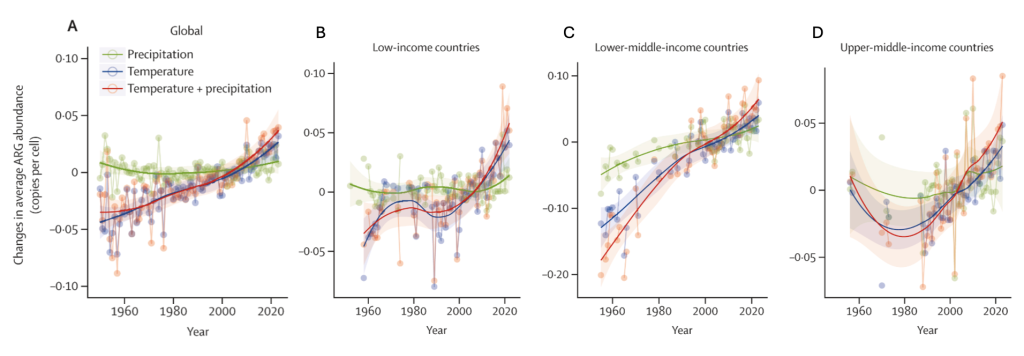
Figure 1.Changes in Salmonella antibiotic resistance gene (ARG) abundance associated with temperature and precipitation variations (A) globally, (B) in low-income countries, (C) in lower-middle-income countries, and (D) in upper-middle-income countries (Zhou et al. 2026). Shading represents a 95% confidence band from multiple regression modelling results.
The impact of changes in temperature and weather events on the AMR in soil ecosystems has also been an area of interest. From 2009 to 2020, a study conducted by Wu et al. (2022) warmed grassland plots to 3 degrees Celsius above the surrounding air temperature and analyzed the abundance of ARGs through metagenomic sequencing of soil samples. These researchers found that ARG abundance of soil microbes increased by 23.9% over 11 years compared to grasslands that were not heated (Wu et al. 2026). Similar results were observed in a recent study by Shan et al. (2026), which looked at the drought as a driving force of antibiotic resistance in soil across various geographic regions and soil types. Strikingly, all five datasets analyzed showed that abundance of ARGs were significantly higher under drought conditions (Figure 2).
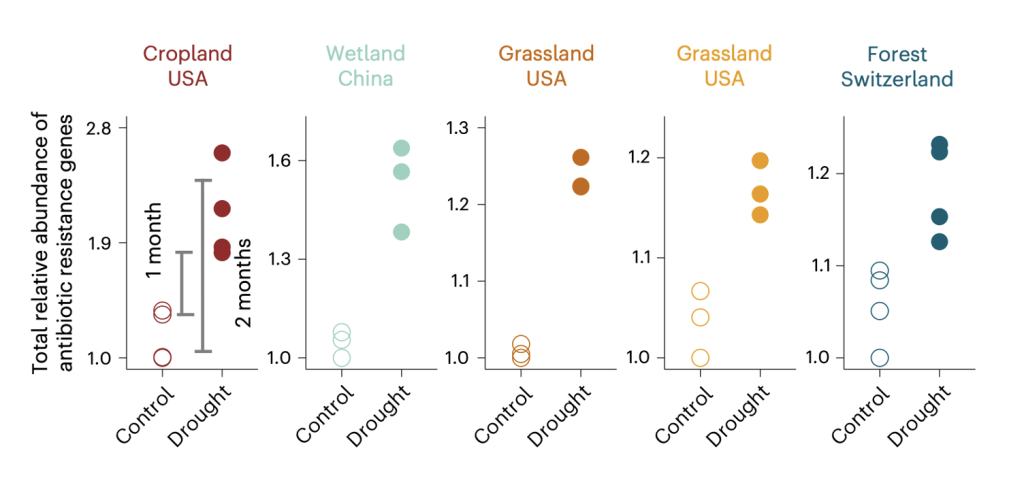
Figure 2. Total relative abundance antibiotic resistance genes under drought and control conditions across five different datasets (Shan et al. 2026). Within each data set, the increase of antibiotic resistance genes was greater when the duration of drought is longer (1 month compared to 2 months).
By examining recent research concerning the effect of climate change on antibiotic resistance, these results suggest that the effects of climate change itself can also act as an environmental pressure that selects for resistance genetically. Although the exact mechanisms driving this selection under changing environments remain under debate, the global scale of rising resistance calls for more efforts towards collective stewardships to integrate climate adaptation into antimicrobial resistance mitigation and public health policies.
References
Davies, Julian, and Dorothy Davies. 2010. “Origins and Evolution of Antibiotic Resistance.” Microbiology and Molecular Biology Reviews: MMBR 74 (3): 417–33. https://doi.org/10.1128/MMBR.00016-10.
Fernández Salgueiro, María, José Antonio Cernuda Martínez, Rick Kye Gan, and Pedro Arcos González. 2024. “Climate Change and Antibiotic Resistance: A Scoping Review.” Environmental Microbiology Reports 16 (5): e70008. https://doi.org/10.1111/1758-2229.70008.
Okeke, Iruka N., Marlieke E. A. de Kraker, Thomas P. Van Boeckel, et al. 2024. “The Scope of the Antimicrobial Resistance Challenge.” The Lancet 403 (10442): 2426–38. https://doi.org/10.1016/S0140-6736(24)00876-6.
Shan, Xiaoyu, Karen Cao, Hannah Jeckel, et al. 2026. “Drought Drives Elevated Antibiotic Resistance across Soils.” Nature Microbiology 11 (4): 867–76. https://doi.org/10.1038/s41564-026-02274-x.
Wu, Linwei, Da-Shuai Mu, Jing An, et al. 2026. “Decade-Long Warming Accelerates Antibiotic Resistance in Grassland Soils.” Nature 654 (8118): 398–407. https://doi.org/10.1038/s41586-026-10413-x.
Zhou, Zhen-Chao, Lin Teng, Xin-Yi Geng, et al. 2026. “Association of Climate Change with the Spread of Antimicrobial Resistance Genes in Salmonella: A Longitudinal Ecological and Modelling Study.” The Lancet Planetary Health 10 (4): 101445. https://doi.org/10.1016/j.lanplh.2026.101445.


Leave a Reply
You must be logged in to post a comment.