Many fictional villains have gone through extreme lengths to achieve immortality, such as: Dracula, Voldemort, and especially the famous Emperor Qin Shi Huang! Though they all had their immaculate plans to achieve this power – especially Emperor Qin Shi Huang – there is an easier solution that already exists in animals today. This process, called transdifferentiation, even has modern regenerative medical applications, making it a powerful tool if used in the right hands.
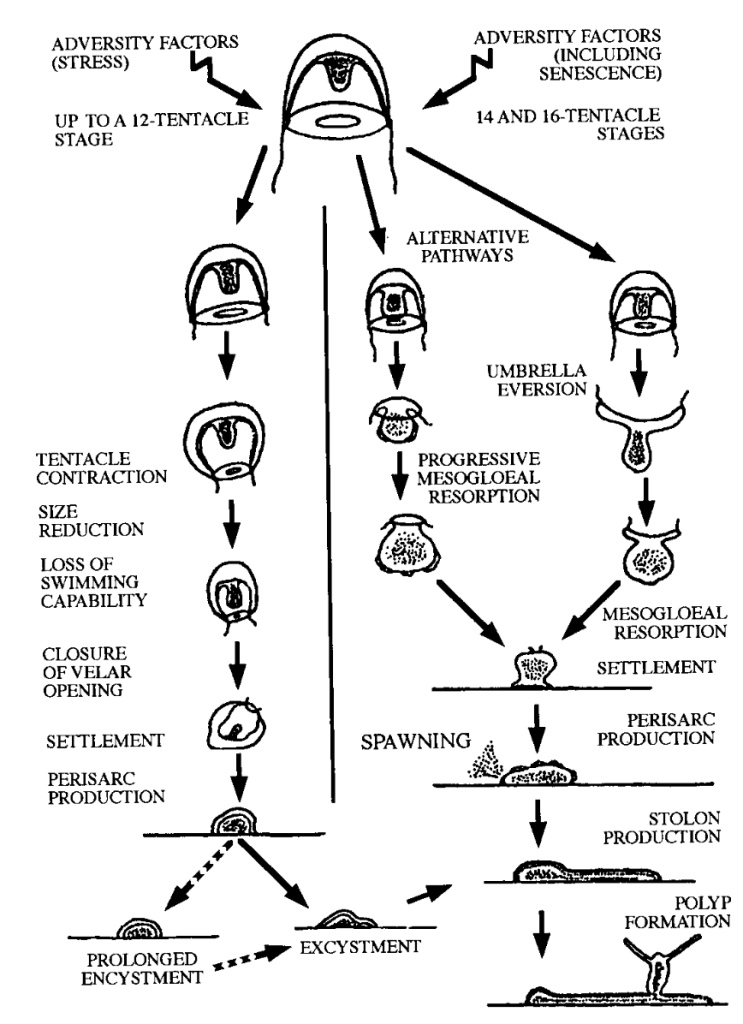
Transdifferentiation is a biological shortcut wherein fully differentiated cells can transform into a secondary fully mature cell – bypassing the normal process of stem cell differentiation (Piraino et al. 1995). By avoiding the regular use of stem cell specialization, transdifferentiation allows for extremely efficient regenerative mechanisms and even immortality in some species. One species that has been shown to exhibit near immortality is Turritopsis nutricula , a hydrozoan jellyfish. When severe environmental stress or damage is caused to individuals, a unique adaptation occurs, where the jellyfish will drop itself to the ocean floor, reconvert into a juvenile polyp, and restart its life cycle (Piraino et al. 1995). It undergoes this specific biological process through transdifferentiation of the exumbrellar epidermis cells, allowing the jellyfish to form juvenile structures. The genetic basis of transdifferentiation is driven by reprogramming DNA expression to allow for rebuilding of juvenile features. By suddenly expressing certain transcriptomes and genetic networks that only activate during the intermediate “cyst” stage of the jellyfish life cycle, jellyfish can reallocate resources from fixing current body parts to complete regeneration of juvenile parts (Matsumoto, Piraino, and Miglietta 2019).
Transdifferentiation also appears in chordates and is exhibited by some amphibian species to repair limbs and even eyesight. Through a process called Wolffian regeneration, newts and salamanders will not use stem cells to regrow their lens, but instead, directly transdifferentiate the mature cells of the dorsal iris into the crystalline lens to completely restore the individual’s vision (Henry, Hamilton 2018). Transdifferentiation is also seen in humans – though severely limited and extremely risky. One example is when an individual suffers from chronic acid reflux. Standard squamous cells cannot survive the acid reflux, and have adapted to transdifferentiate into mucus secreting columnar cells that are similar to intestinal cells. The drawback however, is it highly increases the risk of esophageal cancer (Que et al. 2019). A second example is the adaptation of pulmonary cells in response to chronic smoking. Smoke can damage the lining of the airway, causing the basal cells to transdifferentiate into squamous cells that can survive the toxicity of the smoke, with the drawback that the lungs can no longer clean itself (Crystal 2014).
Resulting from its known existence in human regenerative processes, transdifferentiation has become a frontier of regenerative medical studies under the alias direct reprogramming. A number of applications have and are being studied, such as: The reprogramming of pancreatic exocrine cells into insulin producing β-cells to cure type 1 diabetes (Zhou et al. 2008), or the reprogramming of fibroblasts into neurons using a chemical treatment to potentially treat brain damaging diseases like Parkinson’s (Vierbuchen et al. 2010). The novelty in reprogramming compared to stem cell treatments is that skipping the pluripotent phase during implantation, cells are unable to form tumors, solving one of regenerative medicine’s biggest problems (Heinrich et al. 2015).
Altogether, transdifferentiation is a regenerative process seen in non-chordates and chordates alike, that allow for unparalleled regenerative and healing properties. This discovery has then led to novel studies in potential treatments of human diseases that do not have solidified treatments, cementing its importance in the medical field. Maybe Emperor Qin Shi Huang should not have made jellyfish a Chinese delicacy and instead studied them…..
References
Crystal, Ronald G. 2014. “Airway Basal Cells. The ‘Smoking Gun’ of Chronic Obstructive Pulmonary Disease.” American Journal of Respiratory and Critical Care Medicine 190 (12): 1355–62. https://doi.org/10.1164/rccm.201408-1492PP.
Heinrich, Christophe, Robert Blum, Sergio Gascón, Giacomo Masserdotti, Pratibha Tripathi, Rodrigo Sánchez, Steffen Tiedt, Timm Schroeder, Magdalena Götz, and Benedikt Berninger. 2010. “Directing Astroglia from the Cerebral Cortex into Subtype Specific Functional Neurons.” Edited by Ronald D. G. McKay. PLoS Biology 8 (5): e1000373. https://doi.org/10.1371/journal.pbio.1000373.
Henry, Jonathan J, and Paul W Hamilton. 2018. “Diverse Evolutionary Origins and Mechanisms of Lens Regeneration.” Edited by Bing Su. Molecular Biology and Evolution 35 (7): 1563–75. https://doi.org/10.1093/molbev/msy045.
Matsumoto, Yui, Stefano Piraino, and Maria Pia Miglietta. 2019. “Transcriptome Characterization of Reverse Development in Turritopsis Dohrnii (Hydrozoa, Cnidaria).” G3: Genes|Genomes|Genetics 9 (12): 4127–38. https://doi.org/10.1534/g3.119.400487.
Piraino, S., F. Boero, B. Aeschbach, and V. Schmid. 1996. “Reversing the Life Cycle: Medusae Transforming into Polyps and Cell Transdifferentiation in Turritopsis Nutricula (Cnidaria, Hydrozoa).” The Biological Bulletin 190 (3): 302–12. https://doi.org/10.2307/1543022.
Que, Jianwen, Katherine S. Garman, Rhonda F. Souza, and Stuart Jon Spechler. 2019. “Pathogenesis and Cells of Origin of Barrett’s Esophagus.” Gastroenterology 157 (2): 349-364.e1. https://doi.org/10.1053/j.gastro.2019.03.072.
Vierbuchen, Thomas, Austin Ostermeier, Zhiping P. Pang, Yuko Kokubu, Thomas C. Südhof, and Marius Wernig. 2010. “Direct Conversion of Fibroblasts to Functional Neurons by Defined Factors.” Nature 463 (7284): 1035–41. https://doi.org/10.1038/nature08797.
Zhou, Qiao, Juliana Brown, Andrew Kanarek, Jayaraj Rajagopal, and Douglas A. Melton. 2008. “In Vivo Reprogramming of Adult Pancreatic Exocrine Cells to β-Cells.” Nature 455 (7213): 627–32. https://doi.org/10.1038/nature07314.
Leave a Reply
You must be logged in to post a comment.