You could go up to anyone on the street and ask them if they think dinosaurs are cool and they’d probably say yes. How could they not, giant reptiles that roamed the Earth, ones that people could only observe as bones in a museum or in fiction, what’s not to love? One such of these dinosaurs is the Spinosaurus aegyptiacus, commonly known as the Spinosaurus. The Spinosaurus was a large theropod that lived in North Africa around 95 million years ago, it had a semiaquatic lifestyle, living in and near rivers and consuming mainly fish and other aquatic organisms (Sereno, nd). But, the organism as it is known today may as well be a completely different creature to the one first discovered, and as of this past Thursday, the 19th of February 2026, a new species of Spinosaurus has been described.
The earliest fossils that could be associated with the Spinosaurus date as far back as 1820, but they were falsely named as other species, until German paleontologist Ernst Stromer named the Spinosaurus in 1915 (Moody et al, 2010; Stromer, 1915). Between 1912-1914, Richard Markgraf, a paleontologist hired by Stromer, would find 2 fossil specimens, leading to 2 published papers by Stromer, one based on the original neotype specimen in 1915, and another updated with the new specimen in 1936 (Stromer, 1915; Stromer, 1936). As a part of the 1936 paper, Stromer would work with Dr. Erhardt to reconstruct a full Spinosaurus skeleton based on his 2 specimens (Figure 1). Unfortunately Stromer would lose his life’s work in 1944, when the British Royal Air Force bombed Munich, destroying the museum where all of Stromer’s fossils were kept (Wigfield, nd). There would be much more work done throughout the rest of the 20th century, an at the time disproved theory about it being a quadruped, theories about the purpose of the sail, theories about an aquatic animal focused diet (Carpenter, 2002; Bailey, 1997; Charig and Milner, 1997). The next major discovery would come in 2014, when Nizar Ibrahim and a team of paleontologists published a paper theorizing that the Spinosaurus was actually a semi aquatic dinosaur evolved for swimming and aquatic hunting (Figure 2) (Ibrahim et al, 2014).
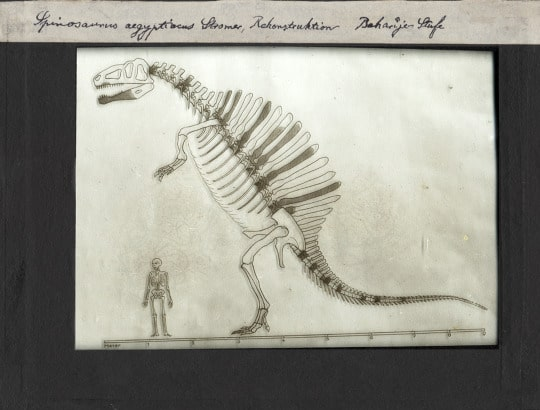
Figure 1: Stromer and Erhardt’s reconstruction of the Spinosaurus aegyptiacus. The shaded bones are the ones from actual specimens while the remainder were filled in from other theropods (Stromer, 1936).
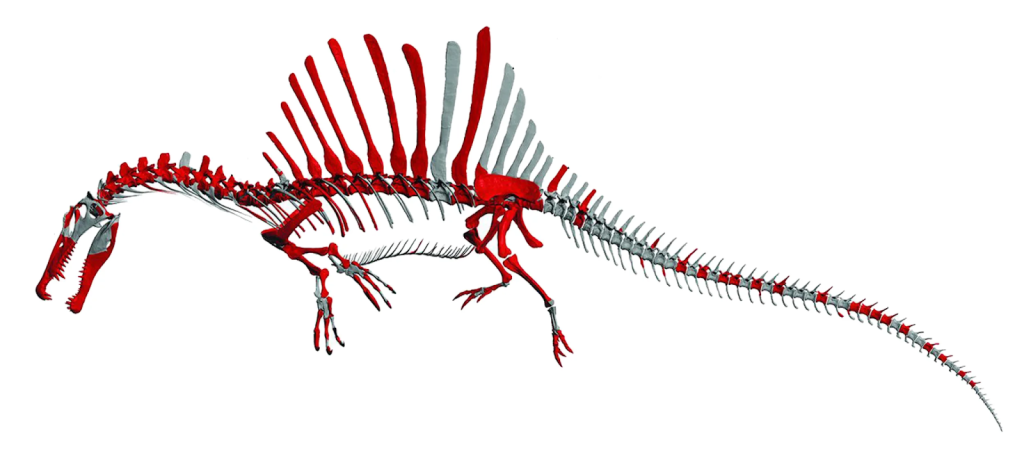
Figure 2: The skeletal structure of the Spinosaurus based on Ibrahim et al’s research, as sketched by Dr. Scott Hartman.
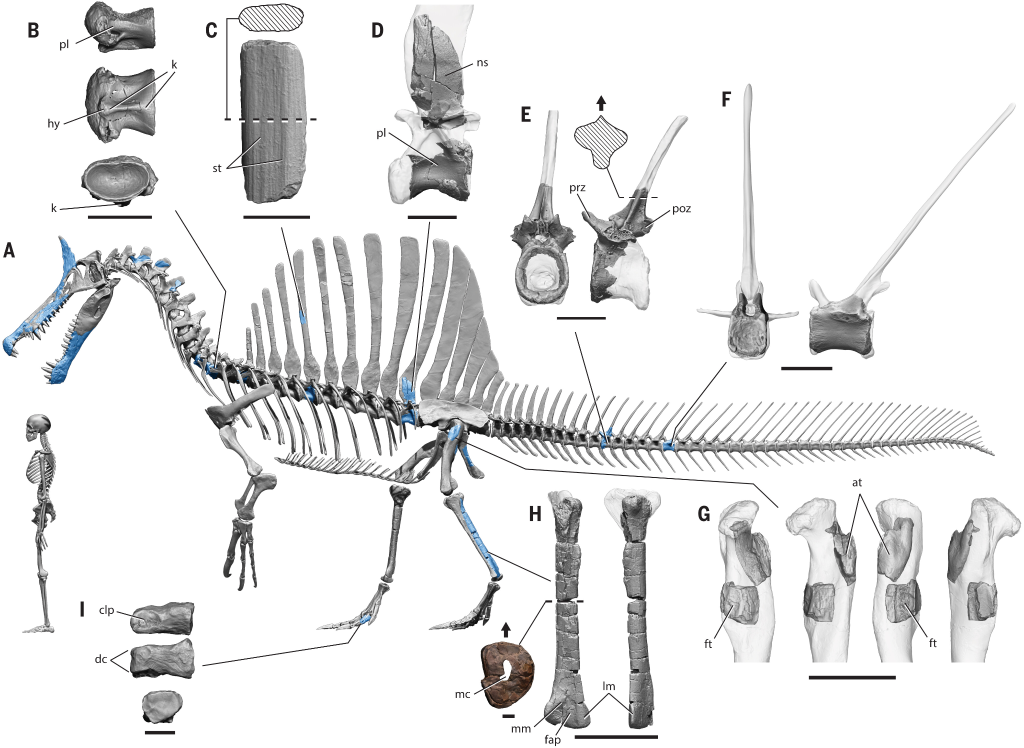
Figure 3: The reconstructed skeletal structure of Spinosaurus mirabilis (Sereno et al, 2026). The highlighted blue sections are the fossils found, with the various other portions showing closer looks at these fossils. The remaining bones are based on the Spinosaurus aegyptiacus.
Most recently, a research team headed by American paleontologist Paul Sereno published a research paper on February 19th, 2026, describing a newly discovered Spinosaurus species, the Spinosaurus mirabilis (Figure 3) (Sereno et al, 2026). The S. mirabilis was found in the Jenguebi fossiliferous area in the central Sahara, an area dated to the same age of ~95my as the Farak Formation where Stromer’s original neotype was found. The new species is distinguished from the neotype based on the low profile of its snout, a greater spacing in its posterior maxillary teeth, and a hypertrophied nasal-prefrontal crest. In fact, the head crest of S. mirabilis is now thought to be the tallest head crest of any theropod dinosaur, with it likely having had a keratinous sheath while the dinosaur was alive making it even larger then the fossil shows. The specific holotype specimen for this species is made up of the following fossils: an associated right premaxilla, both maxillae, the base and the bottom half of the fused nasal crest with portions of both prefrontals, the alveolar edge of the right dentary, and five maxillary teeth found in association with the maxillae. Component analysis of the body places the species in between wader and aquatic diver type predators in terms of predation. Furthermore, Sereno et al found that through phylogenetic analysis, they could determine three broad evolutionary phases for the Spinosaurus that had a hand in this species evolution. First of all in the Jurassic period, an ancestor underwent radiation leading to the skull elongating in order to better hunt for fish, before splitting into 2 main designs, baryonychine and spinosaurine. In the early Cretaceous, spinosaurids as a whole became the dominant predator of the time due to the circum-Tethyan habitats. Finally in the late Cretaceous, spinosaurines were geographically stuck to northern Africa and South America, where they grew to their maximum body size as shallow water ambush specialists. The evidence listed above, and the location of the fossils within a riverbank of an inland basin, leads to a theory that this species was a wading shoreline predator that lived until an abrupt eustatic sea level rise in the Cenomanian, alongside its associated climate change, lead to the end of spinosaurid radiation.
References
BBC. 2025. “Walking with Dinosaurs – the Spinosaurus That Was Lost in the War.” BBC. May 29, 2025. https://www.bbc.co.uk/programmes/articles/600gTCm3Md9ZptCHh1nrV6M/the-spinosaurus-that-was-lost-in-the-war.
Carpenter, Kenneth. 2002. “Forelimb Biomechanics of Nonavian Theropod Dinosaurs in Predation.” Senckenbergiana Lethaea 82 (1): 59–75. https://doi.org/10.1007/bf03043773.
Charig, Alan, and Angela C Milner. 2025. “Baryonyx Walkeri, a Fish-Eating Dinosaur from the Wealden of Surrey.” Bulletin of the Natural History Museum. Geology Series 53: 11–70. https://www.biodiversitylibrary.org/part/75343.
“Discoveries | Paul Sereno – Paleontologist | the University of Chicago.” n.d. Paulsereno.uchicago.edu. https://paulsereno.uchicago.edu/discoveries/spinosaurus_aegyptiacus/.
Folge, Neue, Heft, and Ernst Stromer. n.d. “Abhandlungen Der Bayerischen Akademie Der Wissenschaften Mathematisch-Naturwissenschaftliche Abteilung Ergebnisse Der Forschungsreisen Prof. E. Stromers in Den Wüsten Ägyptens VII. Baharije-Kessel Und -Stufe Mit Deren Fauna Und Flora Eine Ergänzende Zusammenfassung.” https://www.zobodat.at/pdf/Abhandlungen-Akademie-Bayern_NF_33_0001-0102.pdf.
Ibrahim, Nizar, Paul C. Sereno, Cristiano Dal Sasso, Simone Maganuco, Matteo Fabbri, David M. Martill, Samir Zouhri, Nathan Myhrvold, and Dawid A. Iurino. 2014. “Semiaquatic Adaptations in a Giant Predatory Dinosaur.” Science (New York, N.Y.) 345 (6204): 1613–16. https://doi.org/10.1126/science.1258750.
“Redirect Notice.” 2026. Google.com. 2026. https://www.google.com/url?q=https://www.cambridge.org/core/journals/journal-of-paleontology/article/abs/neural-spine-elongation-in-dinosaurs-sailbacks-or-buffalobacks/03FBDA4F4D4B89F96AED9C9FF742F3A7&sa=D&source=docs&ust=1771862376396768&usg=AOvVaw0_ybSnsuMJeEfyYyIxPNLH.
“Results of Prof. E. Stromer’s Research Expedition in the Deserts of Egypt II. Vertebrate Remains from the Baharîje Beds (Lowermost Cenomanian).” n.d. https://www.dinochecker.com/papers/Stromers-Egypt-expedition_Spinosaurus_Stromer_1915.pdf.
Richard, Eric Buffetaut, Darren Naish, and David M Martill. 2010. “Dinosaurs and Other Extinct Saurians: A Historical Perspective – Introduction.” Special Publication – Geological Society of London/Geological Society, London, Special Publications 343 (1): 1–3. https://doi.org/10.1144/sp343.1.
Sereno, Paul C., Daniel Vidal, Nathan P. Myhrvold, Evan Johnson-Ransom, María Ciudad Real, Stephanie L. Baumgart, Noelia Sánchez Fontela, et al. 2026. “Scimitar-Crested Spinosaurus Species from the Sahara Caps Stepwise Spinosaurid Radiation.” Science 391 (6787). https://doi.org/10.1126/science.adx5486.


Leave a Reply
You must be logged in to post a comment.