Acetylcholine, ACh, is a highly important neurotransmitter located in our central and peripheral nervous systems, playing a significant role in our neuromuscular junction with regards to communication between neurons, muscles, and glands (Sam and Bordoni 2023). A sufficient amount of choline-uptake into the presynaptic neuron, allows for the synthesis, packaging and release of acetylcholine. This then allows for diffusion across the synaptic cleft, where acetylcholine binds to its receptors, signalling a response. At the end of this series of events, as displayed by Figure 1, acetylcholine is terminated by its enzyme counterpart acetylcholinesterase, AChE, on the postsynaptic neuron.
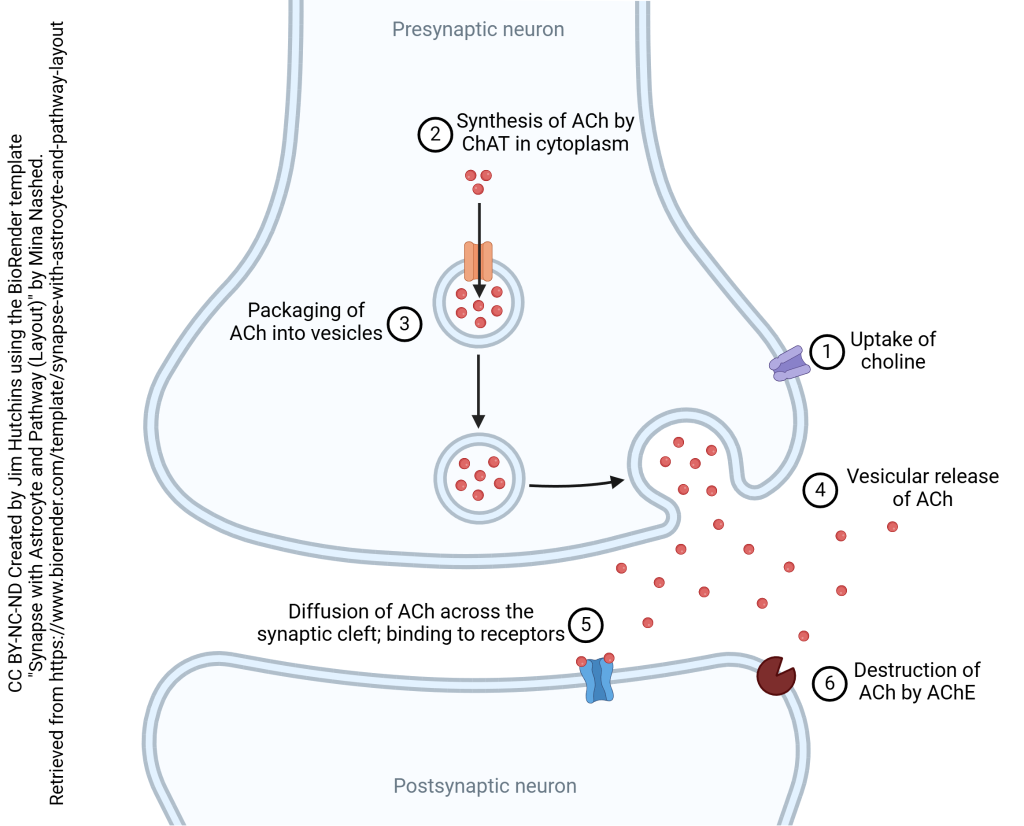
Considering acetylcholine’s importance, acetylcholinesterase arguably is more vital to the body’s response system, as it allows for acetylcholine to be broken down into its choline and acetate substituents. The lack of the enzyme can result in overaccumulation of acetylcholine, causing uncontrollable spasms and potential paralysis (Cleveland Clinic 2022). However, too much acetylcholinesterase can lead to cholinergic deficiency, and the inability to maintain neuronal signals, leading to memory loss, as well as Alzheimer’s disease. (Singh and Sadiq 2023; Fabiani et al. 2018).
With advanced technology and an increasing number of patients for neurodegenerative illnesses, novel medications are being created to inhibit acetylcholinesterase in attempts to prevent and work against Alzheimer’s disease. There currently exists potential known inhibitors, including prescribed medication such as donepezil and rivastigmine, however a commonly used, well-known acetylcholinesterase inhibitor is caffeine (Colovic et al. 2013).
Caffeine acts as a non-competitor inhibitor against acetylcholinesterase, through non-selective acetylcholine-receptor (AChR) antagonism (Pohanka and Dobes 2013). It is important to acknowledge that the overall mechanism is not entirely understood and is under-researched. However, the proposed mechanism explains that caffeine’s binding acts in opposition to the typical AChR, not allowing for the production of acetylcholine. The stimulant’s interaction with the allosteric site on the enzyme creates a conformational change, leading to a chain of events which ultimately hinders its function and reduces its ability to convert acetylcholine into its subparts (Pohanka and Dobes 2013).
Acetylcholinesterase acts as the ‘off switch’ within the cholinergic system, preventing continuous neuronal simulation. AChE inhibitors can be split into two categories: irreversible and reversible. Irreversible inhibitors, such as organophosphates, a class of phosphorus-containing compounds found in pesticides; bind to AChR permanently, leading to toxicity (Robb and Baker 2023). Reversible inhibitors such as donepezil and caffeine are used as treatments, temporarily inhibiting acetylcholinesterase, allowing for an accumulation of the acetylcholine neurotransmitter (Martin, Preedy, and Rajendram 2021).
References
Cleveland Clinic. 2022. “Acetylcholine (ACh).” Cleveland Clinic. 2022. https://my.clevelandclinic.org/health/articles/24568-acetylcholine-ach.
Colovic, Mirjana B., Danijela Z. Krstic, Tamara D. Lazarevic-Pasti, Aleksandra M. Bondzic, and Vesna M. Vasic. 2013. “Acetylcholinesterase Inhibitors: Pharmacology and Toxicology.” Current Neuropharmacology 11 (3): 315–35. https://doi.org/10.2174/1570159×11311030006.
Fabiani, Camila, Ana Paula Murray, Jeremías Corradi, and Silvia Susana Antollini. 2018. “A Novel Pharmacological Activity of Caffeine in the Cholinergic System.” Neuropharmacology 135 (June): 464–73. https://doi.org/10.1016/j.neuropharm.2018.03.041.
Hutchins, Jim. 2024. “Neurotransmitters: Acetylcholine.” Developing Expertise in Neuroscience. Weber State University. September 3, 2024. https://uen.pressbooks.pub/expertneuro/chapter/neurotransmitters-acetylcholine/.
Martin, Colin R., Victor R. Preedy, and Rajkumar Rajendram. 2021. Assessments, Treatments and Modeling in Aging and Neurological Disease : The Neuroscience of Aging. London: Academic Press.
Pohanka, Miroslav, and Petr Dobes. 2013. “Caffeine Inhibits Acetylcholinesterase, but Not Butyrylcholinesterase.” Int. J. Mol. Sci. 14 (5): 9873–82. https://doi.org/10.3390/ijms14059873.
Robb, Erika L, and Mari B Baker. 2023. “Organophosphate Toxicity.” Nih.gov. StatPearls Publishing. 2023. https://www.ncbi.nlm.nih.gov/books/NBK470430/.
Sam, Christian, and Bruno Bordoni. 2023. “Physiology, Acetylcholine.” Nih.gov. StatPearls Publishing. April 10, 2023. https://www.ncbi.nlm.nih.gov/sites/books/NBK557825/.
Singh, Ravneet, and Nazia M Sadiq. 2023. “Cholinesterase Inhibitors.” National Library of Medicine. StatPearls Publishing. July 17, 2023. https://www.ncbi.nlm.nih.gov/books/NBK544336/.

Leave a Reply
You must be logged in to post a comment.