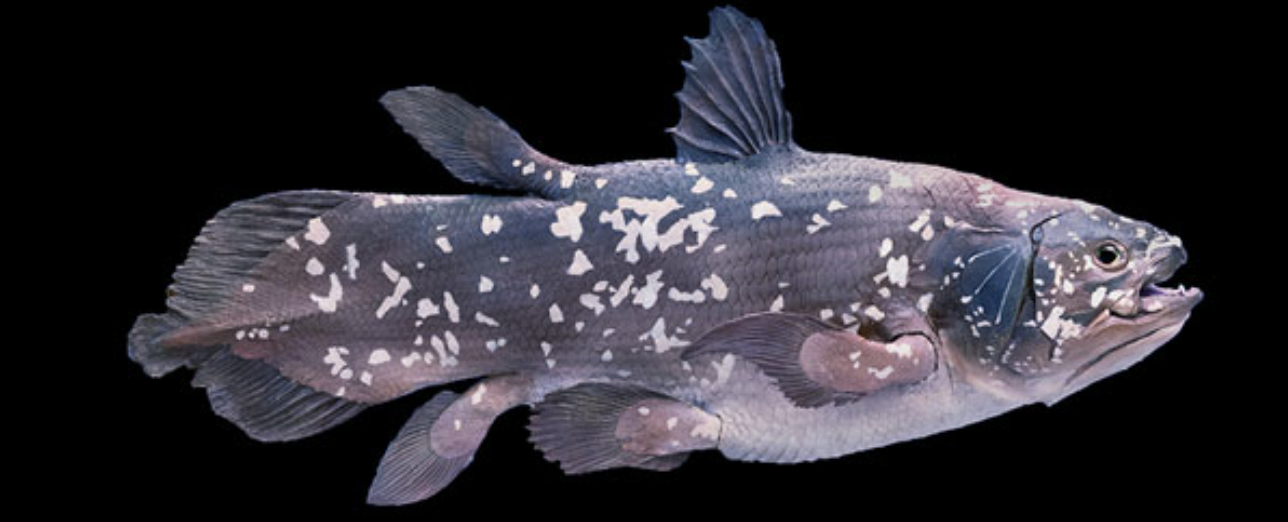
In the grand battle of mass extinction, many species didn’t stand a chance, with creatures like the wooly mammoth, saber tooth tiger, and dinosaurs, all slowly becoming victims to time. To this day, many of these creatures still remain widely unknown, leaving their physiology and behavioural nature as a mystery. Yet despite the passing years, one species remained persistent. Considered one of the most important zoological findings of the 20th century, the coelacanth fish coined the term ‘living fossil’ having evaded extinction for over 65 million years, recently being rediscovered in 1938 along the coast of South Africa (Amemiya et al. 2013). Passive in nature, the coelacanth fish presents itself having large steel blue scales and a distinct cranial profile, giving the body an archaic appearance as seen in Figure 1 (Batista et al. 2019).
Figure 1: Coelacanth fish spotted near the East coast of South Africa (Clarey et al., n.d.)
This lobe-finned vertebrae lives in depths from 180-200 meters with salinities of 35 ppt, predicted to be most abundant during the Cretaceous period (Ferrante and Cavin 2023). As the years progressed the coelacanth species remained, leaving scientists to wonder what about these curious fish made them so resistant to the threat of time, and how to harness this age-defying ability.
This mystery was first approached using an analytical technique to assess the structure of the fish, performed using a situ synchrotron small-angle X-ray. Commonly used on many organic materials and soft matter, this device shoots high-intensity X-ray beams that scatter across a surface at various angles at the nano and meso-scale (Prihar et al. 2024). Upon further inspection, it was revealed that the remarkable lifespan of the coelacanth species can be attributed to their rare elasmoid scales. Mimicking a double bouligand structure, these scales are made of thin collagen fibrils called isopedine, providing the coelacanth fish with defense against contortion and deformation as well as predator attacks. They are also extremely damage-tolerant having evolved from large juxtaposed plates that prevented locomotion, to smaller individualized units orthogonal to each other that don’t hinder movement (Prihar et al. 2024). This ingenious design of the coelacanth’s durable scales, are mutually desirable to synthetic materials.
Since the rediscovery of the coelacanth fish, attempts at designing similarly structured composites have been explored in hopes of mimicking the double bouligand structure. This helical pattern has possible applications in the architectural design of concrete, being implemented in the military, thermal insulation and stormwater management systems because of it’s fortified construction (Prihar et al. 2024). This potential increase in tensile strength for these applications, would be achieved through a relative rotation between each bilayer unit in the concrete. If cracking were to occur, it would alternate throughout the layered material or perpendicular to the fracture plane, opposed to traveling in a straight line as seen in Figure 2. This is known as crack deflection, and helps the material absorb more energy and makes it tougher, ultimately preventing brittle failure (Prihar et al. 2024).

Figure 2: Image A showcases the arrangement of a double-bouligand structure opposed to its single-bouligand, parallel lamellar, perpendicular, and cast reference specimen counterparts. This figure provides a three-dimensional view on how layers of this structure ascend vertically upwards, and how the direction of concrete placement varies per layer comparatively to more standard placements (Prihar et al. 2024).
This newfound disposition of concrete has the potential to reinvent how we build infrastructure and approach sustainable development, combining the innovative evolution from the coelacanth fish to applications of the physical world. By continuing to explore the inner-workings of marine life and understanding their unique adaptations we can continue to develop novel solutions, bridging the gap between humans and the natural world, with the best ideas coming from the bottom of the sea.
References
Amemiya, Chris T., Jessica Alföldi, Alison P. Lee, Shaohua Fan, Hervé Philippe, Iain MacCallum, Ingo Braasch, et al. 2013. “The African Coelacanth Genome Provides Insights into Tetrapod Evolution.” Nature 496 (7445): 311–16. https://doi.org/10.1038/nature12027.
Batista, Thatiany Alencar, Renan Alfredo Machado Bantim, Flaviana Jorge de Lima, Edilson Bezerra dos Santos Filho, and Antônio Álamo Feitosa Saraiva. 2019. “New Data on the Coelacanth Fish-Fauna (Mawsoniidae) from the Late Jurassic and Early Cretaceous of Araripe Basin, Brazil.” Journal of South American Earth Sciences 95 (November):102280. https://doi.org/10.1016/j.jsames.2019.102280.
Clarey, Tim, Ph.D., Jeffrey Tomkins, and Ph.D. *. n.d. “Coelacanths: Evolutionists Still Fishing in Shallow Water.” Accessed March 17, 2025. https://www.icr.org/article/coelacanths-evolutionists-still-fishing.
Ferrante, Christophe, and Lionel Cavin. 2023. “Early Mesozoic Burst of Morphological Disparity in the Slow-Evolving Coelacanth Fish Lineage.” Scientific Reports 13 (1): 11356. https://doi.org/10.1038/s41598-023-37849-9.
Prihar, Arjun, Shashank Gupta, Hadi S. Esmaeeli, and Reza Moini. 2024. “Tough Double-Bouligand Architected Concrete Enabled by Robotic Additive Manufacturing.” Nature Communications 15 (1): 7498. https://doi.org/10.1038/s41467-024-51640-y.