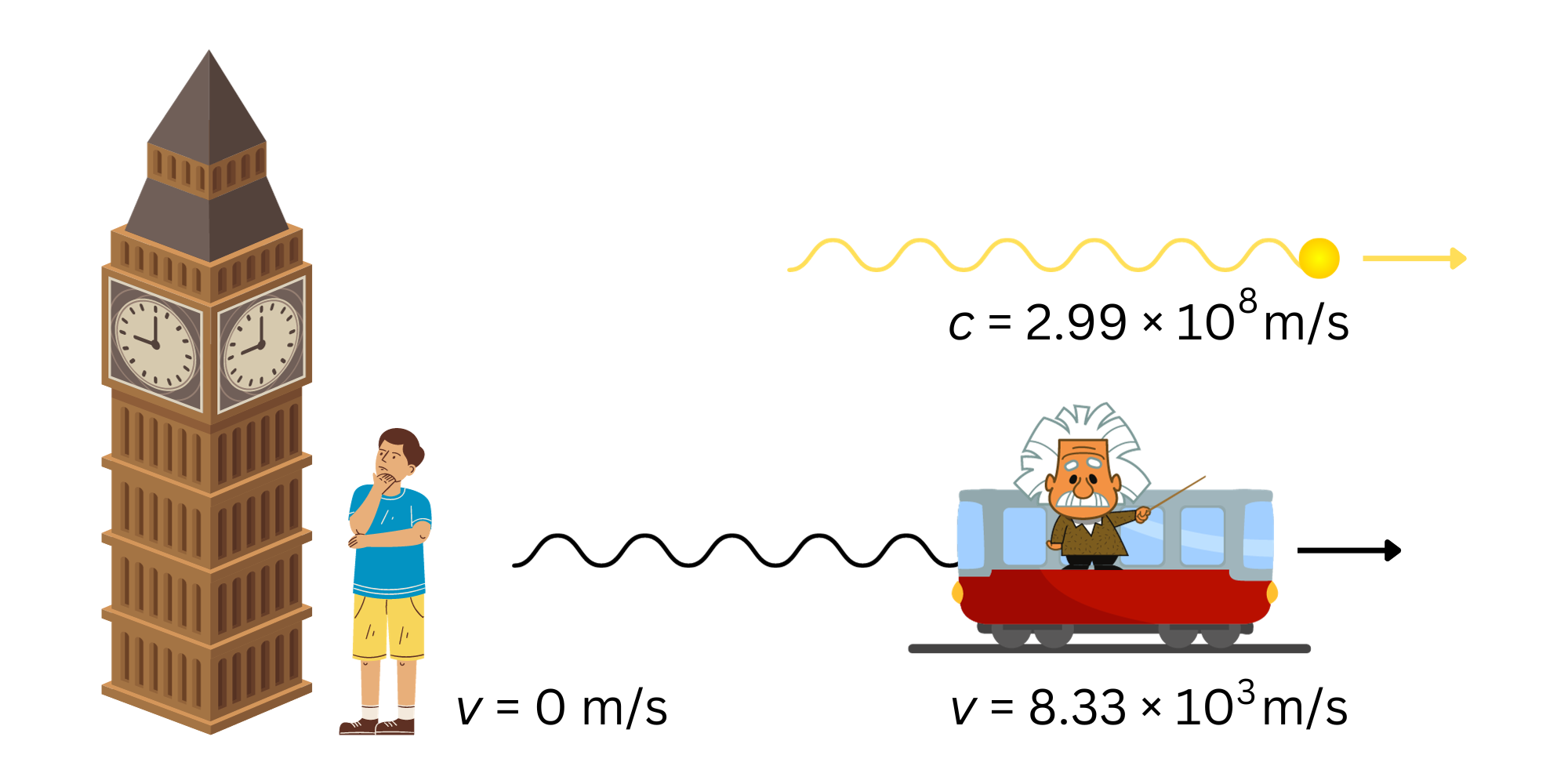
On a warm, sunny evening in the spring of 1905, the notorious Albert Einstein embarked on a fateful ride home. As his tramcar sped away from a turret clock in the distance, the theory of special relativity was born.
Einstein imagined that if the tram was to travel away from the clock near the speed of light (c), the clock’s hands would appear to slow down (Penshin, 2022). Consequently, time has slowed down in his perspective, yet back at the clock tower, a bystander would witness the clock ticking at its expected speed (Figure 1). The bystander’s perception of time remains unchanged; paradoxically, both perspectives are ‘correct.’

Contrary to popular belief, time isn’t a standard constant. Instead, it’s a dimension we travel through (Hale, 1993). Moving through space creates alterations in the flow of time, as the faster you move through physical space, the slower you move through time in relation to an object at rest (Storch and Zimmermann, 2019). This concept of time dilation is demonstrative of special relativity, an explanation of how speed can affect mass, time, and space (Stein, 2022).
Time dilation isn’t a myth, nor a convoluted mind game played by Einstein; it’s a theory that’s been demonstrated through real-world experiments. In 1971, physicist Joseph C. Hafele and astronomer Richard E. Keating flew two atomic clocks on planes around the planet in opposite directions, observing that relative motion caused nanoseconds worth of difference when they returned (Hafele and Keating, 1972). Time dilation is further supported by certain properties of physics, such as how faster-moving elementary particles take longer to decay (Easwar and MacIntire, 1991). Would physics then have to adjust depending on the observer’s speed and perspective?
The short answer is yes, but first, let’s return to the speed of light. Following Einstein’s equation of relativity, (E = mc2), the speed of light plays a huge role in defining the relationship between energy and matter. As an object approaches c, its mass becomes infinitely large, as does the energy required to move it. Thus, it’s impossible for anything to surpass c, a theoretical speed limit of the universe (American Museum of Natural History, n.d.). Physically, the effects of relativity start to manifest at around 1/10 the speed of light (Hale, 1993), so while us commonfolk with our feet on the ground won’t feel the effects of time dilation, it is able to influence human engineering. For instance, global positioning systems (GPS) rely on three or more satellites orbiting Earth (Figure 2). These satellites use fast-moving atomic clocks, so similar to the Keating-Hafele experiments, they tick an extra 7 microseconds each day. Therefore, GPS is designed to lose 7 microseconds per day to ensure our timely navigation (Stein, 2022). It’s not just GPS either, our understanding of special relativity has advanced nuclear energy, electromagnetism, space exploration, and more (Emspak and Mann, 2022; Mohon, 2020; Otto, 2022)!

Special relativity has taken our understanding of the universe on a wild ride, one at speeds even Einstein would find impressive. In fact, try it for yourself. The next time you find yourself late to class, say you were caught in a time warp. After all, punctuality should be relative too, right?
Citations
American Museum of Natural History, n.d. Cosmic Speed Limit. [online] Available at: <https://www.amnh.org/exhibitions/einstein/light/cosmic-speed-limit> [Accessed 22 September 2023].
Canva, 2023. [online] Available at <https://canva.com> [Accessed 23 Sep. 2023].
Easwar, N. & MacIntire, D. A., 1991. Study of the effect of relativistic time dilation on cosmic ray muon flux—An undergraduate modern physics experiment. American Journal of Physics. 59(7), pp.589–592.
Emspak, J. and Mann, A., 2022. 8 ways you can see Einstein’s theory of relativity in Real life. [online] Available at: <https://www.livescience.com/58245-theory-of-relativity-in-real-life.html> [Accessed 22 Sep. 2023].
Federal Aviation Administration, 2022. Satellite Navigation – GPS – How It Works. [online] Available at: <https://www.faa.gov/about/office_org/headquarters_offices/ato/service_units/techops/navservices/gnss/gps/howitworks> [Accessed 24 Sep. 2023].
Hafele, J. C. & Keating, R. E., 1972. Around-the-world atomic clocks: Predicted relativistic time gains. Science . 177(4044), 166–168.
Hale, C. S., 1993. Time dimensions and the subjective experience of time. The Journal of Humanistic Psychology. 33(1), 88–105.
Mohon, L., 2020. Einstein’s theory of relativity, vital for GPS, seen in Distant stars. [online] NASA. Available at: <https://www.nasa.gov/mission_pages/chandra/images/einstein-s-theory-of-relativity-critical-for-gps-seen-in-distant-stars.html> [Accessed 22 Sep. 2023].
Otto, H., 2022. Nuclear fusion research and development need new relativistic mass and energy corrections given by the information relativity theory. Journal of Applied Mathematics and Physics. 10(5), 1813-1836.
Peshin, A., 2022. Time dilation: Why does gravity slow down the flow of time? [online] ScienceABC. Available at: <https://www.scienceabc.com/nature/universe/time-dilation-why-does-gravity-slow-down-the-flow-of-time.html> [Accessed 22 September 2023].
Stein, V., 2022. Einstein’s Theory of Special Relativity. [online] Available at: <https://www.space.com/36273-theory-special-relativity.html> [Accessed 22 September 2023].
Storch, D. & Zimmermann, E., 2019. The effect of space on subjective time is mediated by apparent velocity. Journal of Vision. 19(14), 19–19.