In April 1815, the dormant volcano Tambora in Indonesia suddenly erupted with the largest force recorded in human history. Within 24 hours, about 40-50 km³ dense rock equivalent (DRE) of pyroclastic material was ejected out, instantly killing thousands of people living on Sumbawa (Self et al. 1984). To put this into context, the Krakatau eruption in 1883 was considered to be the second most powerful recorded eruption produced about 12.5 km³ DRE and lowered global temperatures by 0.6℃ for months (Gardner et al. 2013). With an eruption about 3-4 times stronger, Tambora had long-lasting impacts on not only the environment, but also psychology and culture.
The reason for the massive eruption was because of a sealed magma chamber 1.5-4.5 km below the surface (Foden 1986). Over time, the magma cooled and crystalized, separating out into a high-pressure aqueous fluid phase. Mount Tambora had a long period of inactivity prior to the eruption, which allowed pressure to build up to 4-5 kbar, which is equivalent to about 4,000-5,000 times the atmospheric pressure (Foden 1986). Eventually, the pressure became too much and the roof of the magma chamber cracked and failed. The vapour phase blasted out of the chamber at nearly 650 m/s, which is almost twice the speed of sound, and released about 30,000 megatons of TNT (Foden 1986). About 60 million tons of sulfur entered the atmosphere and turned into tiny particles called sulfate aerosols that formed a veil in the atmosphere (Figure 1) (Oppenheimer 2003).
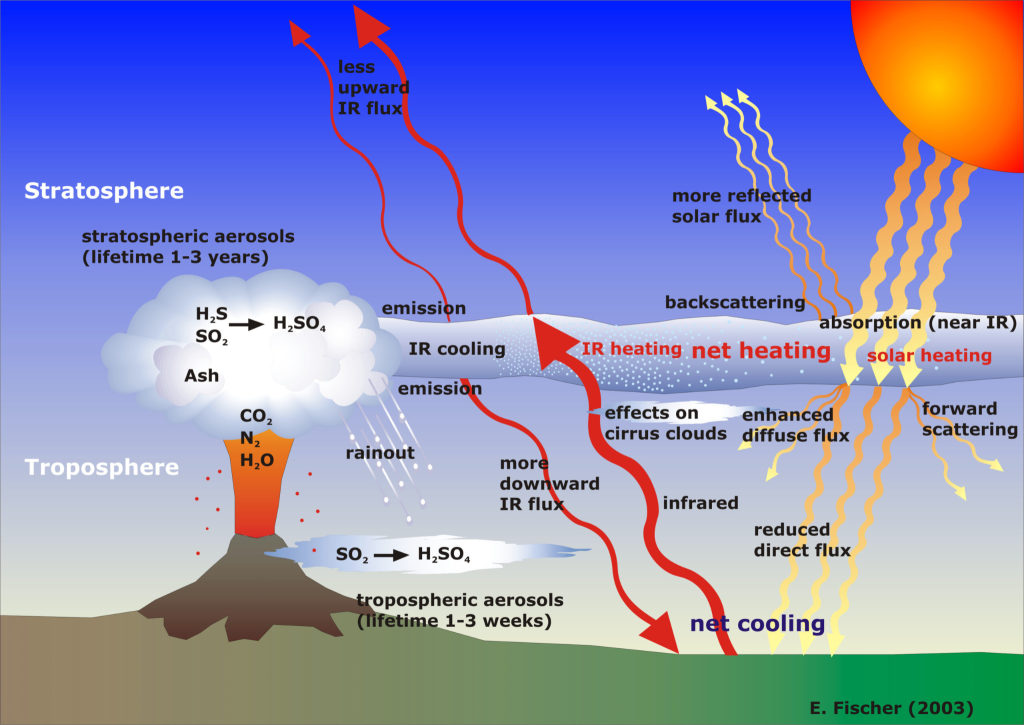
Figure 1: The schematic of the eruption of Mount Tambora as it created a layer of sulfur aerosols in the atmosphere. This layer of ash reflected incoming solar radiation and trapped heat. This led to a prolonged decrease in global climate temperatures as the ground received less heat and sunlight (Fischer 2003).
Solar radiation was shielded for the following three years, leading to what was known as the “Year without a Summer” in 1816. The Tropics and Northern Hemisphere experienced about 0.4-0.8°C more annual cooling compared to the previous 30 years (Raible et al. 2016). This resulted in crops failing, leading to food shortages and famines across regions such as China, North America, and Europe. Food prices spiked, pushing people into poverty and caused national distress. Food insecurity heightened collective anxiety and introduced apocalyptic interpretations as people fell further into despair. Painters such as William Turner captured vivid red sunsets intensified by volcanic aerosols, called volcanic sunsets (Figure 2) (Zerefos et al. 2007).
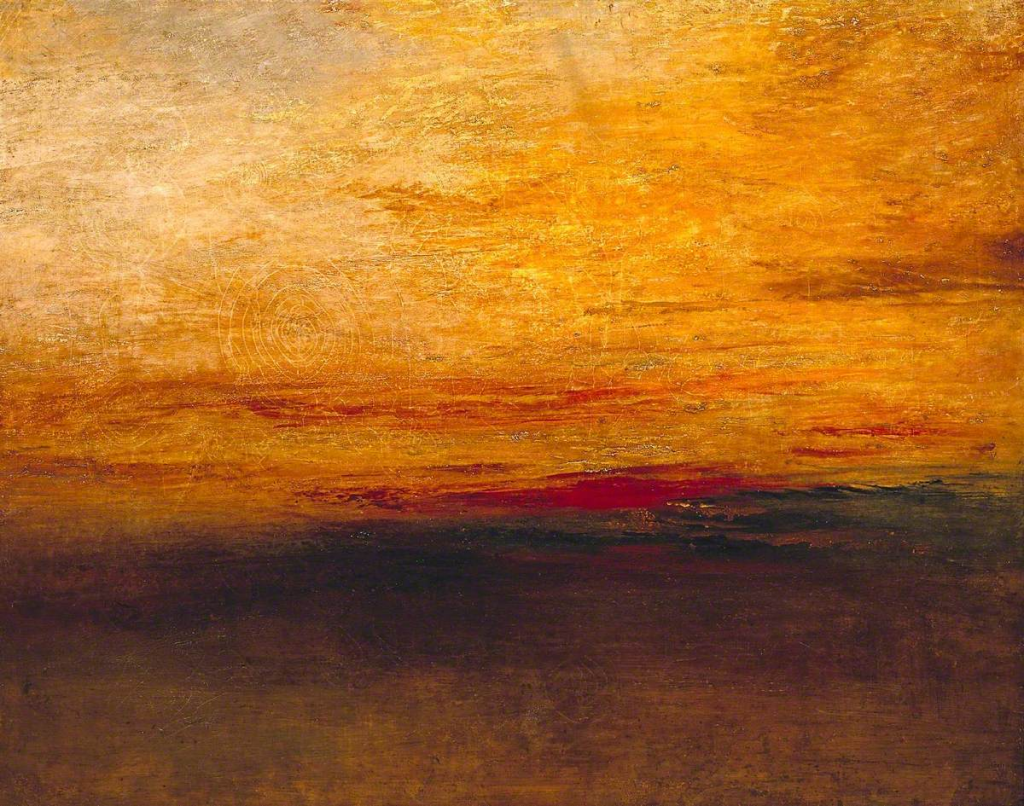
Figure 2: William Turner’s painting of volcanic sunsets caused by the Tambora eruption. It shows how geophysical events can function as psychological stressors and are embedded into visual culture (Zerefos et al. 2007).
The persistent gloom, described as apocalyptic skies and unnatural cold, may have also indirectly shaped the creation of one of literature’s most famous horror stories. Mary Shelley’s Frankenstein was conceived due to the circumstances that occurred in 1816 (Nelson 2024). Frankenstein is a novel steeped in themes of unnatural creation, existential dread, and the power of uncontrollable forces. The torrential rains and gloomy skies during summer of 1816 confined Mary Shelley and a few other writers indoors at Villa Diodati on Lake Geneva in Switzerland, which inspired the writing of Frankenstein (Nelson 2024). Coupled with the rise of romanticism at the time, the Tambora eruption made nature seem overwhelming and destructive. Although Mary Shelley was unaware that the poor climate was caused by the eruption of Tambora, the aftereffects of perpetual rain and wind likely impacted her psyche (Nelson 2024). The Tambora eruption demonstrates how environmental disasters are not just physical phenomena but also have significant effects on psychological and cultural responses.
References
Fischer, Erich. 2003. Schematic Diagram of Volcanic Inputs. https://iacweb.ethz.ch/staff/fischer/volcanic.html.
Foden, J. 1986. “The Petrology of Tambora Volcano, Indonesia: A Model for the 1815 Eruption.” Journal of Volcanology and Geothermal Research 27 (1-2): 1–41. https://doi.org/10.1016/0377-0273(86)90079-x.
Gardner, M. F., V. R. Troll, J. A. Gamble, R. Gertisser, G. L. Hart, R. M. Ellam, C. Harris, and J. A. Wolff. 2012. “Crustal Differentiation Processes at Krakatau Volcano, Indonesia.” Journal of Petrology 54 (1): 149–82. https://doi.org/10.1093/petrology/egs066.
Nelson, Taylin. 2024. “Climate Disaster, Ecoanxiety, and Frankenstein: Mount Tambora and Its Aftereffects.” Environment & Society Portal. June 20, 2024. https://www.environmentandsociety.org/arcadia/climate-disaster-ecoanxiety-and-frankenstein-mount-tambora-and-its-aftereffects.
Oppenheimer, Clive. 2003. “Climatic, Environmental and Human Consequences of the Largest Known Historic Eruption: Tambora Volcano (Indonesia) 1815.” Progress in Physical Geography: Earth and Environment 27 (2): 230–59. https://doi.org/10.1191/0309133303pp379ra.
Raible, Christoph C., Stefan Brönnimann, Renate Auchmann, Philip Brohan, Thomas L. Frölicher, Hans-F. Graf, Phil Jones, et al. 2016. “Tambora 1815 as a Test Case for High Impact Volcanic Eruptions: Earth System Effects.” Wiley Interdisciplinary Reviews: Climate Change 7 (4): 569–89. https://doi.org/10.1002/wcc.407.
Self, S., M. R. Rampino, M. S. Newton, and J. A. Wolff. 1984. “Volcanological Study of the Great Tambora Eruption of 1815.” Geology 12 (11): 659. https://doi.org/10.1130/0091-7613(1984)12%3C659:vsotgt%3E2.0.co;2.
Zerefos, C. S., V. T. Gerogiannis, D. Balis, S. C. Zerefos, and A. Kazantzidis. 2007. “Atmospheric Effects of Volcanic Eruptions as Seen by Famous Artists and Depicted in Their Paintings.” Atmospheric Chemistry and Physics 7 (15): 4027–42. https://doi.org/10.5194/acp-7-4027-2007.


Leave a Reply
You must be logged in to post a comment.