The symbiosis between humans and ornamental or “domesticated” plants should be studied for insight regarding mutualism and the negative effects of exploitative relationships. Mutualism, as defined by modern ecological scientists, provides evolutionary fitness benefits and increases the likelihood of genetic transfer (Herre et al. 1999). Since the Neolithic period from around 8000 BC to 3000 BC, ornamental plants have induced positive behavioural responses in humans (Wilson, Kendal, and Moore 2016). Since these contributions to well-being and aesthetic value are less quantifiable and tangible than food production or medicinal uses, some dismiss the symbiotic relationship as illegitimate. However, recent research efforts have demonstrated tangible benefits, such as stress reduction, enhanced cognitive ability, and improved air quality in built environments. For example, increased proportions of green space in urban areas have been associated with lower age and sex standardized morbidity rates in large-scale studies, demonstrating a strong negative correlation between these two variables (Mitchell & Popham 2007; Maas et al. 2006). Plant efficacy in improving mental health has driven increased plant propagation and geographical dispersal by humans in return.
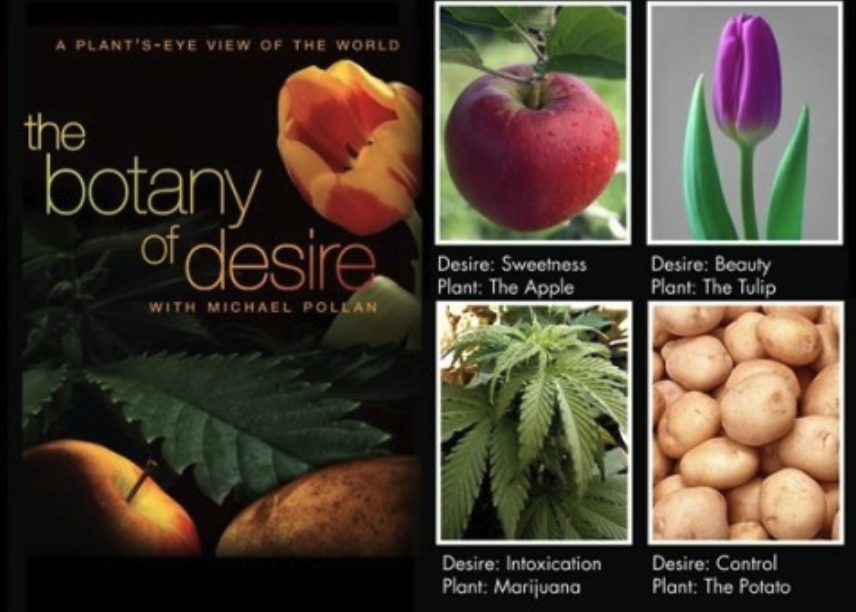
Michael Pollan’s book-turned documentary The Botany of Desire (2001) was the first to suggest that domesticated and/or ornamental species flourish by appealing to basic human cravings (Figure 1) (Pollan 2001).

Figure 1: Pollan’s The Botany of Desire (2001) discusses how four domesticated and/or ornamental plants—apples, tulips, marijuana, and potatoes—have flourished by appealing to four basic human cravings: sweetness, beauty, intoxication, and control, respectively. Pollan argues that these species should not be considered passive objects or classified in literature as “domesticated species.” This human-centric perspective erroneously places humans atop an ecological hierarchy where organismic value is dependent upon human utility. Compared to localization, these species improved their evolutionary fitness by enticing humans for global dispersal (Pollan 2001).
One genus Pollan discussed is Malus, referring to “domesticated” apples. The species Malus domestica became integral to the wellness of animals that consumed it, which improved both species’ fitness. For instance, the significance of herbivore and pest suppression for effective crop production by humans enhanced the reproductive ability of apples (Romero and Koricheva 2011). The shaping of genetic variance by human interest is evident from the grafting of apples to produce sweeter varieties. The association of cider with poor health fostered a dislike for bitter apples used in its production (Pollan 2001). Sugars were a reliable indicator of caloric density to effectively prevent starvation in hunter-gatherer cultures, explaining the natural human affinity to sweetness and supporting the mass production of sweet apples (Pollan 2001).
The negative costs of the symbiotic relationship between humans and ornamental plants, as highlighted in papers focusing on bioinvasion, cannot be neglected. Monocultural and selective breeding increases pest and disease susceptibility. Genetic diversity is consequently lost in local and heirloom varieties, which can have a bottom-up trophic cascade effect (Romero and Koricheva 2011). Increased pesticide reliance has additionally caused detrimental economic impacts. Moreover, some ornamental plants become reliant on human assistance for dispersal or reproduction. Examples include: the reduction of photosynthetic potential from foliage variegation and the development of double flowers, where the reproductive organs fail to develop and instead look like petals (Romero and Koricheva 2011). This can shift a human-plant relationship from facultative mutualism to obligate mutualism. The dominance of domesticated species can also increase resource competition (i.e. spatial and nutritional resources) with native species, disrupting ecosystems and diminishing habitat diversity.
Unfortunately, the belief that human interference reduces the authenticity of nature largely dominates scientific literature, limiting the study of ornamental plants to bioinvasion. As motivated by Pollan, conducting studies on the effects of domesticated or ornamental plants and urban green space on specific health outcomes is necessary. This could substantiate mental and physical health therapies, and inform biodiversity conservation and environmental health strategies.
Works Cited
Herre, E. A., N. Knowlton, U. G. Mueller, and S. A. Rehner. 1999. “The Evolution of Mutualisms: Exploring the Paths between Conflict and Cooperation.” Trends in Ecology & Evolution 14 (2): 49–53. https://doi.org/10.1016/s0169-5347(98)01529-8.
Maas, Jolanda, Robert A. Verheij, Peter P. Groenewegen, Sjerp de Vries, and Peter Spreeuwenberg. 2006. “Green Space, Urbanity, and Health: How Strong Is the Relation?” Journal of Epidemiology & Community Health 60 (7): 587–92. https://doi.org/10.1136/jech.2005.043125.
Mitchell, Richard, and Frank Popham. 2007. “Greenspace, Urbanity and Health: Relationships in England.” Journal of Epidemiology & Community Health 61 (8): 681–83. https://doi.org/10.1136/jech.2006.053553.
Pollan, Michael. 2001. The Botany of Desire: A Plant’s-Eye View of the World. New York: Random House.
Romero, Gustavo Q., and Julia Koricheva. 2011. “Contrasting Cascade Effects of Carnivores on Plant Fitness: A Meta-Analysis.” Journal of Animal Ecology 80 (3): 696–704. https://doi.org/10.1111/j.1365-2656.2011.01808.x.
Wilson, Anna, Dave Kendal, and Joslin L. Moore. 2016. “Humans and Ornamental Plants: A Mutualism?” Ecopsychology 8 (4): 257–63. https://doi.org/10.1089/eco.2015.0077.