When discussing climate change we often focus on the anthropic perspective. How will it affect humanity and our way of life? There is nothing objectively wrong with this perspective but it can often limit our understanding of how truly destructive climate change is. Recent research has shown that in the most biodiverse regions in the world there may soon be mass extinction events brought on by climate change (Holzmann et al. 2026). These biodiverse regions, typically found in the tropics, could see these extinctions occur due to the low thermal tolerance of these species.
To better examine the risk that climate change poses we can use insects as a strong study group. The variety of insect species and the wide range of their habits across tropical regions makes them a strong candidate for study (Holzmann et al. 2026). It is worthwhile here to note that we do not know the full extent of climate change and these models rely heavily on assumption of a 2-3℃ rise in global temperatures (Corlett 2012). With that caveat out of the way, let’s see how those bugs will fare.
Researchers set out to quantify the thermal tolerance of 2,300 insect species across Afrotropical Kenya and Neotropical Peru with various elevation gradients (Holzmann et al. 2026). Within these elevation gradients one of the most notable results was the vulnerability of species residing within tropical lowlands (Corlett 2012). This is the result of the fact that these areas are warming faster and are seeing greater extreme weather events compared to higher elevation regions. These changes put species at risk, which is further worsened by the fact that there are a greater number of species in the lower elevation regions. With these factors in mind there needed to be an effective way to measure thermal tolerance. Most insects have weak plasticity in these thermal limits, meaning they struggle to adapt to new thermal ranges (Weaving et al. 2022). Therefore, to examine thermal tolerance within these species researchers used protein melting temperatures as a proxy, to best understand the destructive force of this increased heat.
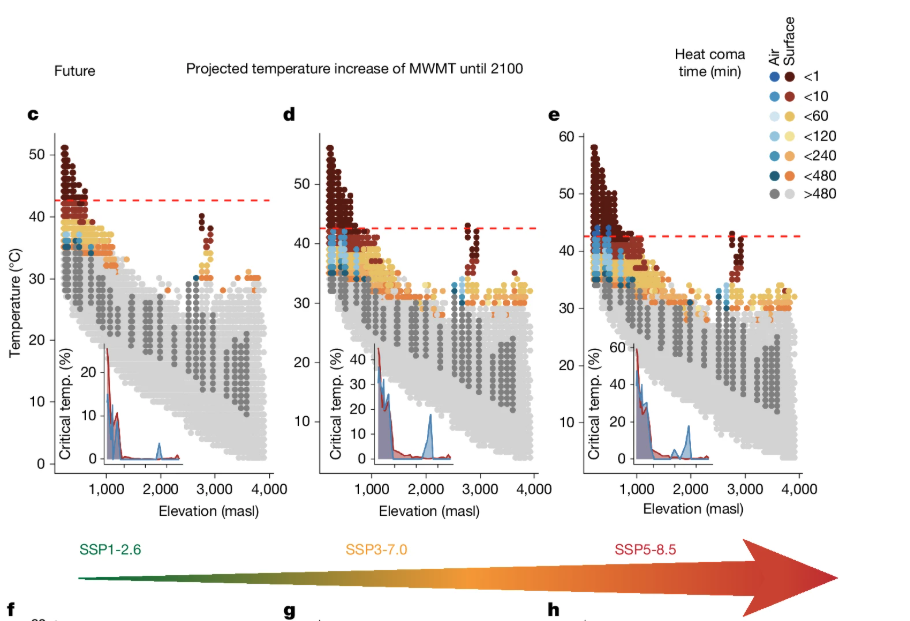
Figure 1: Above we see a figure depicting the speed at which species experience heat comas/substantial thermal injuries based upon mean warmest month temperature (MWMT). Below that are the various climate model projects ranging from a 1-8.5℃ increase. What we can see is how many species are vulnerable and that the vast majority will struggle in the near future (Holzmann et al. 2026).
Based upon the information within Figure 1, we can see that over 70% of species will experience some level of damage because of climate change. This is especially true for those in low elevation regions such as those tropical lowlands. We can clearly see here the threat climate change poses to all species moving forward. While it may be occasionally difficult to think of the importance of insects when compared to our own survival, the damage this mass extinction could cause is unfathomable. If we are to truly tackle climate change, it must not think only anthropically but take upon a perspective focused on the whole of Earth.
References
Corlett, Richard T. 2012. “Climate Change in the Tropics: The End of the World as We Know It?” Biological Conservation, ADVANCING ENVIRONMENTAL CONSERVATION: ESSAYS IN HONOR OF NAVJOT SODHI, vol. 151 (1): 22–25. https://doi.org/10.1016/j.biocon.2011.11.027.
Holzmann, Kim L., Thomas Schmitzer, Antonia Abels, et al. 2026. “Limited Thermal Tolerance in Tropical Insects and Its Genomic Signature.” Nature, March 4, 1–7. https://doi.org/10.1038/s41586-026-10155-w.
Weaving, Hester, John S. Terblanche, Patrice Pottier, and Sinead English. 2022. “Meta-Analysis Reveals Weak but Pervasive Plasticity in Insect Thermal Limits.” Nature Communications 13 (1): 5292. https://doi.org/10.1038/s41467-022-32953-2.


Leave a Reply
You must be logged in to post a comment.