Among the seven major amber deposits containing Cretaceous (145.5-66 Ma) fossils, Burmese amber (burmite) preserves the most diverse paleobiota (G. Shi et al. 2012). A total of 228 organism families have been identified in burmite, compared to 68-125 families recorded in the other six Cretaceous deposits (G. Shi et al. 2012). Burmite has been particularly important in the studies of Cretaceous insect biota, as soft-bodied flying insects are less likely preserved in sedimentary rocks (Grimaldi et al. 2002). Despite the growing number of publications based on Burmese ambers, increasing ethical issues have been raised on the trade and research of these fossils, as many are mined in regions affected by armed conflict and associated human rights issues (Dunne et al. 2022). By examining the situation in Myanmar, an important societal question regarding scientific research emerges: “When is science worth it?”
The Burmese deposit formed roughly 99 Ma on the Burma Terrane, which broke off from Gondwana and later collided with the Asian Plate (Wood and Wunderlich 2023). Although several geological factors contribute to the abundance of amber fossils in this region, the recent increase in burmite-based research stems from the fact that the Burmese deposit is the only amber deposit in the world currently being exploited commercially (G. Shi et al. 2012). Much of amber mining in Myanmar occurs in Kachin State, a region that has experienced high levels of conflict since the 1960s between the Kachin Independence Army (KIA) and the Tatmadaw, the Myanmar government military force (Figure 1; Dunne et al. 2022).
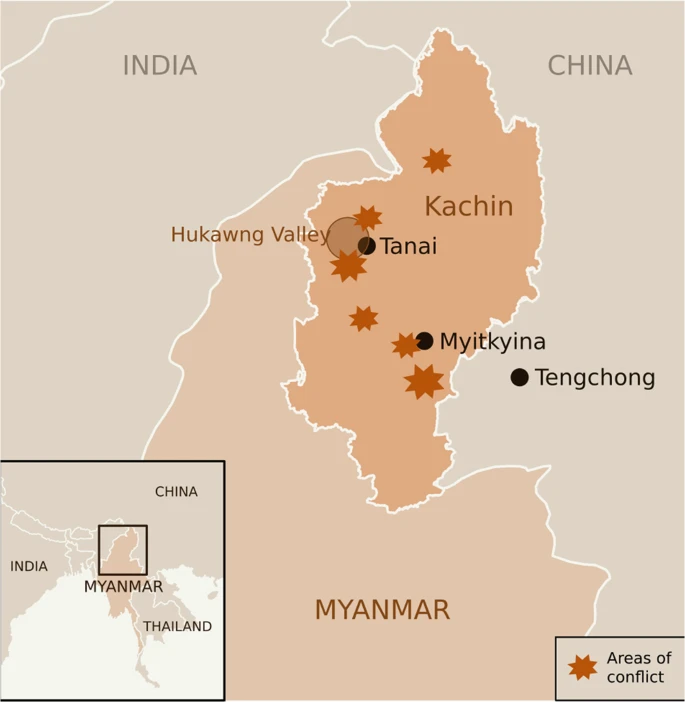
Figure 1.Map showing the location of Hukawng Valley, where most amber mines are situated in Northern Myanmar (Dunne et al. 2022). Major areas of conflict are denoted in star icons, and shown are the major amber trading cities of Myitkyina in Myanmar, and Tengchong in China.
The central ethical issue surrounding the trade of burmite concerns the use of profits from the amber mining industry to fund military activities by both the KIA and Tatmadaw, through both illegal and legal trading routes (Imran 2022). Numerous human rights violations have been reported such as displacement of civilians, forced labour, and even death related to both armed conflict and hazardous mining conditions (OHCHR 2019). Following a surge of burmite-based publications since 2014, the Society of Vertebrate Paleontology (SVP) issued a letter urging for a moratorium on the use of fossil specimens purchased from Myanmar sources after the Myanmar military began armed efforts to seize control of the Kachin’s amber mines (Figure 2; Reyfield et al. 2020).
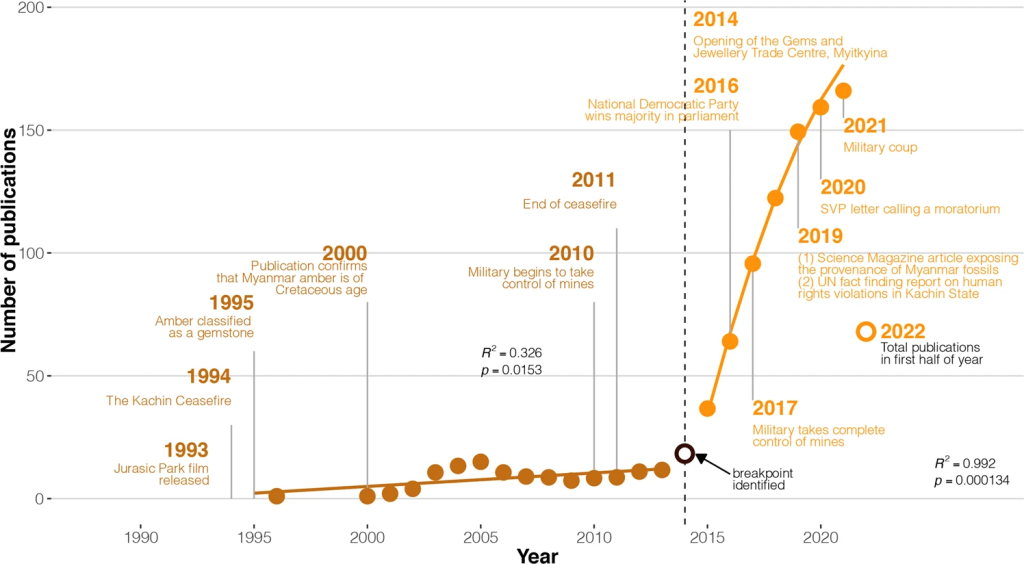
Figure 2.Temporal trends of number of publications involving burmite based on a 3-year rolling average, with major political and military events in Myanmar described (Dunne et al. 2022). During the first period before the identified break point in 2014, the number of publications remained relatively low but still demonstrated an increase over time. After 2014, a rapid increase in the number of publications was observed.
Due to the recent advancements in Cretaceous life studies using burmite, researchers have conflicting opinions on the moratorium request. For instance, responding to the SVP, Shi and his colleagues argued that the scientific community should focus more on the value of the 100-million-year-old amber found in Kachin, instead of “outright international bans and a politically biased treatment of specimens of different derivation” (C. Shi et al. 2021).
Ultimately, amber fossils in Myanmar represent an ongoing complex ethical balance between the human rights issues associated with amber mining and the considerable scientific value of the fossils recovered from these deposits. Although opposing viewpoints exist, it is essential that researchers carefully consider the ethical implications of working with these fossils to ensure that scientific progress does not come at the expense of human rights.
References
Dunne, Emma M., Nussaïbah B. Raja, Paul P. Stewens, Zin-Maung-Maung-Thein, and Khin Zaw. 2022. “Ethics, Law, and Politics in Palaeontological Research: The Case of Myanmar Amber.” Communications Biology 5 (1): 1023. https://doi.org/10.1038/s42003-022-03847-2.
Grimaldi, David A., Michael S. Engel, and Paul C. Nascimbene. 2002. Fossiliferous Cretaceous Amber from Myanmar (Burma) : Its Rediscovery, Biotic Diversity, and Paleontological Significance. American Museum Novitates ; No. 3361. (New York). http://hdl.handle.net/2246/2914.
Imran, Khaled. 2022. “Until the World Shatters: Truth, Lies, and the Looting of Myanmar: Daniel Combs. Melville House, Brooklyn, NY, 2021. Pp. Xv + 400. Maps. Notes. Bibliog. Index. Hb. $28.99. ISBN 978-1-61219-887-3.” Asian Affairs 53 (1): 258–59. https://doi.org/10.1080/03068374.2022.2029193.
OHCHR. 2020. Economic Interests of the Myanmar Military (. United Nations Human Rights Council. https://www.ohchr.org/en/hr-bodies/hrc/myanmar-ffm/economic-interests-myanmar-military.
Reyfield, Emily, Jessica Theodor, and David Polly. 2020. “Fossils from Conflict Zones and Reproducibility of Fossil-Based Scientific Data.” April 21. https://vertpaleo.org/wp-content/uploads/2021/01/SVP-Letter-to-Editors-FINAL.pdf.
Shi, Chao, Hao-hong Cai, Ri-xin Jiang, et al. 2021. “Balance Scientific and Ethical Concerns to Achieve a Nuanced Perspective on ‘Blood Amber.’” Nature Ecology & Evolution 5 (6): 705–6. https://doi.org/10.1038/s41559-021-01479-z.
Shi, Guanghai, David A. Grimaldi, George E. Harlow, et al. 2012. “Age Constraint on Burmese Amber Based on U–Pb Dating of Zircons.” Cretaceous Research 37 (October): 155–63. https://doi.org/10.1016/j.cretres.2012.03.014.
Wood, Hannah M., and Jörg Wunderlich. 2023. “Burma Terrane Amber Fauna Shows Connections to Gondwana and Transported Gondwanan Lineages to the Northern Hemisphere (Araneae: Palpimanoidea).” Systematic Biology 72 (6): 1233–46. https://doi.org/10.1093/sysbio/syad047.

Leave a Reply
You must be logged in to post a comment.