Have you ever been entirely sure that something occurred, only to later find out it never truly happened? Many people may think that a memory is like our own inner camera, recording everything that happens and storing it for future recollection. In contrast, our memories are rather a reconstruction, where our brains piece events together to form bits of information (Newman and Lindsay 2009). To do this, our brains may reshape memories to help fit our own personal story, which can introduce errors. These false memories occur in specific parts of the brain, which are the hippocampus, and the prefrontal cortex (Straube 2012).
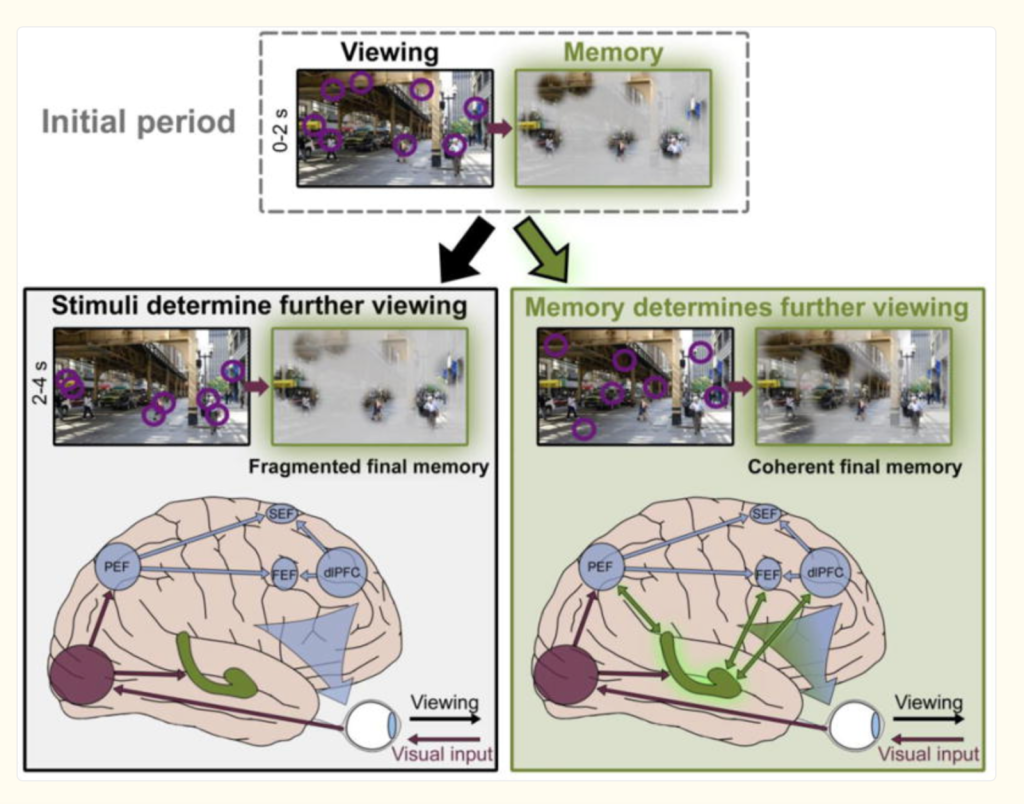
The hippocampus is the location in the brain where memories are stored (Burgess et al. 2002; Straube 2012). It helps us remember important personal experiences by building a mental representation of the memory, as seen in Figure 1. The anterior hippocampus is involved with bigger concepts of memories, whereas the exterior is involved with scenery details and spatial layout of memories. When recalling a memory, there are two things that determine how much the hippocampus needs to work. One aspect is the open-ended nature of memory, like remembering a childhood story, and another is the significant role of perception in memory. Increased mental constitution demands more work from the hippocampus, which may result in mistakes (Sheldon and Levine 2016; Straube 2012).
A memory is not a perfect recording of reality, but rather your brain taking in information, storing it, and rebuilding it for later (Straube 2012). There are three stages of memory reconstruction where false memories occur. The first stage is encoding, which is when you first experience something. During this stage, your brain is recording what you see. If it does not record it perfectly, then false memories can form. Self-referential encoding is a type of encoding where you might recall something because it resonates with you personally, even if it’s not factually accurate. Spreading activation encoding also occurs when your brain links related ideas together. The second stage is consolidation, which occurs when a memory is stored. Your brain stabilizes and stores memories over time, especially when you sleep. Overtime, the exact details of the memory may start to fade away. Misinformation encountered now could blend with facts, altering details of the memory. The third and final stage is retrieval, which is when you finally recall the memory. At this stage, the brain reconstructs the memory again. Before retrieval, the brain is supposed to check if the memory actually occurred, if you imagined it, or if someone else gave you misinformation. The part of the brain that is needed at this step is the prefrontal cortex. If the prefrontal cortex does not catch this error, a false memory is produced (Straube 2012).
In conclusion, although all memories feel true, some of them may be false. The production of false memories goes to show that the human memory is not a flawless recording, but rather a reconstruction of events that happened, sometimes allowing the brain to fill in the gaps where details are missing (Newman and Lindsay 2009). Understanding the mechanism behind memory reconstruction can help us understand why some of our most vivid memories may not always reflect reality (Newman and Lindsay 2009; Straube 2012).
References
Burgess, Neil, Eleanor A. Maguire, and John O’Keefe. 2002. “The Human Hippocampus and Spatial and Episodic Memory.” Neuron 35 (4): 625–41. https://doi.org/10.1016/S0896-6273(02)00830-9.
Newman, Eryn J., and D. Stephen Lindsay. 2009. “False Memories: What the Hell Are They For?” Applied Cognitive Psychology 23 (8): 1105–21. https://doi.org/10.1002/acp.1613.
Sheldon, Signy, and Brian Levine. 2016. “The Role of the Hippocampus in Memory and Mental Construction.” Annals of the New York Academy of Sciences 1369 (1): 76–92. https://doi.org/10.1111/nyas.13006.
Straube, Benjamin. 2012. “An Overview of the Neuro-Cognitive Processes Involved in the Encoding, Consolidation, and Retrieval of True and False Memories.” Behavioral and Brain Functions 8 (1): 35. https://doi.org/10.1186/1744-9081-8-35.
Voss, Joel L., Donna J. Bridge, Neal J. Cohen, and John A. Walker. 2017. “A Closer Look at the Hippocampus and Memory.” Trends in Cognitive Sciences 21 (8): 577–88. https://doi.org/10.1016/j.tics.2017.05.008.


Leave a Reply
You must be logged in to post a comment.