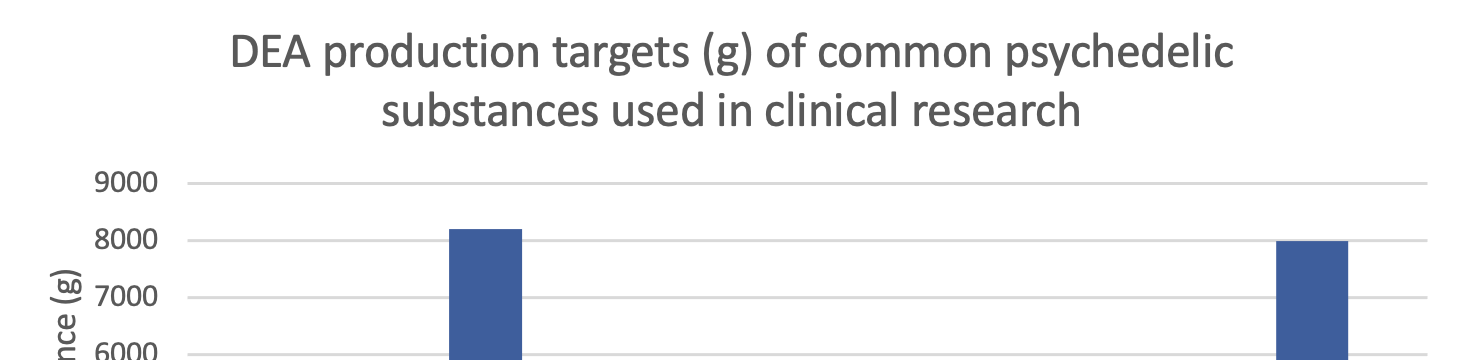
The U.S. Drug Enforcement Administration (DEA) projects the legal synthesis of 8200 grams of MDMA (ecstasy) in 2022, from 50 grams in 2021 (Figure 1) (DEA, 2020; 2021). This increase has led to the proposal of new synthetic pathways for the manufacturing of this drug, but the environmental impacts of these syntheses have not been adequately considered. The Multidisciplinary Association for Psychedelic Studies (MAPS) is on track for approval of MDMA for the treatment of PTSD from the Food and Drug Administration (FDA) next year, showing 67% efficacy in phase III clinical trials (Mitchell et al., 2021; Ali, 2021). MAPS will receive data exclusivity for at least five years, during which they will be establishing industry best practices for MDMA production (Blossom Analysis, 2019). The rapid rise of popular interest in psychedelics has led to extreme scrutiny of the organization. MAPS published a synthesis from catechol as feedstock, which was criticized by media outlets including Hausfeld (2020) for being petroleum derived.

Catechol, or 1,2-dihydroxybenzene, is a common raw material used in the production of pesticides and drugs (Upadhyay and Lali, 2022). It is synthesized from phenol, which is derived largely from petroleum (Figure 2) (Weber, Weber and Weber, 2020). The paper by Nair et al. (2022) does not address sustainability, but this is typical practice in organic chemistry, where proposed synthetic routes are not expected to address environmental impacts.

Historically, MDMA has been illicitly synthesized from plant-derived safrole, with the primary source being the Cinnamomum camphora tree, located in the Cambodian Cardamom Mountains (Figure 3) (Csiernik, 2021). The mass felling of C. camphora has depleted its population and affected the mountain biome, which supports > 60 threatened species (Kemprai et al., 2020). Nearby oil distillation plants use streams as a water source and pollute the flood plain with oil leaks that are toxic to frogs and fish. These impacts may be mitigated if sassafras oil is grown legally in a regulated market (Schmidt, 2016).

In the synthesis of drugs, which are carbon-based compounds, a choice usually must be made between a petroleum-derived precursor or a natural product extract. It is important to consider the benefits and drawbacks of either option. Even though using a naturally sourced material may seem better to those who are environmentally minded, it can result in unintended harms to the local biota. Future decisions about the synthesis of pharmaceutical MDMA should carefully consider the environmental impacts of all options, such as new technologies like Upadhyay and Lali’s (2021) paper using genetically modified bacteria to synthesize cachetol.
The sustainability of MDMA synthesis has not been assessed, as clandestine chemistry focuses solely on immediate profits and has thus prevented a thorough assessment of environmental impacts. A new precedent should be set in chemistry journals to include a sustainability assessment about chemical sourcing, waste products, and alternative routes, modelled after journals such as Green Chemistry and ACS Sustainable Chemistry and Engineering (Jessop, 2020; Subramaniam et al., 2021). Researchers with an interdisciplinary understanding of how chemistry relates to the world around us should support this.
References
Ali, I.L., 2021. Expert: MDMA for the Treatment of PTSD May Be FDA-Approved by the End of 2023. [online] Available at: <https://www.pharmacytimes.com/view/expert-mdma-for-the-treatment-of-ptsd-may-be-fda-approved-by-the-end-of-2023> [Accessed 3 Feb. 2022].
Blossom Analysis, 2019. Intellectual Property. Blossom. Available at: <https://blossomanalysis.com/ip/> [Accessed 3 Feb. 2022].
Csiernik, R., 2021. Substance Use and Misuse. 3rd ed. Canadian Scholars.
DEA, 2020. Established Aggregate Production Quotas for Schedule I and II Controlled Substances and Assessment of Annual Needs for the List I Chemicals Ephedrine, Pseudoephedrine, and Phenylpropanolamine for 2021. [online] Federal Register. Available at: <https://www.federalregister.gov/documents/2020/11/30/2020-26289/established-aggregate-production-quotas-for-schedule-i-and-ii-controlled-substances-and-assessment> [Accessed 3 Feb. 2022].
DEA, 2021. Established Aggregate Production Quotas for Schedule I and II Controlled Substances and Assessment of Annual Needs for the List I Chemicals Ephedrine, Pseudoephedrine, and Phenylpropanolamine for 2022. [online] Federal Register. Available at: <https://www.federalregister.gov/documents/2021/12/02/2021-26227/established-aggregate-production-quotas-for-schedule-i-and-ii-controlled-substances-and-assessment> [Accessed 3 Feb. 2022].
Hausfeld, R., 2020. Forget Plant-Based Medicine, MDMA is Now Made From Crude Oil. [online] Psymposia. Available at: <https://www.psymposia.com/magazine/mdma-crude-oil/> [Accessed 3 Feb. 2022].
Jessop, P., 2020. Editorial: Evidence of a significant advance in green chemistry. Green Chemistry, 22(1), pp.13–15. https://doi.org/10.1039/C9GC90119A.
Kemprai, P., Protim Mahanta, B., Sut, D., Barman, R., Banik, D., Lal, M., Proteem Saikia, S. and Haldar, S., 2020. Review on safrole: identity shift of the ‘candy shop’ aroma to a carcinogen and deforester. Flavour and Fragrance Journal, 35(1), pp.5–23. https://doi.org/10.1002/ffj.3521.
Massyn, A., 2006. Cinnamomum camphorum. Available at: <https://commons.wikimedia.org/wiki/File:Cinnamomum_camphorum.JPG> [Accessed 10 February 2022].
Mitchell, J.M., Bogenschutz, M., Lilienstein, A., Harrison, C., Kleiman, S., Parker-Guilbert, K., Ot’alora G., M., Garas, W., Paleos, C., Gorman, I., Nicholas, C., Mithoefer, M., Carlin, S., Poulter, B., Mithoefer, A., Quevedo, S., Wells, G., Klaire, S.S., van der Kolk, B., Tzarfaty, K., Amiaz, R., Worthy, R., Shannon, S., Woolley, J.D., Marta, C., Gelfand, Y., Hapke, E., Amar, S., Wallach, Y., Brown, R., Hamilton, S., Wang, J.B., Coker, A., Matthews, R., de Boer, A., Yazar-Klosinski, B., Emerson, A. and Doblin, R., 2021. MDMA-assisted therapy for severe PTSD: a randomized, double-blind, placebo-controlled phase 3 study. Nature Medicine, 27(6), pp.1025–1033. https://doi.org/10.1038/s41591-021-01336-3.
Nair, J.B., Hakes, L., Yazar-Klosinski, B. and Paisner, K., 2022. Fully Validated, Multi-Kilogram cGMP Synthesis of MDMA. ACS Omega, 7(1), pp.900–907. https://doi.org/10.1021/acsomega.1c05520.
PubChem, 2022a. 3,4-Methylenedioxymethamphetamine. [online] Available at: <https://pubchem.ncbi.nlm.nih.gov/compound/1615> [Accessed 9 February 2022].
PubChem, 2022b. Catechol. [online] Available at: <https://pubchem.ncbi.nlm.nih.gov/compound/289> [Accessed 9 February 2022].
PubChem, 2022c. Phenol. [online] Available at: <https://pubchem.ncbi.nlm.nih.gov/compound/996> [Accessed 9 February 2022].
Schmidt, B.M., 2016. Regulatory and Quality Issues with the Essential Oils Supply Chain. In: Medicinal and Aromatic Crops: Production, Phytochemistry, and Utilization, ACS Symposium Series. [online] American Chemical Society.pp.27–48. https://doi.org/10.1021/bk-2016-1218.ch003.
Subramaniam, B., Licence, P., Moores, A. and Allen, D.T., 2021. Shaping Effective Practices for Incorporating Sustainability Assessment in Manuscripts Submitted to ACS Sustainable Chemistry & Engineering: An Initiative by the Editors. ACS Sustainable Chemistry & Engineering, 9(11), pp.3977–3978. https://doi.org/10.1021/acssuschemeng.1c01511.
Upadhyay, P. and Lali, A., 2022. Engineered Pseudomonas putida for biosynthesis of catechol from lignin-derived model compounds and biomass hydrolysate. Preparative Biochemistry & Biotechnology, 52(1), pp.80–88. https://doi.org/10.1080/10826068.2021.1910960.
Weber, M., Weber, M. and Weber, V., 2020. Phenol. In: Ullmann’s Encyclopedia of Industrial Chemistry. [online] John Wiley & Sons, Ltd.pp.1–20. https://doi.org/10.1002/14356007.a19_299.pub3.