Whether it is the sweet taste of ripe grapes or the dry flavour of crisp apples, often the first thought that comes to mind when considering champagne are the bubbles, that sparkling signature of facetiousness. What you might not think about is where champagne comes from and its production. What is really in a bottle of champagne and how did this signature drink come to be?
The term champagne comes from the Latin term campania, which is used to describe the open countryside north of Rome (Robinson, 2006). Champagne gained popularity in the mid-to-late 18th century when workers began to replace breakfast with a glass of brandy or white wine (Phillips, 2000). At this point in time, only a few thousand bottles were produced, many of them breaking due to the pressure inside. Such ‘sparkling wines’, as scientists called them, sparkled because they had been trapped in a bottle before completely fermenting (Robinson, 2006). The goal then became to allow the wine to effervesce without provoking an explosion. In 1838, a professor named André François developed an instrument that was able to accurately measure the sugar content and determine the resulting bottle pressure (Bassett, 2017). As a result, over the 19th century, over 36 million bottles of champagne were produced in France (Phillips, 2000).
Effervescence: gas discharging from liquid in the form of bubbles (Liger-Belair, 2005).
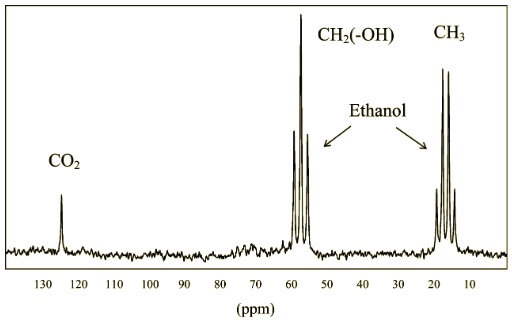
The quality of champagne is typically measured by the size of the bubbles produced in effervescence. Smaller bubbles are preferred over larger ones due to the amount of CO2 released (Khaireh et al., 2021). This can greatly impact the taste and mouth-feel for the consumer (Khaireh et al., 2021; Liger-Belair, 2005). To determine the amount of CO2 in a closed bottle of champagne, a 13C magnetic resonance spectroscopy (MRS) technique is employed. This method is nondestructive to the bottle or the wine, and it does not intrude upon the contents of the bottle (Liger-Belair, 2005). MRS detected three compounds in champagne, shown in Figure 1.

The ethanols do not exist with dissolved CO2 due to the pH of champagne, which is approximately 3.2 (Liger-Belair, 2005). Due to this relatively low pH, carbonated species would not coexist with CO2. When the bottle is uncorked, the liquid quickly attempts to regain equilibrium. For a classic champagne flute of ~0.1 L, approximately 0.6 L of CO2 bubbles escape from it for the champagne to return to equilibrium (Liger-Belair, 2005).
Each bubble is approximately 500 μm in diameter, indicating that approximately 10 million bubbles escape your champagne once in the flute (Liger-Belair, 2005). Considering that a champagne bottle is approximately 6 atm, or six times more pressurized than the pressure outside (Phillips, 2000), aren’t you glad champagne bottles are thick-walled with deep punts (Figure 2)?

While champagne is certainly an enticing drink for many, it did not come without its problems. Quite literally, the bottles were explosions waiting to happen. The pressure was on for a solution, and due to the fabulous minds of scientists, everyone can enjoy their bubbly with the right amount of bubbles, sparkles, and pop!
Works Cited
Basset, G., 2017., Know-it-all wine: the 50 essential topics, each explained in under a minute. Wellfleet Press.
Khalreh, M. A., Angot, M., Cilindre, C., Liger-Belair, G., 2021. Unveiling carbon dioxide and ethanol diffusion in carbonated water-ethanol mixtures by molecular dynamics simulations. Molecules, 26, 1711. Available at: 10.3390/molecules26061711 [Accessed on 12 November, 2021].
Liger-Belair, G., 2005. The physics and chemistry behind the bubbling properties of champagne and sparkling wines: a state-of-the-art review. Journal of Agricultural and Food Chemistry, 53(8), 2788-2802. Available at: 10.1021/jf048259e [Accessed on 11 November, 2021].
Lytle-Barnett, 2020. The Anatomy of Lytle-Barnett Sparkling Wine Bottles. Available at: https://lytle-barnett.com/blog/PRODUCTION/The-Anatomy-of-Lytle-Barnett-Sparkling-Wine-Bottles [Accessed 20 November, 2021].
Phillips, R., 2000. A Short History of Wine. New York: Ecco.
Robinson, J., 2006. The Oxford Companion to Wine. Oxford; New York: Oxford University Press.
Comments
17 Responses to “Champagne Problems: The Challenge of Effervescence”
Hello iSci!
I thought it would be fun to write about champagne as I thought about what actually happens inside of the bottle. This topic is pertinent to the Wine Science project, though I integrated some chemistry and physics concepts with the spectroscopy technique, as well as some history of science to provide you with some context. It was interesting to research those tiny little bubbles as it turns out they have a great impact on the product! I hope you enjoy reading.
Best,
Aoife H
Hello Aoife,
This was an interesting post, very captivating and a unique topic! I liked that you covered both the history of champagne and its creation as well as the science behind it. Great work. Here are a few notes to consider as you begin your editing process:
1) In your first sentence, I think you should specify that most people think of the rising bubbles as opposed to saying that everyone thinks of that. Consider: “When you think of champagne, most people think of the bubbles that rise, that sparking signature of facetiousness.” I would also consider clarifying the last sentence on that paragraph to read “What is truly in a champagne bottle?”
2) This is a personal preference, but I think you should integrate the definition into the paragraph instead of separating it.
3) I think you should add “of these sparling wines” to the end of the sentence in you second paragraphs that starts with “In 1838…”. In that same paragraph, the last sentence feels disconnected. What is the connection between the 36 million bottles produced and Francois instrument? Consider adding more of a transition between the sentences (i.e., “As a result of Francois invention, over the 19th…”)
4) Is the graph supposed to have a y-axis?
5) In your fourth paragraph, the sentences “The ethanols do not exist with dissolved CO2 due to the pH of champagne, which is approximately 3.2 (Liger-Belair, 2005). Due to this relatively low pH, carbonated species would not coexist with CO2” feel a bit redundant of one another. Consider re-working the second half of the second sentence (underlined) to explain why low pH doesn’t allow these to coexist.
I loved your conclusion! It was the perfect ending and wrapped up the post on such a great and captivating note! Overall great work and I can’t wait to read your final draft.
Happy Editing,
Sarah
Hi Sarah!
Thank you for reading! I appreciate the feedback. I will fix my first figure to account for the y-axis. I don’t know if I will have the word count to expand upon my point with pH, but it does allow me to look into literature a little more. I’ll also consider reworking the second paragraph to help with flow.
Thanks!
Hey Aoife,
I hope you are doing well 🙂 I really enjoyed your blog post and thought the topic was interesting as we just researched so much about wine, however, my group did not investigate champagne at all! I had a few suggestions while I was reading that I thought may help during your editing stage.
I would rework the opening sentence slightly to draw the reader in more. Perhaps “Whether it’s the sweet taste of ripe grapes or the dry flavor of crisp apples, often the first thought that comes to mind when considering champagne is the sparkling bubbles that rise throughout your glass.” Or something along these lines. I feel like it may create more of a visual image when reading the introduction. I would also expand of the “What’s in a bottle?” sentence, perhaps by writing “What is really in a bottle of champagne, and how did this signature drink come to be?”
Also, you might consider explaining the image in your figure caption more for those who do not know MRS. If not in the caption, maybe you can add a sentence after “MRS technique was employed.” Just to explain the method and how it is used to detect compounds in the champagne.
You seem to touch on history and chemistry in this blog post which is great! Consider adding in a small part of another discipline to really expand the transdisciplinary approach.
I hope some of these suggestions help while you are editing! Please let me know if you have any questions about my points.
Happy editing,
Madie M.
Hi Madie!
Thank you for your comment! I really appreciate your helpful points. I enjoy the way you reworded the introduction – I’ll definitely play around with the wording and see what works best. If my word count allows, I will try to add some more interdisciplinary foci! Thanks again!
Hi Aoife,
Great work on this post! I found it very interesting how the amount and size of bubbles affects the quality of a champagne. Here are a few suggestions:
-When describing the figure in paragraph three, consider changing the word “species” to “compounds” for clarity.
-Consider explaining the last sentence of paragraph four in a bit more depth. does 0.6 L of CO2 escape from 0.1 L of champagne?
-The figure caption should be italicized.
-Try to get at least one more peer reviewed citation.
-I liked the tone of the piece throughout; questioning the readers is a great way to keep them engaged!
Again great work and happy editing.
Cheers,
Joey
Hi Joey!
Thank you for reading and leaving such great comments. I will definitely work to clear those things up with the amount of CO2 that leaves the bottle. As for the formatting, thank you for pointing that out. I will fix those!
Thanks!
Hi Aoife,
This was a wonderfully written blog post on a super relevant and interesting subject! I also loved the title and your vocabulary throughout. This was overall a fantastic read! Just a few suggestions:
1) As Madie mentioned, I would consider rewording the first sentence slightly just to flow a bit more smoothly. I loved the “sparkling signature of facetiousness” part, I just think that it feels a tad disconnected to the start of the sentence so perhaps rephrasing slightly as Madie mentioned would help this pull in the reader.
2) In the second paragraph, I found the second sentence a tad confusing with the explanation of brandy and white wine becoming breakfast food instead of explicitly mentioning champagne’s connection to these two beverages. Is there a way to clearly draw the connection to champagne here instead of just mentioning the other drinks?
3) In the third paragraph, I think that “their indication of” part could be omitted and instead just connect directly to the explanation of CO2 being released.
4) I’m a bit confused by the second sentence of the 4th paragraph- is this saying the same information as the first sentence, or introducing a new explanation? If you have the word count, elaborating on this slightly would be lovely!
5) This is just an observation but I loved the rich vocabulary throughout, especially in the first and final paragraphs. It made this a very enticing and entertaining read!
I hope that these suggestions help you out, and look forward to reading the final product!
Happy editing,
Taren
Hi Taren!
Thank you for your lovely comment! I will rework some of the content (word count permitting!) to improve the overall flow and voice of my post. Adding in some background would benefit the reader a lot.
Thank you!
Hi Aoife,
I really enjoyed reading this post! Like Taren and Joey, I enjoyed the vocabulary and the tone used throughout. I just have a couple of suggestions:
1. In the fourth sentence of your third paragraph, I would edit the sentence so that it reads “… a 13C magnetic resonance spectroscopy (MRS) technique [is] employed” just because it seems like you are referring to this as a technique as opposed to a process in a study.
2. I think it would be beneficial to add a transition sentence between the fourth and fifth paragraph. I think that they both have interesting ideas and themes, but they read a little disjointed from one another.
I hope my suggestions are useful – happy editing!
Cynthia
Hi Cynthia,
Thank you for your suggestions! I’ll be sure to reword that sentence about the MRS technique. Adding a transition sentence would definitely help to connect paragraphs four and five, so I will do that!
Thanks!
Hello Aoife!
I really enjoyed the writing and content in this post. You have a very natural way of writing that allows the reader to become fully immersed and interested in what you have to say. I especially liked how you highlighted the definition of “effervescence”, this was a really nice way to break up the text! I have a couple of suggestions that I hope will help in your editing:
1. I absolutely love your use of the word “facetiousness” I think it elevates the tone of the writing. In order to maintain this tone consistently, I would consider rewording the last sentence in your introduction to say something like “What truly is in a bottle?” or “What really goes into a bottle?”
2. In your second paragraph, you say that workers were replacing breakfast with alcohol. It may be helpful to include a brief statement about why this was the case, was it the French Revolution or something else?
3. If it is not too much extra work, it might be interesting to include a figure after your fifth paragraph of a champagne bottle that explains the anatomy you write about. This way the reader can visualize the “thick walls and deep punts”.
Overall this post was truly a unique piece of writing that taught me a lot about the history and modality of champagne! I also love that you changed the colour pallet of your headers and highlights to more of a gold-tone, this was a really nice touch. Excellent work as usual!
Cheers,
Madi
Hi Madi!
Thank you for reading! Your comment was really helpful. I will look at rewording my introduction so that the eloquent feeling flows through better. I’ll also add a figure to help describe the anatomy of the champagne bottle! That’s a really great idea.
Thanks!
Hi,
I enjoyed your post and found it informative, just a few suggestions to improve it:
1. I enjoyed your hook but I’m not sure if facetiousness is the right word, frivolousness may work better for your post.
2. I really liked how you added a small glossary, I found that helpful
3. A bit more explanation for your figure 1 may be helpful as I’m unsure what exactly is being measured with no y-axis
Hope this helps,
Nyah D.
Hi Nyah!
Thank you for reading and responding. I appreciate it. I will take your edits into account. I will look at adding a y-axis to the graph and adjusting the figure caption to reflect that. Thank you for your suggestions 🙂
Hi Aoife,
This was honestly such an interesting post to read and I was intrigued from start to finish! I particularly likes how elegantly you wrote everything, trying to retain the fancy and high-class connotations associated with Champaign. Here are a few suggestions I had to elevate your post further:
1. Consider adding another figure! I really liked the current figure you added, but the post still feels a bit bare, and another figure, perhaps pertaining to the effervescence of the win, to make the post more complete.
2. Although the current figure you provided is very helpful, I noticed that it lacked a title or y-axis. I’m not too familiar with this sort of graph, so I could be completely off-base, but perhaps look into if any more detailed images are available!
3. In the second sentence of your last paragraph, you mention “Quite literally, they were explosions waiting to happen”, but I just wanted to ask if you meant to write “there” rather than “they”? If you did mean to write “they”, perhaps consider writing the word “bottles” or “champagne bottles”
Overall, your article was extremely well written, and I really enjoyed getting to learn more about champagne and how it’s created!
-Erin :^)
Hi Erin!
Thank you for reading. I am glad you enjoyed. I will add a title and axes to my figure. Your perspective on that helps a lot! Further, I will look at that sentence you mentioned and see what I can do for revision.
Thanks!