There is something unsettling about how easy it is to destroy a world. Not a planet in the cosmic sense, but a world: a complex web of life, history, and memory. When I first learned about the Great Dying, the event 252 million years ago that wiped out 90 percent of life on Earth, I felt a strange sense of recognition (Chu 2011). A sudden collapse, ecosystems unravelling, one catastrophe setting off the next. It felt less like ancient history and more like a pattern. Human history has its own collapses: genocide, conquest, and environmental destruction. This blog explores how Earth’s mass extinctions echo our own worst actions, and what that connection means now.
The end-Permian extinction was the worst the planet has ever seen. About 90 percent of all life disappeared in a geological instant (Chu 2011). Fossil layers show a dramatic line between abundance and silence. Scientists link this collapse to massive volcanic eruptions in Siberia that released greenhouse gases into the atmosphere. Oceans lost oxygen, temperatures soared, and ecosystems crumbled (Chu 2011). Geochemical records show the Permian carbon spike unfolded nearly as fast as our current emissions. Nature’s disaster played out over thousands of years. Ours is happening in just decades. But even then, life rebounded. New lineages emerged. The cycle of collapse and renewal repeated with each major extinction. And it is beginning again, with humans at the center (University of Hawaiʻi 2022).
Our species has its own record of collapse. Between 1492 and 1600, war, famine, and disease reduced the Indigenous population of the Americas from about 60 million to just 6 million: a 90 percent loss (UCL News 2019). The forest regrowth that followed this die-off pulled enough carbon from the atmosphere to cool the climate. The cause wasn’t an asteroid or supervolcano, but colonialism and contagion. A human shock wave transformed ecosystems and societies across a continent.
Today, we are continuing to push life toward the brink. Deforestation, overfishing, and fossil fuel use are causing rapid biodiversity loss. Scientists now describe this as a sixth mass extinction, caused by us (Cowie et al. 2022). Even once-common species are vanishing in what some call a biological annihilation (Ceballos and Ehrlich 2015). This collapse is not sudden, but slow and sprawling, built from thousands of everyday actions.
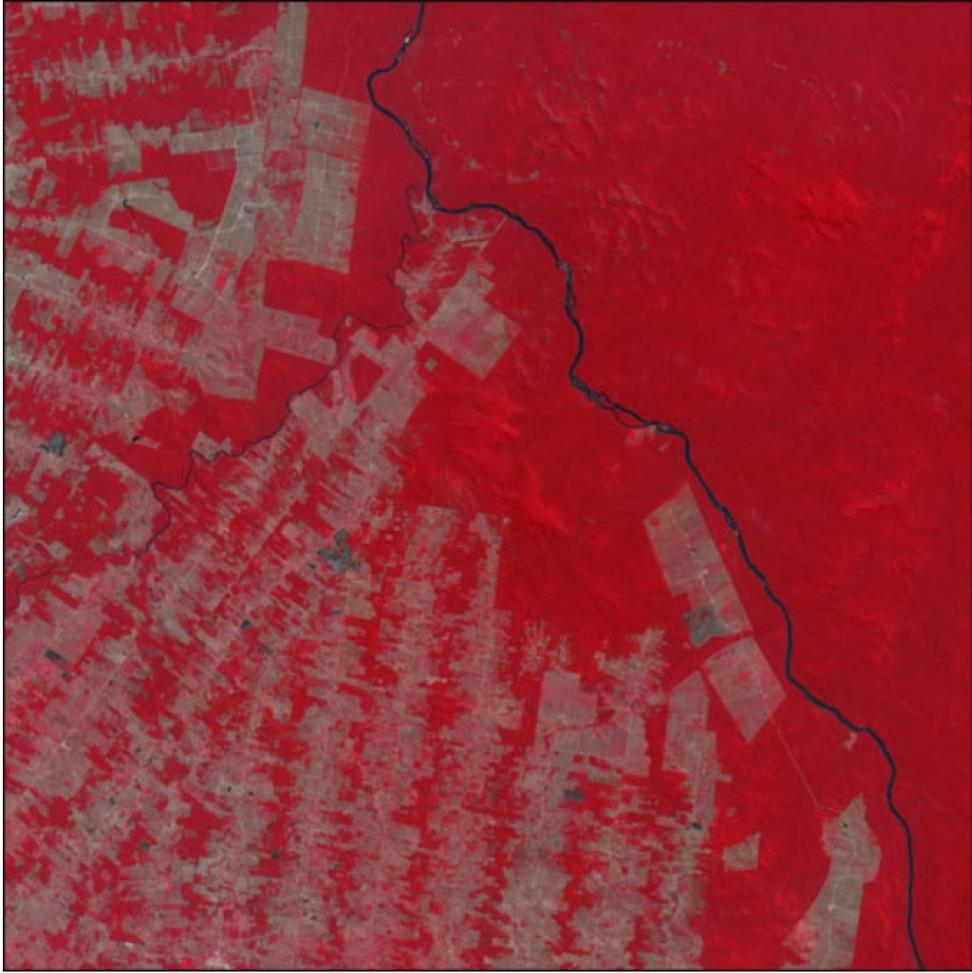
Figure 1. Satellite imagery shows ongoing deforestation in the Amazon Basin. The geometric patterns carved into the forest reflect large-scale habitat loss, echoing the ecosystem disruptions seen in past mass extinctions (Naranjo 2020).
Figure 1 shows satellite imagery of deforestation in the Amazon. The geometric bite marks carved into the forest resemble the kind of habitat loss seen in past extinction events. These patterns reflect not just destruction, but fragmentation: smaller ecosystems, fewer connections, more risk (Naranjo 2020).
But unlike volcanoes or asteroids, this crisis is something we can stop. Nature does not choose to destroy. We do. And if our tragedies echo ancient ones, then we have the rare chance to break the pattern. The fossil record shows how life has suffered and recovered. The question now is whether we will learn in time to protect what remains.
References
Ceballos, Gerardo, and Paul R. Ehrlich. 2015. “The Annihilation of Nature: Human Extinction of Birds and Mammals.” The Royal Society Publishing. https://www.researchgate.net/publication/282199805_The_Annihilation_of_Nature_Human_Extinction_of_Birds_and_Mammals
Chu, Jennifer. 2011. “Timeline of a Mass Extinction.” MIT News, November 18, 2011. https://news.mit.edu/2011/mass-extinction-1118.
Cowie, Robert H., Philippe Bouchet, and Benoît Fontaine. 2022. “The Sixth Mass Extinction: Fact, Fiction or Speculation?” Biological Reviews 97 (2): 640–63. https://doi.org/10.1111/brv.12816.
Naranjo, Laura. 2020. “A Rainforest Divided.” NASA Earthdata, July 21, 2020. https://www.earthdata.nasa.gov/news/feature-articles/rainforest-divided.
University of Hawaiʻi. 2022. “Earth on Trajectory to Sixth Mass Extinction Say Biologists.” University of Hawaiʻi News, January 14, 2022. https://www.hawaii.edu/news/2022/01/14/6th-mass-extinction-progress/.
UCL News. 2019. “‘Great Dying’ in Americas Disturbed Earth’s Climate.” University College London, February 1, 2019. https://www.ucl.ac.uk/news/2019/feb/great-dying-americas-disturbed-earths-climate.

Leave a Reply
You must be logged in to post a comment.