Humans have long been fascinated by flight. As a dominant terrestrial species, the notion of sustained suspension in the air has created a wonder that transcends both cultures and generations (Alexander, 2002). While the flight of birds has created an entire industry, from bird watching to backyard feeders (Tobalske, 2006), many other species have mastered aerial locomotion through other means: Gliding and controlled descent, not just a trait of flying squirrels, but also… flying salamanders.
Aneides vagrans, the wandering salamander, has an unusual habitat for an amphibian: it lives among the tallest trees on Earth in California’s Redwood Forest (Spickler et al., 2006). This habitat may seem odd, however, the fog that rolls in from the Pacific Ocean has created a moisture-rich haven that is ideal for the species. To quickly maneuver through this arboreal habitat, controlled descent has given the salamander a competitive advantage (Brown et al., 2022). While it was demonstrated that the species was reluctant to jump, it was nonetheless an efficient approach to descent in response to predatory cues. If the species began jumping to evade predation, there was likely a selection pressure towards those who could survive the fall by slowing down their descent and directing themselves to a lower branch (Brown et al., 2022).
So how does this phenomenon occur? It all comes down to physics and anatomy. By analyzing the salamanders in a wind tunnel, Brown et al. (2022) discovered that the species was able to control its pitch (side-to-side rotation), roll (front-to-back rotation), and yaw (rotation around the vertical axis). This allows them to right themselves while falling by creating a skydiving posture (Figure 1): a body angle of up to 39° and repeated movements of the tail and torso. This posture maximizes the frontal area and therefore increases drag, which reduces their falling velocity by up to 10% (Brown et al., 2022). Furthermore, by changing their body posture the salamander can create a descent angle of 5-6° (Figure 2) (Lentink, 2022).

Figure 2: A free body diagram demonstrating the forces acting on a wandering salamander during free-fall. The salamander’s position allows it to control its lift-to-drag ratio which ultimately allows it to direct its motion forward by 5-6° (Lentink, 2022).
Other anatomical features that help the salamander are their long digits and large feet. These form a concave surface that further helps with drag and lift control (Holden et al., 2014; Brown et al., 2022). Their long limbs may also help increase torque as the feet are farther away from the center of their body.
Finally, it is important to analyze the salamander’s takeoff. There are two factors that make this species of salamander unique: they have two-footed takeoffs, and they have less lateral bending before their jump than other salamanders (Brown and Deban, 2020). It was reported that the two-footed takeoff allows the salamander to enter the skydiving posture more quickly and lower lateral bending reduces the amphibian’s takeoff velocity (Figure 2).
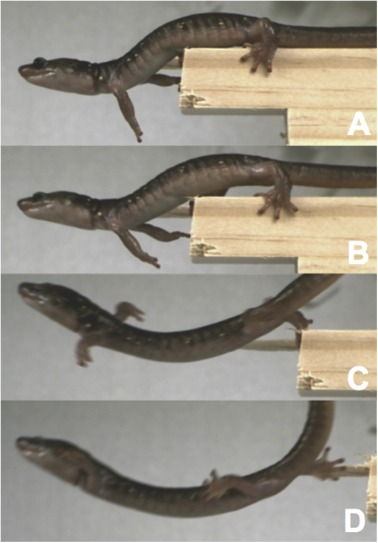
Figure 3: The wandering salamander’s jump. Sections A and B demonstrate a “toe-off” where the animal uses the vertical portion of the platform to push off from one front toe. Sections C and D demonstrate the final push-off from the back two legs, which allows for a quick transition to the skydiving posture. Finally, all sections of the figure demonstrate a lack of lateral trunk bending, which contributes to a reduced takeoff velocity (Brown and Deban, 2020).
This leaves us wondering if the wandering salamander will ever be able to truly fly away. As evolution has no means to plan ahead, we will likely never have a clear answer. However, by studying different species and populations we can better understand why they have evolved to their current morphology. Furthermore, we must analyze the selection pressures that they are currently facing in their habitat to better understand what could possibly improve their evolutionary fitness.
References
Alexander, D.E., 2002. Nature’s Flyers: Birds, Insects, and the Biomechanics of Flight. JHU Press.
Brown, C.E. and Deban, S.M., 2020. Jumping in arboreal salamanders: A possible tradeoff between takeoff velocity and in-air posture. Zoology, 138, p.125724. https://doi.org/10.1016/j.zool.2019.125724.
Brown, C.E., Sathe, E.A., Dudley, R. and Deban, S.M., 2022. Gliding and parachuting by arboreal salamanders. Current Biology, 32(10), pp.R453–R454. https://doi.org/10.1016/j.cub.2022.04.033.
Holden, D., Socha, J.J., Cardwell, N.D. and Vlachos, P.P., 2014. Aerodynamics of the flying snake Chrysopelea paradisi: how a bluff body cross-sectional shape contributes to gliding performance. Journal of Experimental Biology, 217(3), pp.382–394. https://doi.org/10.1242/jeb.090902.
Lentink, D., 2022. How wingless salamanders fly. Nature, 606(7913), pp.251–252. https://doi.org/10.1038/d41586-022-01375-x.
Spickler, J.C., Sillett, S.C., Marks, S.B. and Jr, H.H.W., 2006. Evidence of a new niche for a North American salamander: Aneides vagrans residing in the canopy of old-growth redwood forest. Herpetological Conservation and Biology, Vol. 1(1): 16-27. [online] Available at: <http://www.fs.usda.gov/treesearch/pubs/25045> [Accessed 26 September 2022].
Tobalske, B.W., 2006. FLIGHT OF FASCINATION: Avian Flight. Journal of Experimental Biology, 209(11), pp.2005–2006. https://doi.org/10.1242/jeb.02229.
Comments
9 Responses to “Fly Away Little Salamander”
Hi iSci!
I worked with salamanders this summer as a park discovery ranger and found the creatures fascinating! However, I realized that certain species are even more interesting than the ones we have here. I loved learning about how interdisciplinary the study of animal flight is, and I found it related to first-year physics, life sciences, as well as PAIx. Thank you for taking the time to read my post, I appreciate all of your feedback!
All the best,
Teagan
Hey Teagan! I really love the topic that you picked for your blog! I also really enjoyed the perspectives of physics and biology you brought to light throughout your post! The figures you included were not only adorable, but also enhanced the understanding of the topic. Here are a few suggestions on edits that you can make to your post:
– In the second paragraph, where you introduce and discuss the habitat of these salamanders, you mention that this aspect of flight is useful to them because of the arboreal habitat they live in and to avoid predation. I think that you could expand on those two uses of flight for the salamanders. It will make the idea feel thorough and have a purpose.
– The first sentence of your last paragraph has much potential, however it feels a bit out of place. I think by saying to what extent these forest fires, logging and invasive species have impacted the salamanders by, whether this be endangering them or damaging resources vital for their survival, etc. It will be a great way to connect the sentence back to the topic!
– I love the last sentence of your post! It is a great way to close the post. I think one way to develop your post more, you could incorporate the evolution aspect you brought up in the last sentence. You could say why these salamanders evolved to have flight and what factors influenced it. It would be very stimulating to read about!
Ultimately, I truly appreciate the effort you put into your blog post! Having a topic to write about that you are passionate about, really shone through in your writing. Again, amazing work and I can’t wait to see the final draft!
Good luck in the editing stage!
Virginia 🙂
Hi Virginia,
Thank you so much for your detailed feedback! I expanded upon the evolutionary aspect in my second paragraph and changed my conclusion entirely to refocus it on evolution as well. I really appreciate your input.
Regards,
Teagan
Hi Teagan! Such an interesting topic, anything I learn about salamanders always amazes me. They really are the gift that keeps giving! In terms of your article, it was well written! The addition of the video of the salamander maneuvering its body to induce drag and lift forces was extremely helpful in demonstrating what you were writing about prior. The video definitely made the physics behind your topic clear to me; nice work! For your final draft, I do have some suggestions:
– Consider a re-worded conclusion. I was interested in the first part of it since it was urging the reader to take action to protect salamanders from threats. The ending however, lacked substance due to you explaining the multidisciplinary nature of your article. Consider starting off the paragraph with talking about the various scientific disciplines involved in this mechanism of salamanders, and then ending off with a call to action with a wider look at the threats salamanders face. It will leave readers feeling a stronger connection to salamanders.
– In your second paragraph, you mention that “controlled descent” gives the salamander a competitive advantage. Personally, I would find it very interesting for you to elaborate. In terms of evolution and natural selection (salamanders have been around since dinosaurs), how does the flying salamander reign supreme within its environment? Answering this would further connect scientific disciplines in order to explain the survival rate of flying salamanders.
– Vary your media: as an example, if you can find one, consider a mathematical-anatomy image explaining the flight of a salamander. Right now, you have two media attachments showing basically the same thing, just in different formats. I feel adding a diagram would strongly enforce the physics behind flight.
Overall, great post and topic selection. Good luck with your editing!
Jyot.
Hello Jyot,
Thank you for all of your suggestions! I agree with everyone regarding my conclusion and have changed it to better encompass my post. I have also added some detail to the evolution section in the second paragraph. Finally, I understand your thoughts regarding my media, and I have added a mathematical diagram per your suggestion. However, I will be leaving both original pieces of media as although they are similar, one is portraying the free fall, and the other is portraying the jump. Once again, thank you so much!
– Teagan
Hi Teagan,
Great post! This was super interesting and I loved the inclusion of the video. I also thought that your intro was very good, it really grabbed my attention and made me want to learn more about this “new” flying creature.
– in the second paragraph I think if you re-word ” it lives in the treetops of California’s Redwood Forest, the tallest trees on Earth” to something like “it lives among the tallest trees on Earth in California’s Redwood Forest” I think this is just a bit less repetitive and flows a bit better.
– I would suggest moving where you refer to Figure 1 to right before the colon in the sentence so as to not interrupt the flow of the sentence.
– I think you could add a bit more detail in the Figure 2 caption. Perhaps refer to each panel from A-D, describing each position and its importance to how the salamander is able to glide. I also noticed that the front limbs of the salamander shoot out from the body, so maybe you can touch on why that’s helpful to gliding.
– I thought your concluding paragraph was very interesting, however it felt a bit out of place. I know you talked about the salamander’s habitat a bit early on in your post, so consider adding a bit more about how it is important so the reader can really connect the topic to the ending.
Overall amazing job and I can’t wait to read your final edits.
Hi Maia,
I really appreciate you taking the time to read and respond to my post. I have incorporated your wording in my second paragraph and fixed my error regarding the location of Figure 1. I also added some extra explanation to my second figure caption, hopefully it is clearer now. Finally, I have completely revamped my conclusion as there was a consensus in my comments that it was a bit weak.
Thanks again,
Teagan
My dear Teagan,
To think I almost let this blog post pass me by! This is excellent content, and I enjoyed reading it to myself in the voice of a stereotypical male British nature documentary host. I have a few detail-focused edits for you to consider:
1. The (Tobalske, 2006) in the last sentence of the first paragraph seems oddly placed, and I’m not able to tell which part(s) of the sentence is/are referenced. If you want to cite the portion about the industry inspired by birdflight, put this citation after ‘backyard feeders”. If you want to cite the portion about controlled descent of flying squirrels and salamanders, put it at the end of the sentence. If you really mean to cite just the bit about how “many other species have mastered aerial locomotion through other means”, for instance if Tobalske provides a comprehensive list of non-avian species capable of aerial locomotion, leave it as is. I just wanted to let you know how I would interpret each of these cases so you can make an informed choice and clear it up for readers.
2. Since the word “habitat” is used several times in short succession in the second paragraph, I would change one instance of this word to something else. I also felt that the part “as it is rich in moisture” seemed a little awkwardly tacked on to the end of its sentence. Therefore, I would consider rewording “This habitat may seem odd, however the fog that rolls in from the Pacific Ocean has created an entire habitat that is ideal for the species as it is rich in moisture.” to >> “This habitat may seem odd, however the fog that rolls in from the Pacific Ocean has created a moisture-rich haven ideal for the species.” to resolve both of these.
3. “However” is unecessary at beginning of the next sentence, in my opinion.
4. The section “Other anatomical features that help the wandering salamander are their long limbs and digits as well as their large feet. These large feet and long toes form a concave surface which also aids drag and lift” could be combined into one sentence to avoid repetition. Try: >> “Other anatomical features that help the wandering salamander are their long digits and large feet, which form a concave surface contributing to drag and lift control.” Then leave the last sentence as is.
5. The phrase “they have less lateral bending before their jump” prompts me to ask, less than what? I infer that you mean less than other salamanders, but if that’s what you mean I would make this explicit by writing “less lateral bending before their jump than average salamanders”. Alternatively, replace the word “less” with “minimal” so that you don’t have to make a direct comparison.
6. I agree with previous commenters that the last sentence sets up an expectation of more information. I would either choose to elaborate on anthropogenic selective pressures on the salamanders or don’t mention them so explicitly in the conclusion, and save this topic for a future piece.
I’m truly impressed by this post, Teagan – I think it’s my favourite of yours that I’ve read so far. The flow is outstanding throughout most of the piece, so I hope that these little edits will help you put the cherry on top. See you next time!
-maya
Hello Maya!
Thank you for all your kind words! You are totally right with my Tobalske citation, I have placed it after the bird economy section. I also edited both of the sentences with poor wording, I really appreciate you taking the time to help me out with them. With regards to the lateral bending, I have clarified that it is compared to other salamanders. Finally, I was suspicious about my last sentence myself, I am glad you pointed it out. I have changed it to be more general.
You’re the best,
Teagan