In 2021, the world lost over 25 million hectares of tree cover—roughly the size of the United Kingdom (Global Forest Watch, 2023). While forest loss due to urbanization and agriculture will likely never be replenished, there is some hope for the 14 million hectares lost to wildfires and forestry. Through tree planting, we can regenerate our forests and therefore increase biodiversity and carbon sequestration (Xiao et al., 2015). However, it is no secret that this is an extremely arduous and time-consuming task. In order to make substantial reforestation progress, we must scale up our efforts using innovative science and technology. This is where seed-firing drones and self-drilling seed carriers come into play.
Aerial seeding has been common practice since the 1950s, when helicopters and small planes were used for forest regeneration (Elliott, Gale and Robertson, 2020). This method is effective as it can quickly disperse seeds, covering large and inaccessible areas; however, it is expensive and resource intensive (Luo et al., 2023). To combat these issues, seed-firing drones are now used because they are cheap to purchase and operate, and they are able to fly beneath existing vegetation (Liu et al., 2021). Unfortunately, the effectiveness of aerial seeding with both of these methods is variable because most seeds will fall into hostile microsites—locations that have harsh sunlight, wind, predators, as well as undesirable air temperatures and humidities (Castro et al., 2023; Luo et al., 2023). As such, aerial seeding suffers from low germination rates, causing many experts to claim that successful forest restoration is not as simple as dropping seeds from the air (Castro et al., 2023).
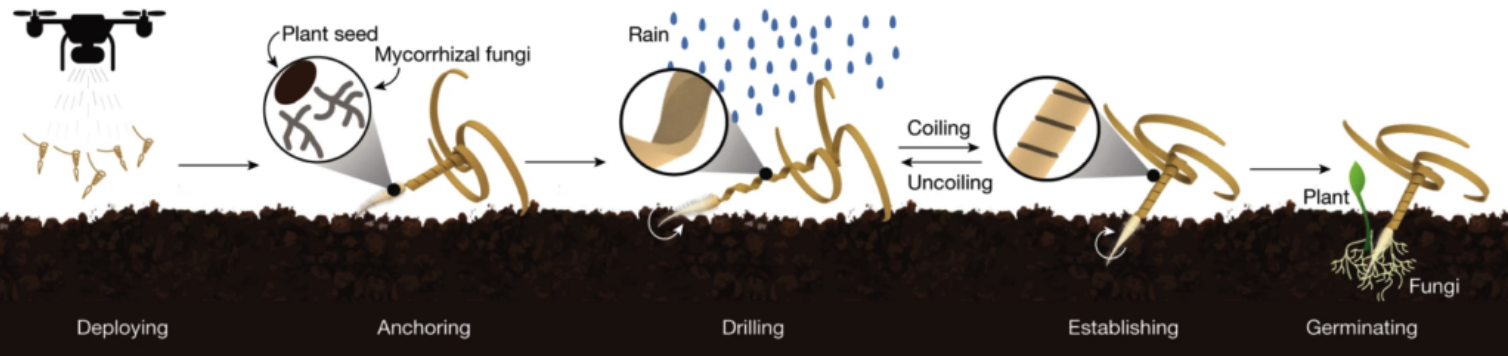
To combat this problem, Luo et al. (2023) have recently designed autonomous self-burying seed carriers that can be dropped from drones (Figure 1). These devices are made of really thin wood that is hygromorphic; it bends and coils depending on its exposure to water. To effectively drill into the soil, the carriers optimize torque (the force that causes rotation) and thrust (the force that causes forward propulsion) due to their three-tailed design. This causes the seeds to land at an optimal angle for drilling, 25° to 30° from the ground. Furthermore, the flexible material allows for a high total number of coils, which increases the tip’s rotational speed in the soil. With such an increased speed, there is a reduced drag force (the force that acts opposite to the object’s motion) between the tip and the soil, further helping to facilitate drilling (Luo et al., 2023). Finally, the seed can be encapsulated with a biofertilizer to increase the chances of plant survival post-germination.

Data over the last 30 years has demonstrated that aerial seeding is a successful strategy for forest regeneration, and with new technological improvements, results should only continue to improve (Xiao et al., 2015). As humans invented chainsaws and other technology to quickly destroy forests, it is our responsibility to equally invent technology to recover our damage. The best time to invent tree planting technology was 20 years ago; the second-best time is today.
References
Castro, J., Morales-Rueda, F., Alcaraz-Segura, D. and Tabik, S., 2023. Forest restoration is more than firing seeds from a drone. Restoration Ecology, 31(1), p.e13736. https://doi.org/10.1111/rec.13736.
Elliott, S., Gale, L. and Robertson, M., 2020. Automated forest restoration: could robots revive rain forests. FORRU-CMU. Thailand: Forest Restoration Research Unit, Chiang Mai University.
Global Forest Watch, 2023. Global Deforestation Rates & Statistics by Country. [online] Available at: <https://www.globalforestwatch.org/dashboards/global> [Accessed 9 March 2023].
Liu, Q., Zhang, Q., Jarvie, S., Yan, Y., Han, P., Liu, T., Guo, K., Ren, L., Yue, K., Wu, H., Du, J., Niu, J. and Svenning, J.-C., 2021. Ecosystem restoration through aerial seeding: Interacting plant–soil microbiome effects on soil multifunctionality. Land Degradation & Development, 32(18), pp.5334–5347. https://doi.org/10.1002/ldr.4112.
Luo, D., Maheshwari, A., Danielescu, A., Li, J., Yang, Y., Tao, Y., Sun, L., Patel, D.K., Wang, G., Yang, S., Zhang, T. and Yao, L., 2023. Autonomous self-burying seed carriers for aerial seeding. Nature, 614(7948), pp.463–470. https://doi.org/10.1038/s41586-022-05656-3.
Xiao, X., Wei, X., Liu, Y., Ouyang, X., Li, Q. and Ning, J., 2015. Aerial Seeding: An Effective Forest Restoration Method in Highly Degraded Forest Landscapes of Sub-Tropic Regions. Forests, 6(6), pp.1748–1762. https://doi.org/10.3390/f6061748.