You have likely seen advertisements for pharmaceutical products before, whether on TV, print, or online, known as direct to consumer advertising (DTCA). It has many implications on the healthcare industry and how patients interact with their physicians (Liu and Gupta, 2014). An increase in advertising can lead patients to request certain prescriptions which is detrimental to physician-patient relationships. Receiving the prescription could further negatively impact the patient. This type of advertising is only partially permitted in Canada by the Food and Drugs Act (Branch, 2023). However, corporations get around this restriction in one of two ways. First, they can create ‘help-seeking’ advertisements that seek to make it known that there exist treatments for a disease, but specifically without mentioning the names of any of those treatments. An example would be : “You might be prediabetic, ask your doctor about treatment.” The other way to get around this law is to create ‘reminder’ advertisements. Reminder advertisements serve to simply get the pharmaceutical name out there. An example would be : a billboard with the word “Rybelsus”. A common reminder advertisement is those seen for Ozempic, a semaglutide-containing tablet or injection meant to promote weight loss by inhibiting glucagon release and glucose production in the liver (Mahapatra, Karuppasamy and Sahoo, 2022).
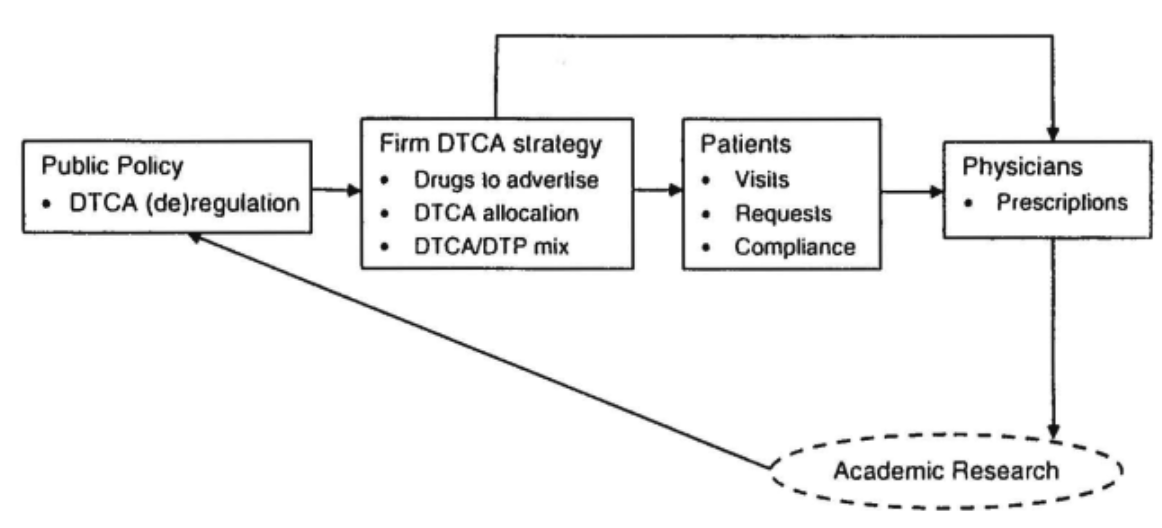
DTCA has both beneficial and adverse on patients seeking prescriptions (Vakratsas and Kolsarici, 2014). It’s chain of influence on firms, patients and physicians is shown in Figure 1. Positively, knowledge of what treatments are potentially available to them can allow patients to take a more active role in the maintenance of their health which is important to the healthcare system (Vakratsas and Kolsarici, 2014). However, DTCA often promotes drugs which are not right for certain individuals, and should a patient request those drugs, it could alter the physicians decision on which drugs to use, potentially favouring a brand that was well advertised over what was right for the patient (Liu and Gupta, 2014). Additionally, DTCA can often not inform or misinform patients about prospective treatments, by not listing or underemphasizing potential side effects and risks associated with the drug. Large-scale advertising can have a chain reaction on other people who weren’t even considering the drug, because they could see family member’s using it and recommending it which could again be positive or negative.

For drugs like Ozempic, this can be very dangerous because often society exerts a pressure to lose weight. This may hold an influence of authority, increasing cognitive pressure for someone to lose weight, creating potential clients for Ozempic In this instance, it would also be beneficial for Ozempic manufacturers to advertise the perceived benefits of losing weight to increase the social pressures felt, since social norms and groupthinking are also important factors in the decision to take medication. Additionally, there are certain mental health disorders that make people more or less susceptible to advertising for medication (Khawagi et al. 2019). Furthermore, there are often illegally listed advertisements online that make no mention of the side effects and risks, often coming from pharmacies attempting to sell prescription medication without prescriptions (Mackey, Cuomo and Liang, 2015).
The first case of DTCA in the United States was in 1981, for an ibuprofen product called ‘Rufen’ (Liu and Gupta, 2014). Prior to this, pharmaceuticals were exclusively advertised to physicians. Since the 1980s, DTCA spending has grown significantly in the United States and is close to becoming the primary method of pharmaceutical advertising, reaching 4 billion dollars and continuing to grow in 2024 (Liu and Gupta, 2014). The bulk of this spending and growth is in 30-second TV advertisements (Liu and Gupta, 2014). This method of advertisement is shown to be very beneficial to the corporations. It has been shown that for every $28 increase in DTCA spending, there is one more physician visit related to the drug (Liu and Gupta, 2014). This shows that DTCA is indispensable to the economic viability of new pharmaceutical companies and the survival of existing drugs.
In conclusion, DTCA is very important to the pharmaceutical industry and has had many implications on public health. It is a growing industry and still a factor for physicians to be aware of in the future. The Food and Drugs Act prohibits DTCA in Canada but many companies have ways to get around it, which is very beneficial to their business model.
References
Branch, L.S., 2023. Consolidated federal laws of Canada, Food and Drugs Act. [online] Available at: <https://laws-lois.justice.gc.ca/eng/acts/f-27/page-1.html#h-234053> [Accessed 4 January 2024].
Liu, Q. and Gupta, S., 2014. Direct-to-Consumer Advertising of Pharmaceuticals: An Integrative Review. In: M. Ding, J. Eliashberg and S. Stremersch, eds. Innovation and Marketing in the Pharmaceutical Industry: Emerging Practices, Research, and Policies, International Series in Quantitative Marketing. [online] New York, NY: Springer. pp.629–649. https://doi.org/10.1007/978-1-4614-7801-0_21.
Mackey, T.K., Cuomo, R.E. and Liang, B.A., 2015. The rise of digital direct-to-consumer advertising?: Comparison of direct-to-consumer advertising expenditure trends from publicly available data sources and global policy implications. BMC Health Services Research, 15(1), p.236. https://doi.org/10.1186/s12913-015-0885-1.
Mahapatra, M.K., Karuppasamy, M. and Sahoo, B.M., 2022. Semaglutide, a glucagon like peptide-1 receptor agonist with cardiovascular benefits for management of type 2 diabetes. Reviews in Endocrine & Metabolic Disorders, 23(3), pp.521–539. https://doi.org/10.1007/s11154-021-09699-1.
Khawagi, Wael Y., Douglas T. Steinke, Joanne Nguyen, and Richard N. Keers. 2019. “Identifying Potential Prescribing Safety Indicators Related to Mental Health Disorders and Medications: A Systematic Review.” PLOS ONE 14 (5): e0217406. https://doi.org/10.1371/journal.pone.0217406.
Vakratsas, D. and Kolsarici, C., 2014. How DTCA Influences Prescription Pharmaceutical Markets. In: M. Ding, J. Eliashberg and S. Stremersch, eds. Innovation and Marketing in the Pharmaceutical Industry: Emerging Practices, Research, and Policies, International Series in Quantitative Marketing. [online] New York, NY: Springer. pp.651–672. https://doi.org/10.1007/978-1-4614-7801-0_22.