Is This The End of Forever Plastic?

Polymers, both natural and synthetic, consist of large linkages of monomer units (Namazi 2017). Anywhere from DNA to polyester and nylon, polymers play a consistent role in our lives, including through plastic (Young and Lovell 2011). Plastic degrades in the same way as other natural polymers do with the environment; thermal, photo-oxidation, chemical degradation and biodegradation, however given a longer time frame (Enuh 2023). Plastics take an approximate 20 to 500 years for degradation to microplastics, but never actually go away. Microplastics are plastic fragments created from decomposition of larger molecules, which are then released into the environment (Savchuk 2025). These infinitely small particles can then work their way up the food chain and contaminate the water humans drink, food we eat and even air we breathe. 

The plastic epidemic has been ongoing for centuries, with almost 460 million tonnes of plastic being produced every year but only less than 10% of that being recycled (Vasarhelyi 2023). As the years go on, the increase in environmental and injurious effects are detrimental, with growing accumulations on ocean surfaces in the past 60 years (MacLeod et al. 2021). However, after much growth in technology and science, surely there must be a solution for this crisis. Although eliminating plastics as a whole would be the ultimate resolution, what if there was a way to mitigate this issue? 

One of the hardest discoveries in science include making something that is strong enough to use, but weak enough to break down, however as of November 2025, researchers from Rutgers’ University have discovered a new way to decompose these stubborn tools (MacPherson 2025). 

With the help of biomimicry, copying nature to solve human problems, the scientists found that as biological polymers, such as our genetic material, contain helping groups that assist with bond-breakage when needed. Therefore, with a simple chemistry alteration, human-made plastics would be able to do the same. The research conducted focused on maintaining structural integrity while in-use and weakening the bonds after serving its purpose, allowing for smooth degradation without harsh chemicals (Figure 1). 
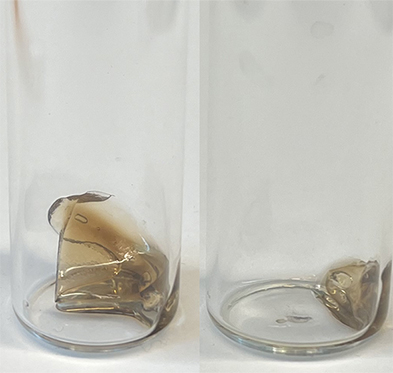
Figure 1. Sample of poly(dicyclopentadiene) plastic, made with degradable chemistry which are typically used in car bumpers and are hard to degrade. The image on the left is the original sample and the right is after being left out for 18 hours in the open air, displaying self-degradation (MacPherson 2025).

Considering this research is still relatively novice, this breakthrough for plastics’ programmable breakdown allows for a glimpse into the cleaner future that scientists have been talking about for decades. Until this level of technology hits the market for mass utility, the best tool for plastic prevention remains reduction and advocacy. Although using a plastic water bottle for 30 minutes is quite accessible, this leaves the cleanup to our descendants for the next five centuries. 

References

Enuh, Blaise. 2023. “How Do Polymers Degrade?” AZoM.com. June 19, 2023. https://www.azom.com/article.aspx?ArticleID=22789.

MacLeod, Matthew, Hans Peter H. Arp, Mine B. Tekman, and Annika Jahnke. 2021. “The Global Threat from Plastic Pollution.” Science 373 (6550): 61–65. https://doi.org/10.1126/science.abg5433.

MacPherson, Kitta. 2025. “Scientists Develop Plastics That Can Break Down, Tackling Pollution.” Rutgers.edu. 2025. https://www.rutgers.edu/news/scientists-develop-plastics-can-break-down-tackling-pollution.

Namazi, Hassan. 2017. “Polymers in Our Daily Life.” BioImpacts 7 (2). https://www.ncbi.nlm.nih.gov/pmc/articles/PMC5524987/.

Savchuk, Katia. 2025. “What’s the Deal with Microplastics, the Material That ‘Never Goes Away’?” News Center. 2025. https://med.stanford.edu/news/insights/2025/01/microplastics-in-body-polluted-tiny-plastic-fragments.html.

Vasarhelyi, Kayla. 2023. “The Impact of Plastic on Climate Change.” Environmental Center. University of Colorado Boulder. December 15, 2023. https://www.colorado.edu/ecenter/2023/12/15/impact-plastic-climate-change.

Young, Robert J, and P A Lovell. 2011. Introduction to Polymers. 3rd ed. Boca Raton: Crc Press.

Comments

8 Responses to “Is This The End of Forever Plastic?”

  1. Cohwyn Grubb Avatar
    Cohwyn Grubb

    Hey Sayana,

    Trying to get rid of forever plastic will likely be one of the best finds of the modern day. So its cool to see a possible solution. For a few of my suggestions:
    – Don’t forget to post an iSci comment talking about your post.
    – You could phrase “Plastics take an approximate 20 to 500 years for degradation to microplastics, but never actually go away.” into “Plastics can take anywhere from 20 to 500 years to break down into microplastics, but they rarely fully degrade at the molecular level.” just to be a little more accurate.
    – Instead of “The plastic epidemic has been ongoing for centuries…” I would put “The plastic pollution crisis has rapidly intensified over the past century…”.

    Of course it’s most important to keep your word count at a good amount, so I can’t wait to see what you end up editing.

    Cohwyn.

  2. Ahad Syed Avatar
    Ahad Syed

    Hey Sayana,

    This was a very interesting blog post! Some suggestions I have for you are to include a comment on your motivations for writing this post. For your last reference, Young and Lovell, I found a DOI you can add: https://doi.org/10.1201/9781439894156. Additionally, make sure that your reference title is a heading. Overall, great work and good luck editing!

    Ahad S.

  3. Maria Konstantinovski Avatar
    Maria Konstantinovski

    Hi Sayana!!

    I loved reading your blog post! I really enjoy reading about microplastics, especially since they’re basically everywhere now, and we have to be conscious of our impacts on the world.

    Here are a few comments to help your editing:
    – In the last sentence of your first paragraph, I think rewriting it to be a list would help the flow of the end of the paragraph. This could be something like “These infinitely small particles can then work their way up the food chain, contaminate the water humans drink, food we eat and even the air we breathe.” The only thing different is the listing format!!
    – I believe making “References” a heading will be clearer and more organized formatting
    – Don’t forget to add a comment explaining why you chose this topic 🙂

    Overall, this is a great post and was very well written, great work!
    Happy editing, I look forward to the final copy 🙂

    Maria K.

  4. Isabel Goncalves Avatar
    Isabel Goncalves

    Hey Sayana!

    What a fascinating blog post!! Here are a few suggestions to aid in the editing process:

    – The sentence “Plastic degrades in the same way…given a longer time frame,” reads a bit long. Consider shortening “chemical degradation and biodegradation” into “chemical and biodegradation.” Additionally, replacing “given” with “over” may enhance sentence clarity. To make this work you could rephrase to “Plastic degrades in the same way as other natural polymers do with the environment —thermal, photo-oxidation, chemical and biodegradation — however, over a longer time frame.”

    – When listing “the water humans drink, food we eat and even air we breathe,” consider changing them all to align stylistically. I think replacing “the water humans drink” with “the water we drink” would flow better.

    – Consider splitting the sentence “One of the hardest…stubborn tools” into two. You could split at at “however” and combine it into the paragraph below so that it isn’t an isolated sentence.

    Overall, a fascinating blog post! I really liked your figure! Happy editing!!

    Isabel

  5. Ava Sproule Avatar
    Ava Sproule

    Hi Sayana!

    This was such an interesting blog post and touched on very relevant topics in the world! I have a few suggestions:

    – ‘This’ and ‘the’ do not need to be capitalized in your title.
    – P2S3: To maintain the formal tone of your writing, I would suggest removing ‘surely’ as the sentence reads just fine without it.
    – Maybe consider switching the order of your second and first paragraph. I find that the second paragraph highlights and introduces the contents of your blog post well and would make as a good intro paragraph with some tweaks.
    – Consider combining paragraph 3 and 4 together.

    Overall, this was a really good blog post, and I look forward to read the final copy!

    -Ava

  6. Sophie Buller Avatar
    Sophie Buller

    Hi Sayana! This is a super interesting blog post! I have a couple points of feedback:

    – In P1S3 i find a bit wordy at the start – perhaps change “Plastic degrades in the same way as other natural polymers do with the environment” to just “Plastic degrades in the same way as other natural polymers do”

    – in P1 your last sentence, consider changing “humans” to “we” as you say “food we eat and even air we breathe.” afterwards to keep the structure of the list the same (however this is personal preference)

    – your P2 is only one sentence and its quite long, consider breaking it up into 2.

    Overall this is a really well written post! Keep up the good work!!
    – Sophie

    1. Sophie Buller Avatar
      Sophie Buller

      I meant P3! not P2

  7. Rishabh Bhatia Avatar
    Rishabh Bhatia

    Hi Sayana,

    One thing you did really well was clearly explaining the problem in a way that is easy to follow from the very beginning. I also liked that you connected the broader environmental problem to a specific scientific development from Rutgers, because that gave the piece both context and focus. Here are some ways you can improve:

    – Try tightening some of the sentence structure and wording, because a few sentences feel a bit long or repetitive. Shorter, clearer sentences would make your ideas sound stronger and more polished.

    – You could improve the overall flow by making the transition into the Rutgers solution a little smoother. Right now, the paper explains the plastic crisis well, but the shift from the problem to the proposed scientific breakthrough could feel more connected.

    – The conclusion should have a a clearer final takeaway about why this research matters and what it could realistically change in the future. That would leave the reader with a stronger closing impression.

    Overall, this was a great read. Happy editing!

Leave a Reply