“It was a dark and stormy night,” is a well-known phrase insinuating the beginning of a story, written by the English novelist Edward Bulwer-Lytton. Although popular and recognized by many, this quote is ridiculed for its overuse. In a world of illustrative anecdotes, this phrase is less effective in capturing an audience than more meaningful opening statements. Almost as much as storytellers frown upon this cliché, scientific writers misjudge the act of storytelling, considering it an ineffective technique for scientific communication.
Storytelling has long been criticized in science for encouraging a single narrative and potentially producing biased results. The lack of interpretation power given to the audience is one of the primary concerns (Katz, 2013). But as more social and environmental issues arise, scientists must learn to communicate effectively and efficiently to a non-expert, general public. In recent years, educational videos on platforms such as YouTube have solidified their place in the domain of science communication (Maynard, 2021). These videos have become a popular means of communicating scientific topics to students of all ages and levels.
To understand how science videos have grown to become a well-enjoyed form of communication, we analyze its process from a psychological perspective. One major contributor is the criteria of student engagement and attention retention. Educational videos are a prime example of this as their length, content, and design can be customized. In particular, video length is a critical component of retaining a student’s attention span. A study conducted by Guo, Kim, and Rubin observed that the median engagement time was 6 minutes, across all genres of videos (2014). Any video longer than that timespan risked losing the audience’s attention (Giasiranis and Sofos, 2020). Figure 1 displays boxplot results from the 2014 study, supporting the hypothesis that top engagement times occur at a maximum of 6 minutes, regardless of video length.

Figure 1: Video length and engagement time across videos of different lengths (Guo, Kim and Rubin, 2014).
This leads us to the technique of segmenting, where chunk information is separated into a series of shorter videos. This method complements the educational video style of delivery as it allows the audience to manage intrinsic load (Brame, 2016). Successful YouTube channels such as Crash Course and Khan Academy frequently employ this technique to create series of short-form content for specific topics.
Taking a different perspective, the neuroscience behind storytelling indicates that metaphors have been observed to drive attention and impact audience response (Klooster et al., 2020). Research has shown that metaphors correlate to the five senses, allowing the audience to formulate a connection between two concepts from their semantic memory (Benedek et al., 2014). Semantic memory refers to a collection of general knowledge about the world, not associated with emotional or personal experience. An example of this would be the fact that grass is green. This technique of story writing can activate sensory areas in the brain’s cortex, evoking a response from those who may have had an experience with what is being described (Lacey, Stilla and Sathian, 2012).
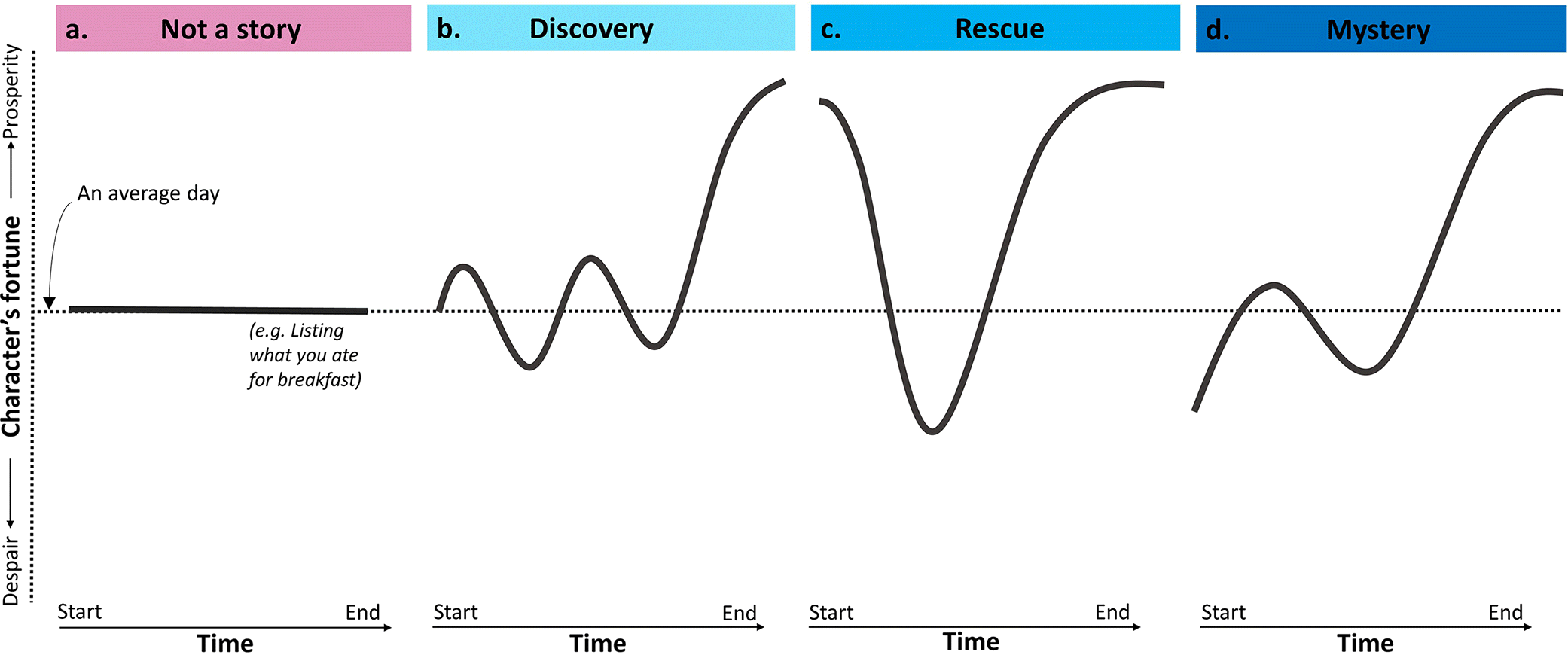
Although this sounds complicated, the process of scientific storytelling is not too different from writing a creative piece of fiction. In fact, it appears that the basic structure of a set-up, leading to conflict and resolution, produces an emotional response for the reader. Figure 2 illustrates a simplified pacing of stories for several genres, showcasing their potential application in both the scientific and creative world of writing.

Figure 2: The plot of a character’s fortune throughout the timeline of a story. Proposed by American author Kurt Vonnegut, he illustrates several types of storyline pacing, showing how a lack of climax and suspense is unlikely to create a story that engages with the audience. The solid black lines display the characters’ relationship with fortune, which can be interpreted as creating a nonlinear timeline; where there is conflict, a build-up to the climax, followed by a resolution. Unsurprisingly, the techniques for developing an impactful and successful science story are similar to those of a fictional story (Green, Grorud-Colvert and Mannix, 2018).
As the world gears up for approaching threats such as global warming and novel diseases, it remains crucial for scientists to convey their discoveries in ways that are effective for the public, most of whom are non-experts. The inherently technical and complex jargon used to describe scientific research is less likely to be understood, let alone be impactful. As a result, scientific storytelling should be strategically used in conjunction with other methods of scientific communication to form a connection with the public. Furthermore, scientific storytelling is a powerful pedagogical tool with great potential to engage and encourage future scientists in their groundbreaking endeavours.
References
Benedek, M., Beaty, R., Jauk, E., Koschutnig, K., Fink, A., Silvia, P.J., Dunst, B. and Neubauer, A.C., 2014. Creating metaphors: The neural basis of figurative language production. NeuroImage, 90, pp.99–106. https://doi.org/10.1016/j.neuroimage.2013.12.046.
Brame, C.J., 2016. Effective educational videos: Principles and guidelines for maximizing student learning from video content. CBE—Life Sciences Education, 15(4), p.es6. https://doi.org/10.1187/cbe.16-03-0125.
Giasiranis, S. and Sofos, L., 2020. The effect of self-regulation in a MOOC environment on the completion and performance of learners. Open Journal of Social Sciences, 08(10), pp.127–158. https://doi.org/10.4236/jss.2020.810010.
Green, S.J., Grorud-Colvert, K. and Mannix, H., 2018. Uniting science and stories: Perspectives on the value of storytelling for communicating science. FACETS, 3(1), pp.164–173. https://doi.org/10.1139/facets-2016-0079.
Guo, P.J., Kim, J. and Rubin, R., 2014. How video production affects student engagement: an empirical study of MOOC videos. In: Proceedings of the first ACM conference on Learning @ scale conference. pp.41–50. https://doi.org/10.1145/2556325.2566239.
Katz, Y., 2013. Against storytelling of scientific results. Nature Methods, 10(11), pp.1045–1045. https://doi.org/10.1038/nmeth.2699.
Klooster, N., McQuire, M., Grossman, M., McMillan, C., Chatterjee, A. and Cardillo, E., 2020. The neural basis of metaphor comprehension: Evidence from left hemisphere degeneration. Neurobiology of Language, 1(4), pp.474–491. https://doi.org/10.1162/nol_a_00022.
Lacey, S., Stilla, R. and Sathian, K., 2012. Metaphorically feeling: Comprehending textural metaphors activates somatosensory cortex. Brain and Language, 120(3), pp.416–421. https://doi.org/10.1016/j.bandl.2011.12.016.
Maynard, A.D., 2021. How to succeed as an academic on YouTube. Frontiers in Communication, 5, p.572181. https://doi.org/10.3389/fcomm.2020.572181.