The Cold War was a period of ideological and geopolitical conflict led by the United States and the Soviet Union between 1947 and 1991 (Haslam 2001). It created a competitive atmosphere between the two superpowers and was a breeding ground for anti-communist sentiment and Cold War paranoia (Lai 2021). The Americans felt that the Soviet-allied government invented new ways in which to brainwash their citizens. In 1953, the appointed director of the Central Intelligence Agency (CIA), Allen Dulles, said that the ‘Communist enemy had invented new ‘brain perversion techniques’” (Dunne 2013, 14). In the United States, federal support for science increased dramatically, with studies often politically or militaristically motivated, including that of Project MKUltra, which was designed to find substances that could be used to discredit spies or make it difficult for them to maintain a fabrication under questioning (Oreskes 2014; CIA 2018; Alvarez-Cruz 2025).
Many of the studies within MKUltra involved the use of the psychotropic drug LSD. It is a chemical alkaloid derivative from the fungus Claviceps purpurea (Alvarez-Cruz 2025). Psychological symptoms include pseudohallucinations, mood swings, reduced attention span, and changes in perception, such as increased empathy, as seen in Figure 1 (Passie et al. 2008). LSD alters the expression of serotonin (5-HT) neurons by acting as a 5-HT2A agonist. This property is common amongst other psychedelics such as mescaline, psilocybin, and DMT, and is thought to be the reason for the drug’s behavioural changes and hallucinatory effects (Passie et al. 2008; Alvarez-Cruz 2025).
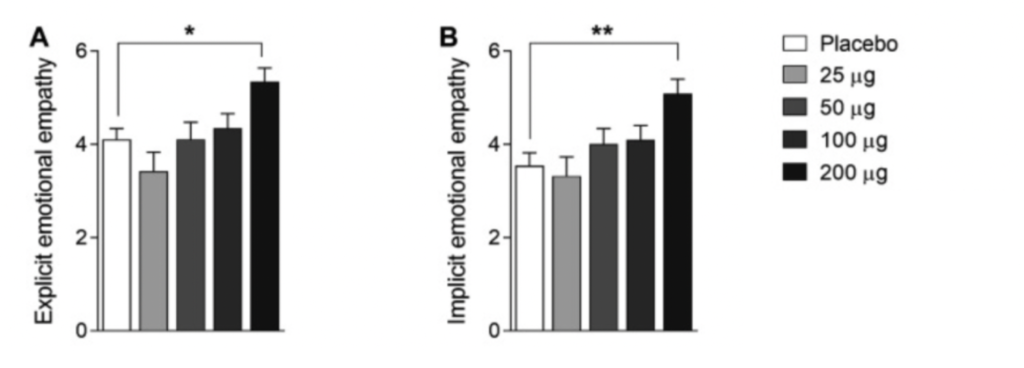
Figure 1: Effects of LSD on emotional empathy. LSD increased explicit (A) and implicit (B) emotional empathy compared with placebo, with the 200 µg LSD dose producing significant effects (Holze et al. 2021)(Modified from Article).
MKUltra was divided into various “subprojects”, with one project, known as “Subproject 68”, crossing the border. This project was conducted by Dr. Donald Ewen Cameron at the Allan Memorial Institute in Montréal. (CIA 2018; Torbay 2023). Dr. Donald Ewen Cameron was of interest to the CIA due to his previous experiments looking into his proposed theory of psychic driving, where he proposed that one would be able to unlock another’s subconscious through sensory deprivation and drugs (Torbay 2023). The goal of Subproject 68 was to find a method to break down personality structures and then implement new behavioural patterns through psychic driving. Subproject 68 was done on subjects who had mental health conditions, as well as people with passive-aggressive behaviour, or who fell into the broad category of having “inadequate” personality traits. Patients were subjected to prolonged drug-induced sleep, intensive electroconvulsive therapy, and sensory deprivation to disrupt their cognitive stability. Once patients were disoriented, they would undergo “psychic driving,” where repetitive verbal messages were played for hours to days to implant new behavioural patterns (Torbay 2023).
As a result, many patients suffered from traumatic responses. A class-action lawsuit was filed in the Superior Court, District of Montréal: J. Tanny vs. Royal Victoria Hospital et al. (Torbay 2023). This case was filed by the daughter of a victim of the MKUltra experiments, J. Tanny, with her father initially undergoing treatment for trigeminal neuralgia. After his time in the hospital, which included 50 days of insulin-induced sleep therapy and a cocktail of antipsychotics and barbiturates, Tanny experienced near total memory loss and disorientation (Torbay 2023).
MKUltra is a grave reminder of what can happen despite regulations. Before MKUltra began, Dr. Cameron was present at the Nuremberg trials, which had the goal of stopping the very experiments he performed (Torbay 2023). MKUltra serves as a stark reminder of how political power and authority shape scientific trajectories, and of the responsibility that scientists have to ensure the safety of those involved.
References
Alvarez-Cruz, Antonio. “The US Intelligence Agencies’ Search for the ‘Truth Serum’, 1941-1973.” Revista de Historia de La Psicología 46, no. 3 (2025): 12–22. https://doi.org/10.5093/rhp2025a19.
Dunne, Matthew W. “The Origins of Brainwashing.” In A Cold War State of Mind: Brainwashing and Postwar American Society, 13–51. University of Massachusetts Press, 2013. http://www.jstor.org/stable/j.ctt5vkbcz.5.
Haslam, Jonathan. “The Cold War as History.” Annual Review of Political Science 6, no. 1 (2003): 77–98. https://doi.org/10.1146/annurev.polisci.6.121901.085556.
Holze, Friederike, Isidora Avedisian, Nimmy Varghese, Anne Eckert, and Matthias E. Liechti. “Role of the 5-HT2A Receptor in Acute Effects of LSD on Empathy and Circulating Oxytocin.” Frontiers in Pharmacology 12 (July 2021): 711255. https://doi.org/10.3389/fphar.2021.711255.
Lai, Albert K. The Cold War, the Space Race, and the Law of Outer Space: Space for Peace. Routledge Studies in Modern History. Routledge, 2021. https://doi.org/10.4324/9781003162308.
Oreskes, Naomi, and John Krige. Science and Technology in the Global Cold War. Transformations. The MIT press, 2014.
Passie, Torsten, John H. Halpern, Dirk O. Stichtenoth, Hinderk M. Emrich, and Annelie Hintzen. “The Pharmacology of Lysergic Acid Diethylamide: A Review.” CNS Neuroscience & Therapeutics 14, no. 4 (2008): 295–314. https://doi.org/10.1111/j.1755-5949.2008.00059.x.
Torbay, Jordan. “The Work of Donald Ewen Cameron: From Psychic Driving to MK Ultra.” History of Psychiatry 34, no. 3 (2023): 320–30. https://doi.org/10.1177/0957154X231163763.
“(U) Project MKULTRA.” Central Intelligence Agency, December 12, 2018. https://www.cia.gov/readingroom/docs/project%20mk-ultra%5B15545700%5D.pdf.


Leave a Reply
You must be logged in to post a comment.