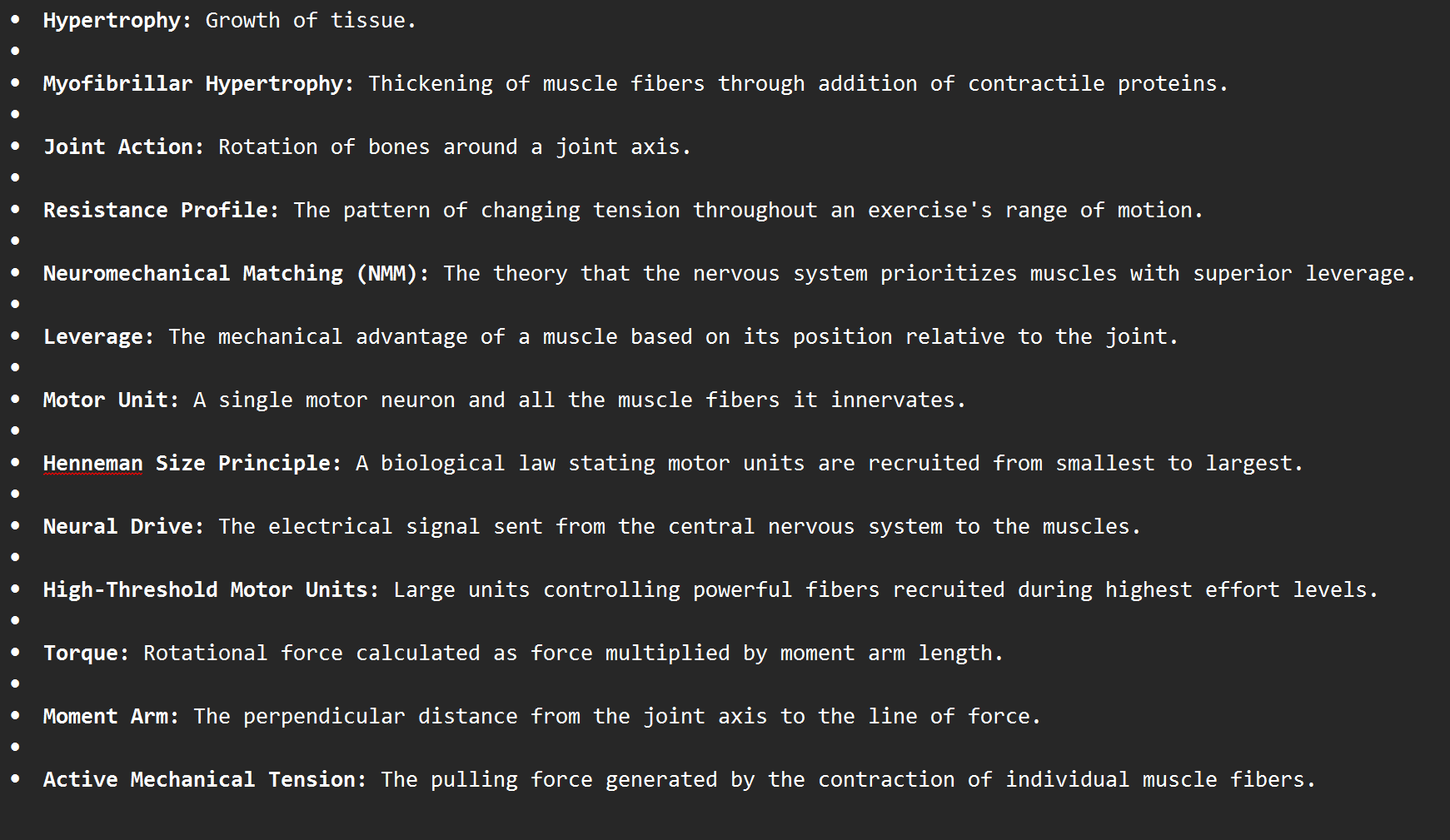
*For this post to be understood by most readers the word bank will be necessary.
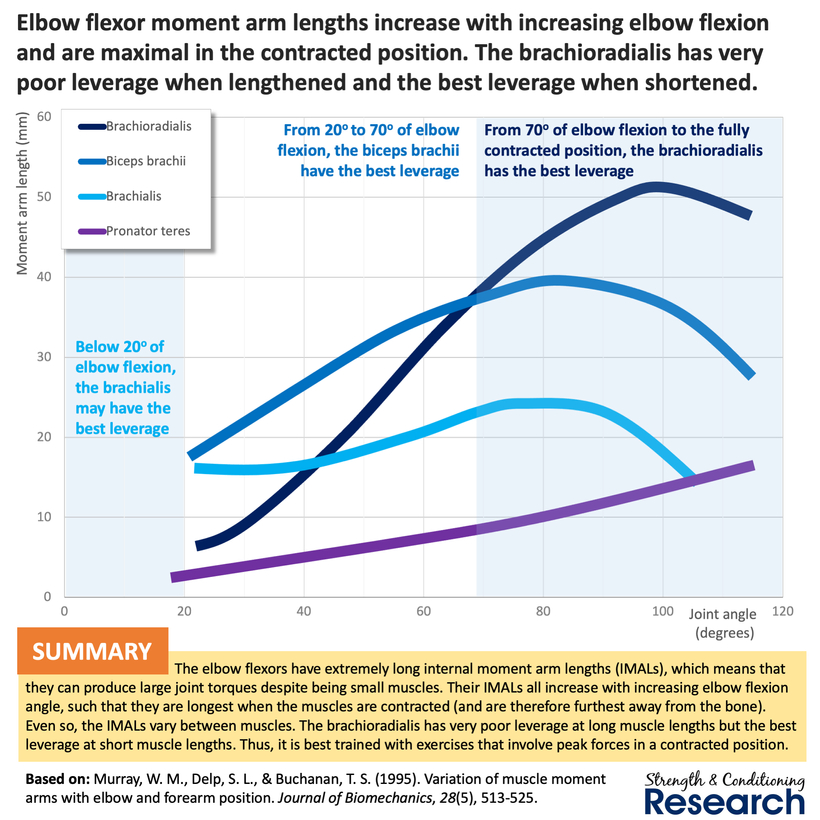
During resistance training, the goal is to challenge a joint action; this, in turn, drives myofibrillar hypertrophy in the controlling muscles via mechanical tension exerted on recruited motor units. Traditional exercises — especially free weights — are often designed without considering resistance profiles. The dumbbell bicep curl is a perfect example of an exercise with a suboptimal resistance profile for its target tissue, as it is most challenging when the forearm is parallel with the ground. Using the theory of Neuromechanical Matching (NMM) we can clearly outline the flaw with this exercise. Because the biceps lose leverage relative to other flexors above 70 degrees, the exercise primarily challenges the brachioradialis rather than the biceps (Figure 1).
A common counterargument to this idea is that the motor units in musculature with worse leverages will still be recruited because of the Henneman Size Principle. This principle postulates that motor units are recruited in a strict, predictable fashion based on the size of the unit, with smaller units being recruited first and larger units being recruited last with increased force demands (Henneman 1957). This perspective assumes that as a set approaches failure, the more difficult-to-recruit motor units will fire, thus NMM is irrelevant to them because the poorly leveraged muscles will still experience stimulus. This logic is flawed because while motor units from muscles with worse relative leverage will be recruited, they will experience a lower degree of stimulus compared to those with better leverages. This proves true because neural drive is not infinite. In a curl, the biceps compete with the brachioradialis for neural recruitment which leads to a lower degree of motor unit recruitment in the biceps which means mechanical tension is distributed among less high threshold fibers, reducing the degree of myofibrillar hypertrophy.
From a physics perspective, torque is equal to force multiplied by the moment arm length. For example, because the biceps have a diminishing internal moment arm length at 90 degrees of flexion they are mechanically incapable of exerting high levels of torque, thus motor units in muscles with longer moment arm like the brachioradialis will be recruited disproportionately. Outcome data from a cross sectional study conducted on rats demonstrates that when a muscle is mechanically disadvantaged it cannot reach the same degree of active mechanical tension (Zuurbier et al. 1992). This indicates that while there may be some spillover in motor unit recruitment, the degree of said activation will be at a much smaller scale than the muscle with ideal leverage.
Overall, the theory of NMM is a well supported, and well documented phenomenon. While most individuals who lift weights are not well versed in the mechanism behind muscle growth, a baseline understanding of resistance profiles, NMM, motor unit recruitment, and mechanical tension would greatly improve the efficiency and success of the average lifter. Additionally, if equipment companies had a better understanding of this theory they could make better, more useful equipment. Some companies like Prime have acknowledged the importance of resistance profiles and have made exercise equipment with customizable resistance profiles.
References
Henneman, Elwood. 1957. “Relation between Size of Neurons and Their Susceptibility to Discharge.” Science 126, no. 3287 (December): 1345–47. https://doi.org/10.1126/science.126.3287.1345.
Zuurbier, Christian J., and Paavo A. Huijing. 1992. “Influence of Muscle Geometry on Shortening Speed of Fibre, Aponeurosis and Muscle.” Journal of Biomechanics 25, no. 9 (September): 1017–26. https://doi.org/10.1016/0021-9290(92)90037-2.

Leave a Reply
You must be logged in to post a comment.