Cancer is a prevalent illness that many develop, often leading to death. Cancer remains the leading cause of death in Canada, as 1 in 4 Canadians die from cancer, and 2 in 5 are expected to be diagnosed with it at some point in their lives (Government of Canada 2021). Apart from being very widespread, cancer is highly complicated. There are numerous variations of cancer, each arising from the type of cells they initially mutated from (Worldwide Cancer Research 2024). Since cells from different body parts vary, the type of genetic mutation, physical appearance and behaviour of every cancer is different; therefore, the treatment for every cancer also differs (Worldwide Cancer Research 2024).
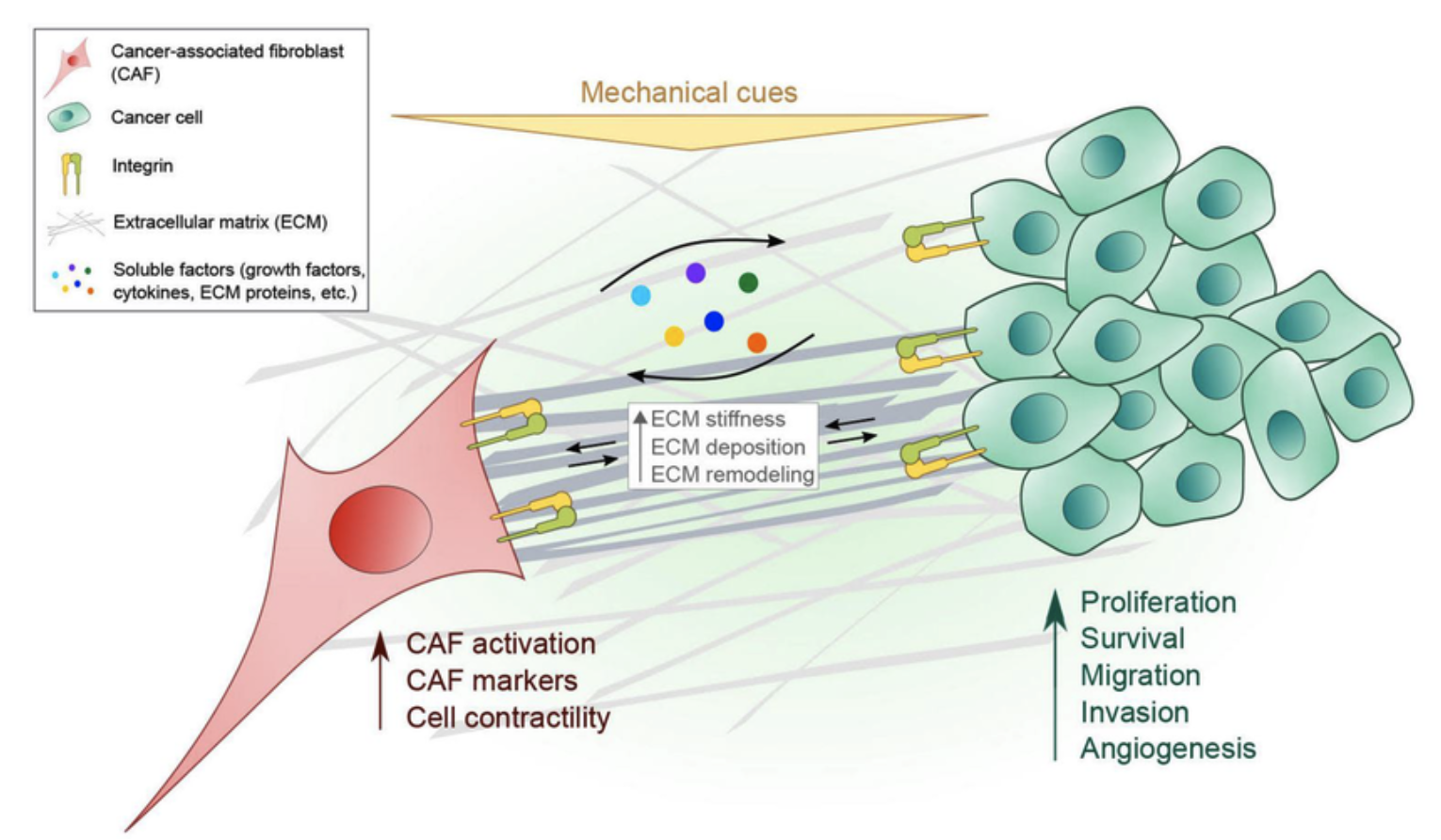
Physicians often recommend getting checked for hard lumps found on external regions of the body, since tumours can be located by feeling for these lumps (National Cancer Institute 2007). Why do tumours stiffen and harden? This typical behaviour associated with cancer arises from changes in the extracellular matrix (ECM) (National Institute of Biomedical Imaging and Bioengineering n.d.). The tumour microenvironment (TME) contains cellular components such as stromal cells, which aid in tumour growth and metastasis (Papait et al. 2022). Stromal cells, also commonly called Cancer-Associated Fibroblasts (CAF), control the immune response and the ECM’s composition (Papait et al. 2022). CAFs contribute to ECM degradation and stiffness by inducing hypoxia, in other words, conditions with low oxygen levels (Najafi, Farhood, and Mortezaee 2019). These interactions between the ECM and tumour can be visually depicted (Figure 1).

This tumour stiffness has been observed to have numerous benefits for the tumour, including tumour cell proliferation, migration, invasion, and angiogenesis (Najafi, Farhood, and Mortezaee 2019). A primary concern associated with this stiffness is drug resistance, a major issue for administering chemotherapy, as chemoresistance adversely impacts the treatment’s ability to reduce the tumour size while still damaging healthy cells (National Institute of Biomedical Imaging and Bioengineering n.d.). Increased blood vessels from angiogenesis, overgrowth of cancer cells, and cancer cell adhesion to the ECM components such as fibronectin and collagen increase the physical components in the ECM, increasing pressure (Kalli et al. 2023). As pressure increases, fluid such as chemotherapy cannot reach the tumour due to the high pressure surrounding it, as explained by the Bernoulli principle (Figure 2) (Lawence-Brown et al. 2011). Following the concentration gradient, fluid flow is from higher to lower pressured areas, and areas with higher pressure flow faster (away from the tumour) to areas with low pressure and a slower flow rate (Lawence-Brown et al. 2011).

It’s been previously discovered that resistance to chemotherapy due to tumour stiffness can be reversed by transferring the tumour to a less stiff environment (National Institute of Biomedical Imaging and Bioengineering n.d.). Recently, Stanford University researchers used 3D cell cultures mimicking pancreatic ductal adenocarcinoma (PDAC) to assess the effect of chemotherapy on environments with different ECM thicknesses (National Institute of Biomedical Imaging and Bioengineering n.d.). They confirmed that higher thickness results in higher resistance to chemotherapy; however, they also found that higher-thickness cultures had more drug efflux pumps, which pump chemotherapy out of cancer cells. The presence of efflux pumps is linked to the CD44 protein, which in and of itself is linked to ECM thickness. Ultimately, the cancer cells can once again become vulnerable to chemotherapy by removing the CD44 protein or unlinking the cells from a stiff ECM to a less stiff ECM (National Institute of Biomedical Imaging and Bioengineering n.d.).
Although these trials were done using cell culture imitating the human body, they show immense promise. With the development of procedures and treatments that minimize chemoresistance, cancer treatments can maintain their efficiency, ultimately helping save the lives of countless cancer patients across the world.
References
“Canadian Cancer Statistics 2021.” 2021. Research. Government of Canada. November 10, 2021. https://www.canada.ca/en/public-health/services/reports-publications/health-promotion-chronic-disease-prevention-canada-research-policy-practice/vol-41-no-11-2021/canadian-cancer-statistics-2021.html.
“Interplay between CAFs and Cancer Cells in the TME.” n.d. ResearchGate. Accessed October 22, 2024. https://www.researchgate.net/figure/Interplay-between-CAFs-and-cancer-cells-in-the-TME-Multiple-types-of-integrins-shown-as_fig1_333363673.
Kalli, Maria, Matthew D. Poskus, Triantafyllos Stylianopoulos, and Ioannis K. Zervantonakis. 2023. “Beyond Matrix Stiffness: Targeting Force-Induced Cancer Drug Resistance.” Trends in Cancer 9 (11): 937. https://doi.org/10.1016/j.trecan.2023.07.006.
Lawence-Brown, Michael MD, Kurt Liffman, James B. Semmens, and Ilija D. Sutalo. 2011. “Vascular Arterial Haemodynamics.” In Mechanisms of Vascular Disease: A Reference Book for Vascular Specialists, edited by Robert Fitridge and Matthew Thompson. Adelaide (AU): University of Adelaide Press. http://www.ncbi.nlm.nih.gov/books/NBK534265/.
Najafi, Masoud, Bagher Farhood, and Keywan Mortezaee. 2019. “Extracellular Matrix (ECM) Stiffness and Degradation as Cancer Drivers.” Journal of Cellular Biochemistry 120 (3): 2782–90. https://doi.org/10.1002/jcb.27681.
Papait, Andrea, Jacopo Romoli, Francesca Romana Stefani, Paola Chiodelli, Maria Cristina Montresor, Lorenzo Agoni, Antonietta Rosa Silini, and Ornella Parolini. 2022. “Fight the Cancer, Hit the CAF!” Cancers 14 (15): 3570. https://doi.org/10.3390/cancers14153570.
“Researchers Reverse Drug Resistance in Pancreatic Cancer Model.” n.d. National Institute of Biomedical Imaging and Bioengineering. Accessed October 22, 2024. https://www.nibib.nih.gov/news-events/newsroom/researchers-reverse-drug-resistance-pancreatic-cancer-model.
The Fast And The Nerdy, dir. 2022. How Bernoulli’s Equation Explains Pressure Transformation – Static to Dynamic. https://www.youtube.com/watch?v=QhcX3gjWzxc.
“What Is Cancer?” 2007. cgvArticle. National Cancer Institute. Nciglobal,ncienterprise. September 17, 2007. https://www.cancer.gov/about-cancer/understanding/what-is-cancer.
“Why Is Cancer So Hard To Cure?” 2024. Worldwide Cancer Research. August 7, 2024. https://www.worldwidecancerresearch.org/information-and-impact/cancer-myths-and-questions/why-is-cancer-so-hard-to-cure/.