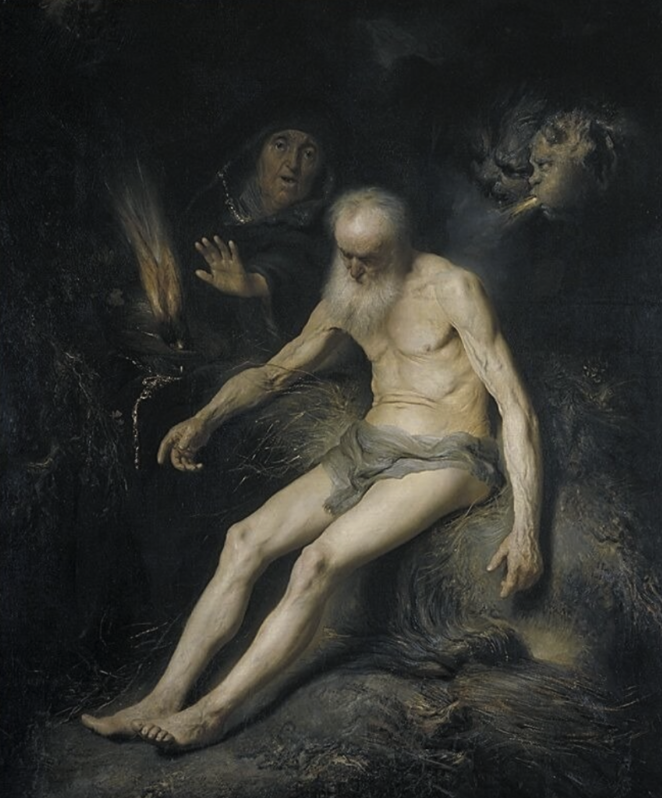
The Scientific Revolution began in the 14th century, and it was a time where many scientific discoveries came to fruition. (World History Encyclopedia, 2024). In the 17th century, Sir Isaac Newton discovered the properties of gravity (National Geographic, 2024). The theory of the water cycle was tested and substantiated by Pierre Perrault in the 17th century as well (Deming, 2014). Long after the scientific revolution, in 1936, Earth’s inner core was discovered by Inge Lehmann (American Museum of Natural History, 2024). However, there are Biblical texts that have discussed these theories long before scientists considered them. The Book of Job (Figure 1), one of the 66 books of the Bible, mentions all three of these scientific concepts.

The Book of Job is the 17th book of the Bible written shortly after 540 BCE (Yale University Press, 2020). Job 26:7 mentions how Earth is suspended in space, “ ……He hangs the Earth upon nothing” (Coogan et al., 2010, Job 26:7). In other Biblical translations, the phrase “suspends over nothing” is used instead. This was written over 1000 years before even Brahmagupta, a prominent mathematician and astronomer, discussed the possibility of gravitational forces during 600 AD. However, Newton openly expressed how he referred to Biblical scripture when working towards his discoveries and encouraged others to do the same (Jones, 2011).
In Job 26:8, it states “He binds up the waters in His clouds, and the cloud is not torn apart by them.” (Coogan et al., 2010, Job 26:8). Then in Job 36:27-28 it states “For He draws up the drops of water; He distills His mist in rain, which the skies pour down and drop upon the mortals abundantly.” (Coogan et al., 2010, Job 36:27-28). The three parts of the water cycle are mentioned: the concept of condensation in Job 26:8, and evaporation with precipitation in Job 36:27-28. This theory is believed to have been difficult to grasp during ancient times however, over 2000 years before the water cycle was discovered it found in writing within the Book of Job.
Finally in Job 28:5 it states “As for Earth out of it comes bread, but underneath it is turned up by fire.” (Coogan et al., 2010, Job 28:5). This section discusses how food can be grown on Earth’s crust, and it is also a warning that as one goes deeper into the Earth it is extremely hot, which suggests Earth’s inner core. Over 2000 years ago this was stated in the Bible, but was stated in academic literature in the 20th century by Dr. Inge Lehmann (See figure 2). Again, during ancient times how could one have known this concept without the geological technology humanity has today?

The Bible has many more scientific concepts within its text and are discussed by many scholars who are both religious and non-religious. There are geological, physical or even medical concepts mentioned throughout scripture, an example being Jesus Christ experiencing hematohidrosis in the garden of Gethsemane (Jerajani et al., 2009). Some scholars have said that science and the Bible cannot coexist, however there are many scientific references made throughout the Bible that say otherwise. Now this is not a matter of science versus religion, but more of how scientists must be more open minded to the idea of referring more to religious texts – not just the Bible – to help lead to many more scientific discoveries.
References
American Museum of Natural History, 2024. Inge Lehmann: Discoverer of the Earth’s Inner Core | AMNH. [online] American Museum of Natural History. Available at: <https://www.amnh.org/learn-teach/curriculum-collections/earth-inside-and-out/inge-lehmann-discoverer-of-the-earth-s-inner-core> [Accessed 15 March 2024].
Coogan, M.D., Brettler, M.Z., Newsom, C. and Perkins, P., 2010. The New Oxford Annotated Bible with Apocrypha: New Revised Standard Version. Oxford, UNITED STATES: Oxford University Press, Incorporated.
Deming, D., 2014. Pierre Perrault, the Hydrologic Cycle and the Scientific Revolution. Groundwater, [online] 52(1), pp.156–162. https://doi.org/10.1111/gwat.12138.
Jerajani, H.R., Jaju, B., Phiske, M.M. and Lade, N., 2009. HEMATOHIDROSIS – A RARE CLINICAL PHENOMENON. Indian Journal of Dermatology, [online] 54(3), pp.290–292. https://doi.org/10.4103/0019-5154.55645.
Jones, E.S., 2011. A Brief Survey of Sir Isaac Newton’s Views on Religion | Religious Studies Center. [online] Available at: <https://rsc.byu.edu/converging-paths-truth/brief-survey-sir-isaac-newtons-views-religion> [Accessed 20 March 2024].
National Geographic, 2024. Isaac Newton: Who He Was, Why Apples Are Falling. [online] Available at: <https://education.nationalgeographic.org/resource/isaac-newton-who-he-was-why-apples-are-falling> [Accessed 15 March 2024].
National Gallery of Canada, 2024. Job. [online] Available at: <https://www.gallery.ca/collection/artwork/job> [Accessed 15 March 2024].
World History Encyclopedia, 2024. Scientific Revolution – World History Encyclopedia. [online] Available at: <https://www.worldhistory.org/Scientific_Revolution/> [Accessed 15 March 2024].
Yale University Press, 2020. The Historical Context of the Book of Job. Available at: <https://yalebooks.yale.edu/2020/08/05/the-historical-context-of-the-book-of-job/> [Accessed 15 March 2024].