The flavour of the wine you drink comes partly from wood, specifically, the wooden barrel it was aged in. Wooden barrels are an integral part of the wine aging process and affect the taste of wine in various ways. During fermentation, the wine is in contact with the wood, allowing chemicals from the barrel to leach into the wine, changing its chemical composition (del Alamo-Sanza and Nevares, 2018). Furthermore, since wood is porous it allows for the wine to be oxygenated which can cause beneficial chemical reactions. However, before all that can happen, the barrel must be made suitable for the aging process. The art of making barrels is called cooperage, and while there are many steps involved, one of the most important is seasoning (Mathewson, 1930).
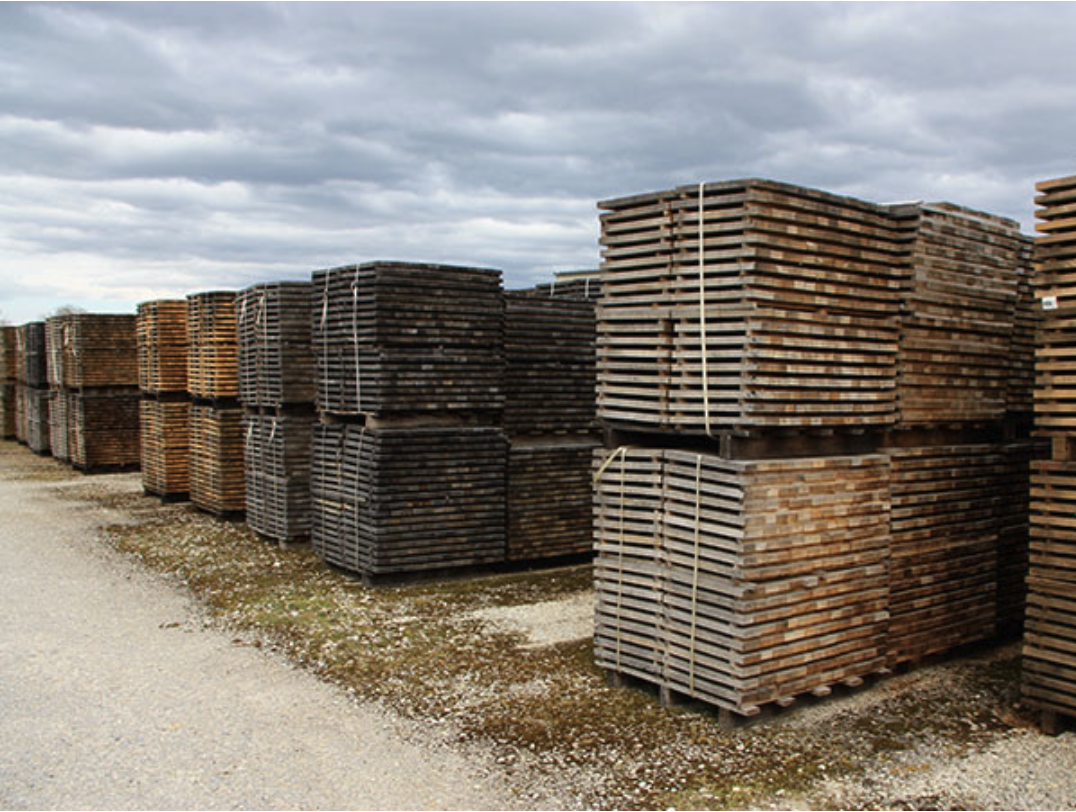
After wood is cut into staves, it is exposed to open air and left to dry in a process known as seasoning. This process is divided into dehydration, rehydration, and constant humidity, which result in the wood’s maturation (Figure 1)(Martínez et al., 2008). The staves are left to be seasoned outdoors where they can endure natural processes caused by sunlight, rain and microorganisms. This occurs over a period of 18-36 months, depending on the winemakers discretion (Fernández de Simón et al., 2010). Overall, these changes in the woods chemical composition can decrease astringency and bitterness while increasing aroma.

Figure 1: An image of what wood seasoning looks like. The wooden staves are stacked and left outside in natural conditions. During dehydration, the wood air dries increasing its dimensionally stability, which is the wood’s ability to maintain its shape when moistened without shrinking or swelling. After it rains, the staves are rehydrated as water enters the wood’s pores. Finally, the humidity of the wood will eventually match that of its surroundings, as wood has a tendency to absorb or release moisture until it is balanced with the atmosphere (Mathewson, 1930; Vinethos, 2014; Sargent, 2019; Guerrero-Chanivet et al., 2023).
So what really happens when wood is seasoned? The main biochemical change is the loss of hydrosoluble polyphenolic substances, due to leaching by rain, hydrolytic oxidative degradation and fungal enzyme activity (Fernández de Simón et al., 2010). The most common polyphenolic substances found in oak wood are tannins, specifically, the two ellagitannins, castalagin and vescalagin which are hydrolyzed during the seasoning process (Figure 2) (Cadahía et al., 2001). Ellagitannins can also undergo polymerization, which results in water-insoluble phenolic extractives (Klumpers, Scalbert and Janin, 1994). Since these bitter compounds are insoluble, they precipitate out of the wood, preventing them from entering wine. Seasoning softens these tannins, however not all tannins cause astringency and some improve mouthfeel, colour stabilization and remove of reductive off-flavors (Versari, du Toit and Parpinello, 2013). Thus, winemakers that desire these compounds may choose to season their barrels for shorter periods of time.

Figure 2: Castalagin and vescalagin can undergo chemical hydrolysis or enzymatic degradation during seasoning which reduces their final concentration in the oak wood. There are many methods of degradation, such as acid degradation shown above, which all result in the formation of free ellagic acid. Ellagic acid is a cofactor molecule that interacts in a protective fashion with pigment molecules. This co-pigmentation is thought to be responsible for 30%–50% of the pigmentation in young red wines. In other words, degradation of castalagin and vescalagin not only impacts flavour, but colour too (Peng, Scalbert and Monties, 1991; Zhang et al., 2018).
Wood seasoning is essential to cooperage. The chemical and physical changes that occur during this process contribute to wine taste and can reduce unpleasant and bitter flavors. For this reason it is imperative for winemakers to decide for how long they want to season their staves. So next time you drink wine, appreciate that some of the flavour was a result of this highly influential process.
References
del Alamo-Sanza, M. and Nevares, I., 2018. Oak wine barrel as an active vessel: A critical review of past and current knowledge. Critical Reviews in Food Science and Nutrition, 58(16), pp.2711–2726. https://doi.org/10.1080/10408398.2017.1330250.
Cadahía, E., Varea, S., Muñoz, L., Fernández de Simón, B. and García-Vallejo, M.C., 2001. Evolution of Ellagitannins in Spanish, French, and American Oak Woods during Natural Seasoning and Toasting. Journal of Agricultural and Food Chemistry, 49(8), pp.3677–3684. https://doi.org/10.1021/jf010288r.
Fernández de Simón, B., Cadahía, E., del Álamo, M. and Nevares, I., 2010. Effect of size, seasoning and toasting in the volatile compounds in toasted oak wood and in a red wine treated with them. Analytica Chimica Acta, 660(1), pp.211–220. https://doi.org/10.1016/j.aca.2009.09.031.
Guerrero-Chanivet, M., García-Moreno, M.V., Valcárcel-Muñoz, M.J. and Guillén-Sánchez, D.A., 2023. Determining the impact of seasoning on the volatile chemical composition of the oak wood of different Sherry Casks® by DTD–GC–MS. Wood Science and Technology, 57(4), pp.861–878. https://doi.org/10.1007/s00226-023-01478-2.
Klumpers, J., Scalbert, A. and Janin, G., 1994. Ellagitannins in European oak wood: Polymerization during wood ageing. Phytochemistry, 36(5), pp.1249–1252. https://doi.org/10.1016/S0031-9422(00)89646-6.
Martínez, J., Cadahía, E., Fernández de Simón, B., Ojeda, S. and Rubio, P., 2008. Effect of the Seasoning Method on the Chemical Composition of Oak Heartwood to Cooperage. Journal of Agricultural and Food Chemistry, 56(9), pp.3089–3096. https://doi.org/10.1021/jf0728698.
Mathewson, J.S., 1930. The air seasoning of wood. [online] Available at: <https://ageconsearch.umn.edu/record/159433/files/tb174.pdf> [Accessed 23 November 202
Peng, S., Scalbert, A. and Monties, B., 1991. Insoluble ellagitannins in Castanea sativa and Quercus petraea woods. Phytochemistry, 30(3), pp.775–778. https://doi.org/10.1016/0031-9422(91)85250-4.
Sargent, R., 2019. Evaluating dimensional stability in solid wood: a review of current practice. Journal of Wood Science, 65(1), p.36. https://doi.org/10.1186/s10086-019-1817-1.
Versari, A., du Toit, W. and Parpinello, G. p., 2013. Oenological tannins: a review. Australian Journal of Grape and Wine Research, 19(1), pp.1–10. https://doi.org/10.1111/ajgw.12002.
Vinethos, 2014. Wood Seasoning. Available at: https://vinethos.com/wood-seasoning/ [Accessed 29 November 2023].
Zhang, X.-K., He, F., Zhang, B., Reeves, M.J., Liu, Y., Zhao, X. and Duan, C.-Q., 2018. The effect of prefermentative addition of gallic acid and ellagic acid on the red wine color, copigmentation and phenolic profiles during wine aging. Food Research International, 106, pp.568–579. https://doi.org/10.1016/j.foodres.2017.12.054.