Technological developments have allowed us to uncover the identities of mystery substances with increasing accuracy. From applications in forensic research to artifact analysis, gas chromatography-mass spectrometry (GC-MS) combines two methods used in modern analytical chemistry to provide an effective means of identifying chemicals.
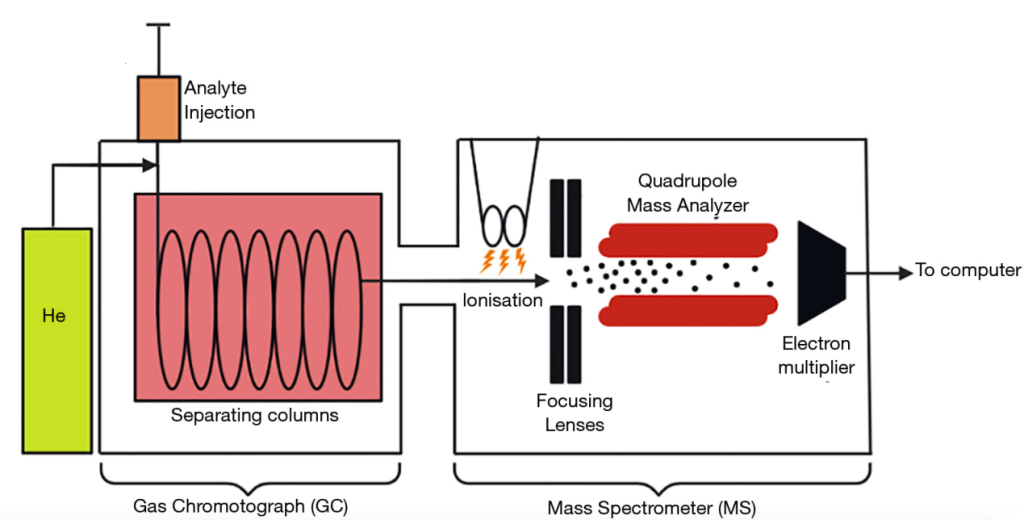
GC-MS is an analytical technique often used to identify and measure the amount of constituents in bulk samples (Figure 1) (Kristo 2012). Mixture components undergo separation in the gas chromatograph, where a carrier gas (usually an inert gas) is used as the mobile phase. The components are transported through a column, a narrow bore tube, and separated according to their volatility and affinity for either the mobile phase or column material (called the stationary phase). They are then identified in the mass spectrometer, where components are ionized and fragmented. Typically, electron ionization is used to ionize the sample into fragments by bombarding it with a beam of electrons; fragmentation occurs as a result of ion instability (Medeiros 2018). Separation will then occur depending on the mass-to-charge (m/z) ratio of the ions (the ion mass divided by its charge).
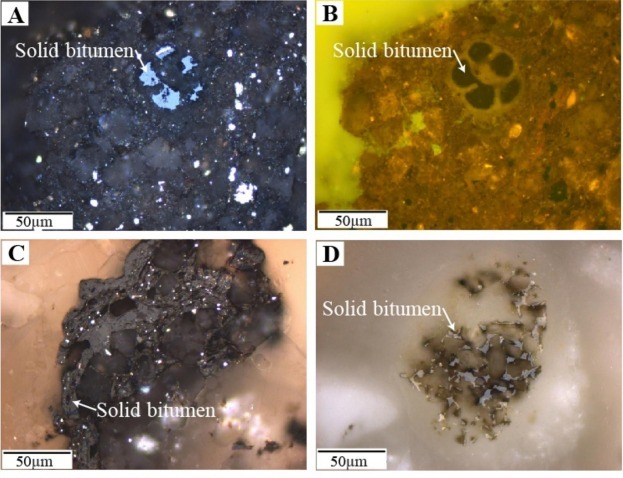
GC-MS has many applications in the field of geology, playing a major role in the development of biomarker geochemistry that then extended to general organic geochemistry (Medeiros and Simoneit 2007). In particular, GC-MS is important for analyzing petroleum oils and the biomarker constituents found in said oils and rocks. Biomarkers are exceptionally stable, retaining the structure of the biogenic precursors in organisms and providing information about their geologic conditions and history (Sharma, Sharma, and Lahiri 2009). In the context of petroleum exploration, GC-MS is used to identify organic biomarkers by assessing hydrocarbon profiles to draw conclusions about source matters, the ratio of the terpenoids pristane to phytane to infer the state of redox conditions in the depositional environment, and the ratio of hydrocarbon phenanthrene and its methyl homologues to infer a maturity date (Medeiros 2018). Source rocks of petroleum contain organic matter, typically accumulated in the form of plant and animal remains preserved in sediments and/or sedimentary rock (Akande 2012). This organic matter has been shown to split into two fractions in a source rock, called kerogen (insoluble in organic solvent) and bitumen (soluble in organic solvent); the latter has become an essential component in performing GS-MS analyses (Figure 2).
The deviate hydrocarbons in petroleum are used for biomarkers in the fossil record. The terpenoids found in plant fossils are the result of the synthesis of precursor compounds from the living plant (Medeiros and Simoneit 2007). These geoterpenoids can be sorted into structural classes and also be compared to bioterpenoid distribution in extant plants, as they retain their natural skeleton despite the degradation and diagenesis of the original plant material. Plants can also be used to provide insight into paleoclimatology through lipid analysis, where average chain length and carbon preference index are some examples of measurements that provide information on past postdepositional processes, ecosystems and climates (Medeiros 2018).
The interdisciplinary nature of GS-MS has allowed for major developments in the field of geochemistry and many other sciences. Its versatility allows it to be a popular method used for analysis, and it will likely continue to be increasingly used in the future.
References
Akande, Waheed Gbenga. 2012. “A Review of Experimental Procedures of Gas Chromatography-Mass Spectrometry (Gc-Ms) and Possible Sources of Analytical Errors.” Earth Sciences 1 (1): 1–9. https://doi.org/10.11648/j.earth.20120101.11.
Crosby, Benjamin T., Adam Ridzuan-Allen, and John P. O’Neill. 2021. “Volatile Organic Compound Analysis for the Diagnosis of Pancreatic Cancer.” Annals of Pancreatic Cancer 4 (0). https://doi.org/10.21037/apc-20-39.
Gonçalves, P. A., J. Kus, P. C. Hackley, A. G. Borrego, M. Hámor-Vidó, W. Kalkreuth, et al. 2024. “The Petrology of Dispersed Organic Matter in Sedimentary Rocks: Review and Update.” International Journal of Coal Geology 294 (November):104604. https://doi.org/10.1016/j.coal.2024.104604.
Kristo, Michael J. 2012. “Chapter 21 – Nuclear Forensics.” In Handbook of Radioactivity Analysis (Third Edition), edited by Michael F. L’Annunziata, 1281–1304. Amsterdam: Academic Press. https://doi.org/10.1016/B978-0-12-384873-4.00021-9.
Medeiros, Patricia M. 2018. “Gas Chromatography–Mass Spectrometry (GC–MS).” In Encyclopedia of Geochemistry: A Comprehensive Reference Source on the Chemistry of the Earth, edited by William M. White, 530–35. Cham: Springer International Publishing. https://doi.org/10.1007/978-3-319-39312-4_159.
Medeiros, Patricia M., and Bernd R. T. Simoneit. 2007. “Gas Chromatography Coupled to Mass Spectrometry for Analyses of Organic Compounds and Biomarkers as Tracers for Geological, Environmental, and Forensic Research.” Journal of Separation Science 30 (10): 1516–36. https://doi.org/10.1002/jssc.200600399.
Sharma, K., S. P. Sharma, and S. C. Lahiri. 2009. “Characterization and Identification of Petroleum Hydrocarbons and Biomarkers by GC-FTIR and GC-MS.” Petroleum Science and Technology 27 (11): 1209–26. https://doi.org/10.1080/10916460802564714.