Close your eyes and listen. Listen to the noises you hear, the scents that you smell, and the feeling of skin surfacing your body. Why is it that we only notice this once our eyes are closed? This is the concept behind neuroplasticity. Neuroplasticity is the ability for the brain to reorganize itself by creating new synaptic connections (Torday, 2015). The body attempts to maintain homeostasis through feedback systems, systems that allow self-regulation and internal balance. Neuroplasticity exemplifies the behaviour of a positive feedback system as it adapts to changes occurring in the brain. Individuals who suffer from blindness are a prime example of how the brain uses neuroplasticity to aid one’s impaired lifestyle.
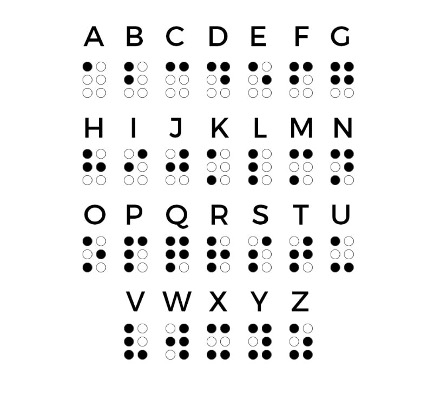
Those visually impaired frequently demonstrate heightened proficiency in their functioning senses when compared to sighted people. Regions of the brain that are deprived of targeted sensory inputs may undergo the readjustment of resource processing to other sensory modalities (Mašić et al., 2020). Sensory specific areas like the visual cortex, receive direct and prompt inputs from other stimulus systems in the body. The National Library of Health (Billman, 2020) explored a phenomenon where the visual cortex activates when learning braille (Figure 1). In the case of children with congenital blindness, the visual cortex undergoes redistribution at an early age in order to accommodate the depletion of sight.

Figure 1: The figure expressed above exemplifies the English Alphabet and their translations to Braille. In the Braille alphabet, specific patterns are followed. Braille consists of raised dots arranged in a grid of sic dots, organized into two columns of three dots each. Different combinations of raised dots within this grid represents letters, numbers, and other symbols. (Canada Science and Technology, n.d.)
A cohort composing of 12 subjects with early onset blindness (either congenital or acquired before the age of three) was contrasted with a control group of 16 individuals, all possessing typical visual acuity within the same age bracket (Billman, 2020). The neuroimaging scans of the premature blindness cohort revealed clear distruptions in both structural and functional brain connectivity (Mašić et al., 2020). Notably, augmented connections in certain regions of the brain were also observed. This was concluded to facilitate bi-directional information exchange in the readjustment of resource processing stated above. This phenomenon was not observed in the control group. The learning of braille can be connected to this clear bi-directional information exchange.
Typically, the visual pathway begins with the eye, where light signals from the surrounding areas are converted into neuron impulses in the retina. This visual information then travels through the optic nerve, optic chiasm, and then the optic tract to reach the thalamus (specifically two lateral geniculate nuclei). The lateral geniculate nuclei that make up the thalamus act as the control centre for processing information, sorting it into three areas of the brain: the primary visual cortex, the superior colliculi, and the pretectal area (Mašić et al., 2020). In order to grasp the study on how the brain adapts this natural process learns to read through touch, it is crucial to comprehend the structure and function of the visual and parietal lobes. These lobes are vital for the reading of braille. Understanding the anatomy and neurology of these brain regions is key to unraveling the intricacies of brain plasticity and tactile braille reading.
When a blind individual reads braille, the visual cortex aids in touch processing. Unlike sighted people who utilize the visual cortex in order recognize letters, those who are blind utilize the sense of touch. This ability to modify another sense in order to fill the role of a non-existing one shows how remarkable the the brain is.
Work Cited
Billman, G.E., 2020. Homeostasis: The Underappreciated and Far Too Often Ignored Central Organizing Principle of Physiology. Frontiers in Physiology, 11, p.200. https://doi.org/10.3389/fphys.2020.00200.
Mašić, V., Šečić, A., Trošt Bobić, T. and Femec, L., 2020. Neuroplasticity and Braille reading. Acta Clinica Croatica, 59(1), pp.147–153. https://doi.org/10.20471/acc.2020.59.01.18.
Torday, J.S., 2015. Homeostasis as the Mechanism of Evolution. Biology, 4(3), pp.573–590. https://doi.org/10.3390/biology4030573.
Comments
18 Responses to “Seeing Through Your Fingers”
Hey Isci! Want to know about the brain and how it redistributes? Check this out! I love learning about Neuroplasiticity and find it such an amazing and interesting topic! Let me know what you think!
I also dont know how to add indentations
so any help is welcome!
Hi Ariya,
Your blog post was very interesting and very well written! The human brain and all its capabilities never ceases to amaze me!
Some suggestions I have are the following:
-In the second paragraph, the National Library of Health is referenced, the specific posting this information was received from should also be cited within the bibliography and the article’s year should be in brackets behind “National Library of Health”. Or, if this is simply an article from the NLM website, it is better to say, “According to author last name (year of article)” rather than the National Library of Health.
This same concept (addition of the article’s year) also applies to the third paragraph’s mention of the Massachusetts Eye and Ear Researchers.
– Don’t forget to add an in-text citation to the last sentence of your figure caption.
– The first sentence of fourth paragraph should have an in-text citation.
– Consider adding another academic journal to supplement the article, several paragraphs contain only one citation from the same source.
Again, great job and happy editing!
– Rakel
Oops! Must’ve slipped my mind with the figure caption but I will definitely add that as well as the years of publication! Thank you Rakel!
Hi Ariya,
I really enjoyed your post on neuroplasticity. Studying the brain is an interesting research area as it unveils the intricate mechanisms behind human cognition and behaviour. Here are some suggestions that you can consider while editing your post:
– In the fifth sentence of your first paragraph, the Eckart citation requires a comma after the author’s name. For example, (Eckart, 2019).
– Throughout the post, the Mašić in-text citations should be re-formatted to be “(Mašić, 2020)”.
– When referring to braille code, “braille” should not be capitalized. However, I recommend double-checking each circumstance to make sure that you aren’t referring to the inventor of the system, Louis Braille, in which case you should capitalize accordingly.
– I recommend removing the indent at the start of your concluding paragraph.
– Double-check the Eckart, 2019 and Daily, 2020 citations in your reference list, as both sources have the same title and URL. Also, make sure to cite the Daily, 2020 source throughout your text.
Overall, you presented some really interesting research, and I’m excited to read your final copy.
Cheers,
Adam
I will check the citations and the indentation! Thank you so much!
Hey Ariya,
Great post overall and I really enjoyed reading how what many consider to be the common sense regarding the loss of a sense heightens others has been investigated. I had the following suggestions to make small improvements on your post:
In your figure caption you mention sic dots? I believe you meant this to be six
For your Works Cited, perhaps bold it and increase the text size just to offset it from the rest of the article
Just a note of clarity, when you mention bi-directional information exchange in your paragraph following the figure, its not immediately clear what this means. Whilst, it becomes apparent in the conclusion you may want to define the term in a little more detail when its introduced.
All and all, great post and I can’t wait to see the final copy.
Ed
Thank you so much for spotting the typo! I really appreciate it!
Hi Ariya,
This was an engaging and easy to read blog post!
– in P2: I would put a proper citation instead of saying “according to the National Library of Health”. I would also say (Figure 1) instead of (see Figure 1).
– There is great bio content in this post, I would try and integrate another science as well. The most applicable may be incorporating psychology content. Alternatively, it may be possible to incorporate some physics or chemistry since you are talking about the brain and brain imaging.
– It may be helpful for the reader if you included a visual of the brain as you are talking about the areas in P4. It would be interesting if you could find/ create an image that shows the pathway differences between seeing and non-seeing people.
Overall, you chose a really interesting topic and I enjoyed reading your post. Happy editing!
Jeysa
I was thinking of maybe adding some chemistry but some pyschology is a great idea! Thank you so much Jeysa
Hi Ariya,
This was a really interesting blog post on braille! I just have a few suggestions:
– In paragraph three, consider revising the start of the second sentence to “The examination of neuroimaging scans…”
– In the second sentence of your fourth paragraph, consider adding a comma after “optic chiasm”. Additionally, there should be a comma after “smell” in your second sentence.
– Consider adding a second figure that outlines the anatomy of the brain to match your fourth paragraph. This could help visual learners better understand the content you are discussing.
– In the Masic (2020) citation, there are other authors that need to be included in the reference list and internal citation. Ensure that you double check the link (https://doi.org/10.20471/acc.2020.59.01.18) for the full author list.
Overall, this was well-written and I can’t wait to read the final copy! Happy editing!
Vikram
What would you suggest about another figure, maybe the brain with the parts? Thank you!
Hi Ariya,
This was a very amazing blog post about braille and neuroplasticity!
Some suggestions I have for you are:
– In your first in text citation you are missing the comma between the author’s last name and year
– Instead of saying ‘see figure 1’ I think you can have it as (Figure 1)
– I would recommend using a different figure or adding a second one to further explain the concepts you are discussing
Overall, this is a really good topic and very well written blog post, good luck editing!
Ahad.S
Thanks for the corrections Ahad! I will add the comma for sure!
Hi Ariya,
This was a great blog post to read! Your use of clear vocabulary and language made it easy to understand specific parts of the brain and their functions. Here are a few suggestions:
1) I think that it might be better to introduce your (Eckart 2019) citation earlier to the sentence before it, as the following sentence that defines what neuroplasticity is can be linked to the same source
2) For when you mention “National Library of Health” make sure to have a proper year citation after it
3) Where is this figure from? There should be a citation in the figure caption
4) When you mention “Massachusetts Eye and Ear Researchers,”who are these researchers? That is, there should be a citation right at the end of this sentence to define who did this investigation
5) Paragraph 4 requires more citations as information on the brain and its functions are not common knowledge. However, if all the information is from the source you provided in that paragraph, it should be brought up earlier. That way, it is clear that the information you mentioned later can be linked to that one source
6) Make sure to have indentations consistent throughout your blog post. For example, your last paragraph has an indent while your previous paragraphs did not
7) Be sure to look over your citations, as “Eckart, K […]” has the same title as “Daily, S. […]”but are different authors
8) I believe that there are more reliable sources to use that will define neuroplasticity instead of citing a news article. I recommend looking at DOI articles and neuroscience journals to acquire these sources
Overall, this was a very well-written blog post! Excited to see the final draft!
All the best,
Russell
Hey Russel! Thank you so much for the feedback! I did go ahead and fix the indentations as well as the citations! Thank you so much
Hi Aria,
I liked that you used a super unique way to begin your blog post. It immediately caught my attention. You used your figure really effectively too! I easily understood with your caption and it was in the perfect place in your post to aid comprehension.
Here are my recommendations:
– Consider altering your third sentence to “as one sense is being ‘turned off’, notice how heightened your other senses have become” or “… notice the rest of your sense…”. This may clarify the comparison you are trying to draw attention to.
– Changing “…in the case of activating the visual cortex…” to “… in the case of visual cortex activation…” might make your writing flow a little better.
– “…the visual and parietal lobes, lobes vital for the..” could be shortened to “the visual and parietal lobes, vital for the..”
– Consider changing your works cited heading to be bold or a different colour/size to make the separation obvious
Awesome work! I really enjoyed reading and learning about your topic. Best of luck editing!
Kyla
Sorry for the typo, Ariya! I don’t know how to edit it!