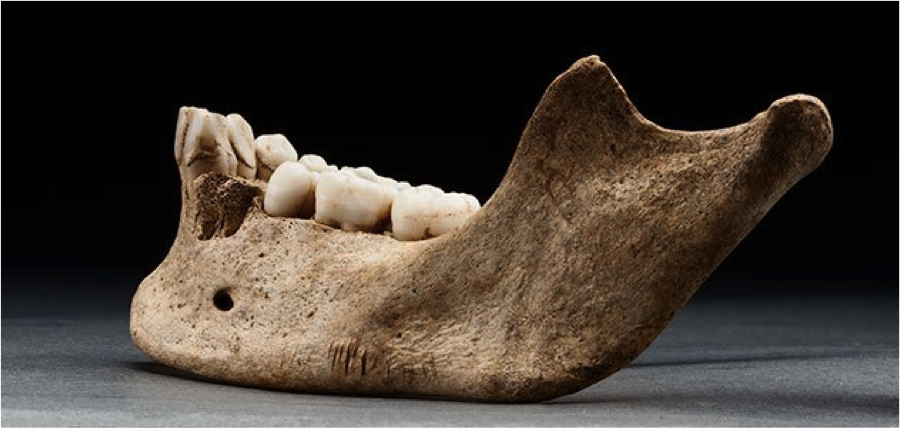
The Hallowe’en season conjures all sorts of monsters, legends, and gruesome displays that are allegedly grounded in truth. Grisly murders, ghost hauntings, and appalling acts of cannibalism survive as folklore – but is there evidence to suggest that cannibals did exist? For hundreds of years, Inuit legends told of cannibalism among doomed explorers of the 1845 Franklin Expedition (Zerehi, 2015). Only recently did scientists garner proof that the chilling stories were true.
Anthropologists believe that human cannibalism was practiced historically for several different reasons. Revenge cannibalism as a form of torture may have involved consumption of parts of a victim’s body while they watched. Some cultures employed ritual cannibalism of deceased relatives as a mortuary rite. Finally, some human populations may have resorted to cannibalism in the face of starvation (Flinn, Turner and Brew, 1976). This practice has also been observed in many animal species in times of resource scarcity, including fish, toads, and insects (Fox, 1975).
It is very difficult to find physical evidence of the actual consumption of human flesh, so research must instead focus on indirect signs (Marlar, et al., 2000). Archaeologists have come to recognize tell-tale signs of butchering, the most simple of which is the disarticulation or scattering of bones (Flinn, Turner and Brew, 1976). Skeletons of individuals peacefully laid to rest would likely be found in one area.

Another simple observation is the presence of cut marks (Figure 1), which are deep grooves in bones, likely made by a knife during removal of edible tissues. Such cuts are often observed parallel to joints, and suggest somewhat skillful human butchering rather than gnawing by scavenging animals (Flinn, Turner and Brew, 1976). Many bones from the Franklin expedition bore such cut marks (Zerehi, 2015).

Indications of trauma can also point to cannibalism. Heavy blows to the head to expose brain tissue produce radiating fractures or even crush the skull (Flinn, Turner and Brew, 1976). Percussion pits, which are circular crushed regions of bone, can also indicate such impacts (Degusta, 2000). Sharp-edged clean breaks in long bones may be observed, as these would have exposed edible marrow (Figure 2). Greenstick splintering may also be observed; similar to green twigs, these fractures involve a fraying, partial break in which one side of the bone severs but the other merely bends (Pountos, Clegg and Siddiqui, 2010). These fractures occur when bones are still “fresh”, which implies that that they occurred soon after death, rather than post-burial. In the case of the Franklin Expedition, some bones were found in heating vessels so as to extract marrow, and were found in a polished state indicative of such a boiling practice (Zerehi, 2015).
Charring of skeletal remains suggests that tissue may have been roasted on the bone. In some cases, fracture edges are charred, which shows that formal cremation did not take place and bones were instead burned after they had been broken (Flinn, Turner and Brew, 1976). It is also possible to infer the circumstances under which cadavers were burned, as specific patterns of charring correlate to bare bones, partial soft tissue cover, or other conditions (Degusta, 2000).
Finally, chemical assays can provide more direct evidence for cannibalism. For example, residue from cooking vessel artifacts can be tested for human myoglobin, which is present only in muscle cells and would indicate preparation of human flesh for consumption (Marlar, et al., 2000). Furthermore, analysis of human coprolites (fossilized excrement) can be used to infer dietary habits. Although human cells, including those from intestinal lining, are often excreted along with digested material, myoglobin content of coprolites can also be tested. A study of a prehistoric Puebloan site in Colorado revealed that although myoglobin is partially digested, levels in excrement of cannibalistic populations is higher than the undetectable levels in stool from modern populations (Marlar, et al., 2000).
Evidence of historic cannibalism for torture, ritual, or survival can be obtained through physical indicators and chemical analyses. The legend of the Franklin Expedition is true. Thankfully, such barbaric practices are a thing of the past – or are they?
References:
Degusta, D., 2000. Fijian Cannibalism and Mortuary Ritual: Bioarchaeological Evidence from Vunda. International Journal of Osteoarchaeology, 10, pp.76–92.
Diamond, J.M., 2000. Archaeology: Talk of cannibalism. Nature, 407, pp.25–56.
Flinn, L., Turner, C.G. and Brew, A., 1976. Additional Evidence for Cannibalism in the Southwest: The Case of LA 4528. American Antiquity, 41(3), pp.308–318.
Fox, L.R., 1975. Cannibalism in Natural Populations. Annual review of ecology and systematics, 6, pp.87–106.
Herrmann, R.B., 2011. The ‘tragicall historie’: Cannibalism and Abundance in Colonial Jamestown. The William and Mary Quarterly, 68(1), pp.47–74.
Marlar, R.A., Leonard, B.L., Billman, B.R., Lambert, P.M. and Marlar, J.E., 2000. Biochemical evidence of cannibalism at a prehistorical Puebloan site in southwestern Colorado. Nature, 407, pp.74–78.
Pountos, I., Clegg, J. and Siddiqui, A., 2010. Diagnosis and treatment of greenstick and torus fractures of the distal radius in children: a prospective randomised single blind study. Journal of Children’s Orthopaedics, 4(4), pp.321–326.
Stromberg, J., 2013. Starving Settlers in Jamestown Colony Resorted to Cannibalism. Smithsonian Magazine. [online] Apr. Available at: <http://www.smithsonianmag.com/history/starving-settlers-in-jamestown-colony-resorted-to-cannibalism-46000815/?no-ist>.
Zerehi, S.S., 2015. Franklin expedition to Arctic included cannibalism, researchers say. [online] CBC News. Available at: <http://www.cbc.ca/news/canada/north/franklin-expedition-to-arctic-included-cannibalism-researchers-say-1.3174502> [Accessed 2 Nov. 2015].