Microplastics have become a modern concern for the health of our ecosystems as well as for our own bodies. Between 1950 and 2015, approximately 6.3 billion tonnes of plastic waste were globally produced, and it is estimated that in 2015, up to 51 trillion microplastic particles (MPs) were drifting in the ocean waters (Xiang, et al., 2022). Unfortunately, this number has only increased over time. MPs are defined as plastic particles that are smaller than 5 mm in size (Thompson, et al., 2009). The abundance of MPs in the environment and the effects of these particles on human health must be analyzed so we can better understand the consequences of our actions and how we can improve going forward.
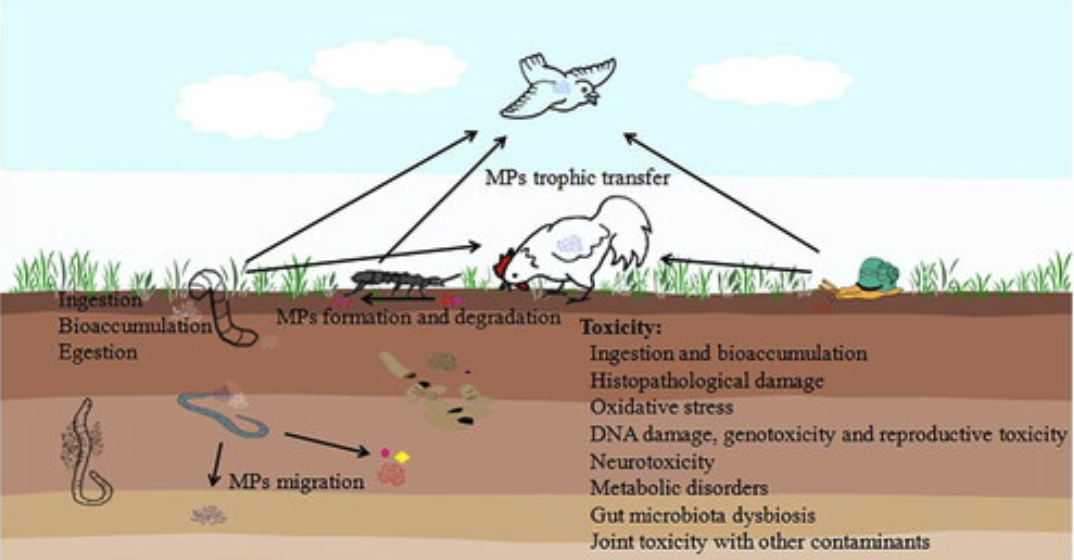
MPs typically have a large surface area to volume ratio and are strongly hydrophobic, meaning they can easily absorb and concentrate on various environmental pollutants (Xiang, et al., 2022). For example, MPs are great sorbent substances for heavy metals in the environment, such as aluminum, arsenic, and nickel. The MPs bind to these heavy metals, release toxic substances, and negatively impact soil in several ways such as disrupting the microfaunal component, chemical properties, and soil fauna (Kasmuri, Tarmizi and Mojiri, 2022). MPs can induce negative effects on the growth, reproduction, and lifespan of soil fauna species such as earthworms and nematodes through toxicity mechanisms such as bioaccumulation, oxidative stress, genotoxicity, and metabolic disorders (Figure 1) (Wang, et al., 2022). MPs also degrade relatively slowly, and their lifetime in the environment may extend between months to thousands of years (Kasmuri, Tarmizi and Mojiri, 2022). Therefore, the presence of MPs in these natural ecosystems cannot decline as quickly as they accumulate and are a rising concern for the floral and faunal species.

Figure 1: Diagram describing the movement of microplastic particles (MPs) and possible toxicity mechanisms in a terrestrial setting. The arrows represent the movement of MPs through the environment and the arrow points from the prey to the predator. The small phrases beside the black arrows describe the type of movement mechanism that is occurring (eg. MP trophic transfer and MP migration). On the bottom right, there is a list of the possible toxicity mechanisms that may be occurring in this environment (Wang, et al., 2022).
Although the effect of MPs on animals and humans is not perfectly understood, the effects of some microplastic materials are known. It has been well-researched that humans most commonly ingest MPs through food, drinking water, and inhalation (Cox, et al., 2019). A few common chemicals of concern are bisphenols, phthalates, dyes, and flame retardants, which are often added to plastics and eventually assemble in animals and humans through bioaccumulation. In the bodies of these organisms, the bioaccumulation of MPs can cause cancer or disrupt the endocrine system functions (Kasmuri, Tarmizi and Mojiri, 2022). For example, polyamide (PA) and polyurethane (PU) exhibited the highest irreversible sorption ability for bisphenol A (BPA), due to hydrogen bonding. This strong bond is formed between the hydrogen-bond-donating BPA particle and the hydrogen-bond-accepting amide groups residing on the PA or PU particles (Figure 2). BPA is a moderately toxic environmental estrogen that may be associated with cardiovascular disease, reproductive disorders and breast cancer (Liu, et al., 2019). This bonded molecule is also more harmful than the BPA, PU, or PA molecules analyzed separately.

Figure 2: The chemical structure of bisphenol A (BPA). The polyamide or polyurethane molecule would bind to the OH groups on the left and right sides of the BPA molecule (Cousins, et al., 2002).
The abundance and effects of MPs must be understood so effective treatment plans can be created. Through understanding the damage that MPs have on our bodies and ecosystems, it is hoped that companies will attempt to reduce the amount of plastics produced. This will help to lower the number of microplastics in our ecosystems and hopefully, grant more time for remediation efforts to be employed.
References
Cousins, I., Staples, C.A., Klecka, G. and Mackay, D., 2002. A Multimedia Assessment of the Environmental Fate of Bisphenol A. Human and Ecological Risk Assessment, 8, pp.1107–1135. https://doi.org/10.1080/1080-700291905846.
Cox, K.D., Covernton, G.A., Davies, H.L., Dower, J.F., Juanes, F. and Dudas, S.E., 2019. Human Consumption of Microplastics. Environmental Science & Technology, 53(12), pp.7068–7074. https://doi.org/10.1021/acs.est.9b01517.
Kasmuri, N., Tarmizi, N.A.A. and Mojiri, A., 2022. Occurrence, impact, toxicity, and degradation methods of microplastics in environment—a review. Environmental Science and Pollution Research, 29(21), pp.30820–30836. https://doi.org/10.1007/s11356-021-18268-7.
Liu, X., Shi, H., Xie, B., Dionysiou, D.D. and Zhao, Y., 2019. Microplastics as Both a Sink and a Source of Bisphenol A in the Marine Environment. Environmental Science & Technology, 53(17), pp.10188–10196. https://doi.org/10.1021/acs.est.9b02834.
Thompson, R.C., Moore, C.J., vom Saal, F.S. and Swan, S.H., 2009. Plastics, the environment and human health: current consensus and future trends. Philosophical Transactions of the Royal Society B: Biological Sciences, 364(1526), pp.2153–2166. https://doi.org/10.1098/rstb.2009.0053.
Wang, Q., Adams, C.A., Wang, F., Sun, Y. and Zhang, S., 2022. Interactions between microplastics and soil fauna: A critical review. Critical Reviews in Environmental Science and Technology, 52(18), pp.3211–3243. https://doi.org/10.1080/10643389.2021.1915035.
Xiang, Y., Jiang, L., Zhou, Y., Luo, Z., Zhi, D., Yang, J. and Lam, S.S., 2022. Microplastics and environmental pollutants: Key interaction and toxicology in aquatic and soil environments. Journal of Hazardous Materials, 422, p.126843. https://doi.org/10.1016/j.jhazmat.2021.126843.