Is it a bird? Is it a plane? Is it Superman? Even better, it’s Super-Coral, the potential solution to coral reef conservation! Coral reefs are some of the most genetically diverse ecosystems on planet Earth, providing a habitat for around a third of all marine species (Fisher et al. 2015). Unfortunately, climate change caused by human greenhouse gas emissions has posed a great threat to their health, causing ocean warming, ocean acidification, and a higher frequency of harmful weather events (Voolstra, Peixoto, and Ferrier-Pagès 2023). According to estimations from 2021, 70-90% of reefs could be lost if global temperatures rise by 1.5°C, and if they rise by 2.0°C, we could face a 99% loss (Knowlton et al. 2021). Evidently, these precious ecosystems are in jeopardy, and thus scientists have taken to some avant-garde conservation methods.
The term “Super-Coral” is not scientific, rather it’s a colloquial umbrella term that refers to increasing the fitness of coral through several parallel conservation methods, including assisted evolution, genetic engineering, and assisted symbiosis. A 2018 used CRISPR-Cas9, a gene-editing tool that utilizes a guide RNA and Cas9 endonuclease to induce a double-stranded break in DNA for modification purposes (Redman et al. 2016), to prove that coral genes can be successfully disrupted (Cleves et al. 2018). The coral species Acropora millepora was chosen, and target genes included those which encoded for fibroblast growth factor 1a (FGF1a), a protein responsible for the growth and development of coral, green fluorescent protein (GFP), a protein useful for UV protection, and red fluorescent protein (RFP), a protein responsible for photosynthesis enhancement (Gittens et al. 2015). First, signal guide RNAs (sgRNAs) were designed target the desired sequences and complexed with Cas9 proteins. These were microinjected into embryos, and their development was monitored (Figure 1). GFPwas the gene knocked out to demonstrate successful genome editing, while RFP served as an injection marker to confirm reagent delivery, and FGF1a was injected to monitor normal embryonic development. Together, these three components showed that CRISPR editing worked, was delivered successfully, and did not damage embryo viability (Cleves et al. 2018).
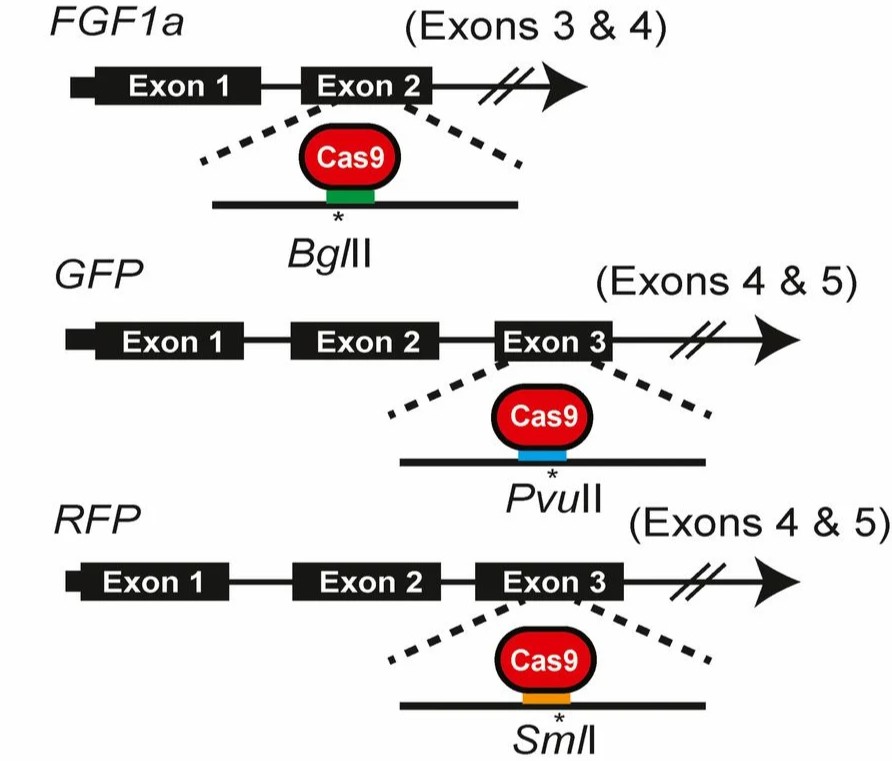
It is important to note that genetically edited coral animals have not been introduced into a real-world environment, they remain in developmental stages. However, other relevant methods for coral conservation include assisted evolution and assisted symbiosis. Assisted evolution refers to using techniques that accelerate the natural evolutionary processes that improve coral fitness, while assisted symbiosis refers to utilizing symbiotic partners of coral to modify traits within the animal. For example, introducing a more heat-resilient strain of algae can reduce the effects of bleaching, which occurs in increased water temperatures (Bowden-Kerby 2022).
Overall, despite the multitude of threats facing coral reefs, emerging technologies like genetic engineering, assisted evolution, and assisted symbiosis provide hope for their future. While still in early stages, they demonstrate that coral biology can be modified in ways that may boost fitness and improve survival.
References
Bowden-Kerby, Austin. 2022. “Coral-Focused Climate Change Adaptation and Restoration Based on Accelerating Natural Processes: Launching the ‘Reefs of Hope’ Paradigm.” Oceans 4 (1): 13–26. https://doi.org/10.3390/oceans4010002.
Fisher, Rebecca, Rebecca A. O’Leary, Samantha Low-Choy, Kerrie Mengersen, Nancy Knowlton, Russell E. Brainard, and M. Julian Caley. 2015. “Species Richness on Coral Reefs and the Pursuit of Convergent Global Estimates.” Current Biology 25 (4): 500–505. https://doi.org/10.1016/j.cub.2014.12.022.
Gittins, John R., Cecilia D’Angelo, Franz Oswald, Richard J. Edwards, and Jörg Wiedenmann. 2015. “Fluorescent Protein-Mediated Colour Polymorphism in Reef Corals: Multicopy Genes Extend the Adaptation/Acclimatization Potential to Variable Light Environments.” Molecular Ecology 24 (2): 453–65. https://doi.org/10.1111/mec.13041.
Knowlton, Nancy, Emily Corcoran, Thomas Felis, Sebastian Ferse, Jasper de Goeij, Andréa Grottoli, Simon Harding, et al. 2021. “Rebuilding Coral Reefs: A Decadal Grand Challenge.” International Coral Reef Society and Future Earth Coasts, July. https://doi.org/10.53642/nrky9386.
Redman, Melody, Andrew King, Caroline Watson, and David King. 2016. “What Is CRISPR/Cas9?” Archives of Disease in Childhood – Education & Practice Edition 101 (4): 213–15. https://doi.org/10.1136/archdischild-2016-310459.
Voolstra, Christian R, Raquel S Peixoto, and Christine Ferrier‐Pagès. 2023. “Mitigating the Ecological Collapse of Coral Reef Ecosystems.” EMBO Reports 24 (4). https://doi.org/10.15252/embr.202356826.
Leave a Reply
You must be logged in to post a comment.