Our life is plasticized, we absorb, inhale and wear microplastics daily (Ziani et al. 2023). They are found in virtually every ecosystem, impacting all species on this planet, as there are around 10 to 40 million metric tons of microplastics released into the environment every year, and based on current trends, by 2060, the annual production of plastic is expected to triple (Thompson et al. 2024). This means that human exposure to microplastics will only increase in the coming decades (Thompson et al. 2024). Due to this, microplastics are infiltrating our human bodies, being found in eight of the twelve human organ systems, including the cardiovascular, digestive, endocrine, integumentary, lymphatic, respiratory, reproductive, and urinary systems (Roslan et al. 2024).
Microplastics enter the human body through a variety of ways, the main ones being ingestion, inhalation and dermal exposure (Figure 1)(Sun and Wang 2023). Through ingestion, microplastics are found in bottled water, tap water, seafood and even crops grown in contaminated soil (Ziani et al. 2023). Additionally, heating food in plastic containers releases microplastics (Ziani et al. 2023). Through inhalation, microplastics from synthetic textiles get stirred in the air and are inspired by humans. This could be from vehicle tires, urban dust, synthetic furniture and carpets within homes (Saha and Saha 2024). Lastly, polyester clothing sheds plastic fibres during washing and wearing (Saha and Saha 2024). Cosmetic products such as toothpaste, bodywash and makeup contain microbeads, causing further dermal absorption (Canada 2015).
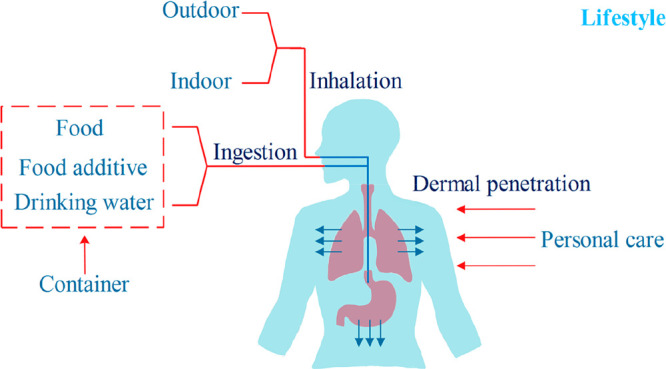
Figure 1: Diagram displaying how microplastics enter the human body through inhalation, ingestion and dermal penetration (Sun and Wang 2023).
Now the big question is, how do these microplastics affect the human body? Major issues are that they can affect our cardiovascular and reproductive systems (Irfan et al. 2025). Studies have shown a link between increased microplastics and abnormalities in the cardiovascular systems, such as increased blood pressure, cardiovascular inflammation and myocardial damage (Figure 2)(Marfella et al. 2024). In one particular study, researchers tested plaque removed from the neck arteries of 257 people and found polyethylene and polyvinyl chloride microplastics in 60% of individuals (Marfella et al. 2024). The research followed the patients three years after the procedure was done and found that the individuals who had microplastics detected in their arterial plaque were 4.5 times more likely to experience a heart attack or stroke, potentially leading to death (Marfella et al. 2024).
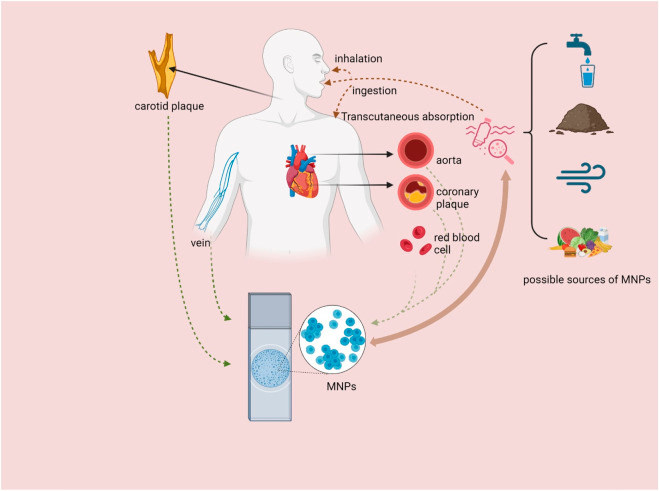
Figure 2: Visual representation of how microplastics cause cardiovascular health issues. The possible causes of microplastics are tap water, soil particles in the wind and food. These then get transferred into the body through inhalation, ingestion and transcutaneous absorption (penetrate through skin and enter the bloodstream). The effects of the blood vessels cause the buildup of coronary plaque, leading to issues such as heart attacks (Zheng et al. 2024).
In the reproductive system, microplastics cause oxidative stress and inflammation, interfering with hormones and damaging reproductive tissue (Inam 2025). This happens in both males, impacting sperm quality and testicular structure and in females, affecting ovarian function and placental dysfunction (Inam 2025; Karimian and Yaqubi 2026). More specifically, microplastics can cross the placenta and act as carriers for toxic chemicals, negatively affecting fetal development, leading to pregnancy complications (Sharma et al. 2024). With evidence from both animal and human studies, this impacts the brain, immune, liver, lungs and heart development of the fetus (Sharma et al. 2024).
Within the brain, there is a higher portion of polyethylene, which is a type of microplastic, compared to the kidney and liver (Nihart et al. 2025). Using electron microscopy, nanoscale shard-like fragments of microplastics were found within the brain (Nihart et al. 2025). With an even greater accumulation found in human brains of patients who had a documented dementia diagnosis (Nihart et al. 2025). With the most deposition occurring in the cerebrovascular walls and immune cells (Nihart et al. 2025). Thus, microplastics are causing complications in the most important organ in our body, the brain, potentially leading to cognitive decline (Kim et al. 2025).
Microplastics are now not just an environmental problem but also a human health issue (Ziani et al. 2023). These tiny particles are making their way into the human body and causing an abundance of problems, and scientists are now just uncovering the potential effects of these microplastics, and continued exposure may cause major health challenges in the future (Ziani et al. 2023).
References
Canada, Environment and Climate Change. 2015. “Microbeads – A Science Summary.” Assessments;research. July 8. https://www.canada.ca/en/environment-climate-change/services/evaluating-existing-substances/microbeads-science-summary.html.
Inam, Özen. 2025. “Impact of Microplastics on Female Reproductive Health: Insights from Animal and Human Experimental Studies: A Systematic Review.” Archives of Gynecology and Obstetrics 312 (1): 77–92. https://doi.org/10.1007/s00404-024-07929-w.
Irfan, Hamza, Haider Irfan, Muhammad Ahtesham Khan, Oyku Inanc, and Md. Al Hasibuzzaman. 2025. “Microplastics and Nanoplastics: Emerging Threats to Cardiovascular Health – a Comprehensive Review.” Annals of Medicine and Surgery 87 (1): 209–16. https://doi.org/10.1097/MS9.0000000000002831.
Karimian, Mohammad, and Sahar Yaqubi. 2026. “Microplastics and Male Reproductive System: A Comprehensive Review Based on Cellular and Molecular Effects.” Toxicology Reports 16 (February): 102226. https://doi.org/10.1016/j.toxrep.2026.102226.
Kim, Dong Yeon, Min Kyu Park, Hyun Wook Yang, et al. 2025. “Effects of Microplastic Accumulation on Neuronal Death After Global Cerebral Ischemia.” Cells 14 (4): 241. https://doi.org/10.3390/cells14040241.
Marfella, Raffaele, Francesco Prattichizzo, Celestino Sardu, et al. 2024. “Microplastics and Nanoplastics in Atheromas and Cardiovascular Events.” New England Journal of Medicine 390 (10): 900–910. https://doi.org/10.1056/NEJMoa2309822.
Nihart, Alexander J., Marcus A. Garcia, Eliane El Hayek, et al. 2025. “Bioaccumulation of Microplastics in Decedent Human Brains.” Nature Medicine 31 (4): 1114–19. https://doi.org/10.1038/s41591-024-03453-1.
Roslan, Nur Sakinah, Yeong Yeh Lee, Yusof Shuaib Ibrahim, et al. 2024. “Detection of Microplastics in Human Tissues and Organs: A Scoping Review.” Journal of Global Health 14: 04179. https://doi.org/10.7189/jogh.14.04179.
Saha, Suvash C., and Goutam Saha. 2024. “Effect of Microplastics Deposition on Human Lung Airways: A Review with Computational Benefits and Challenges.” Heliyon 10 (2): e24355. https://doi.org/10.1016/j.heliyon.2024.e24355.
Sharma, Raj Kishor, Usha Kumari, and Sudhir Kumar. 2024. “Impact of Microplastics on Pregnancy and Fetal Development: A Systematic Review.” Cureus 16 (5): e60712. https://doi.org/10.7759/cureus.60712.
Sun, Anqi, and Wen-Xiong Wang. 2023. “Human Exposure to Microplastics and Its Associated Health Risks.” Environment & Health 1 (3): 139–49. https://doi.org/10.1021/envhealth.3c00053.
Thompson, Richard C., Winnie Courtene-Jones, Julien Boucher, Sabine Pahl, Karen Raubenheimer, and Albert A. Koelmans. 2024. “Twenty Years of Microplastic Pollution Research—What Have We Learned?” Science 386 (6720): eadl2746. https://doi.org/10.1126/science.adl2746.
Zheng, Haixiang, Gianpaolo Vidili, Gavino Casu, Eliano Pio Navarese, Leonardo A. Sechi, and Youren Chen. 2024. “Microplastics and Nanoplastics in Cardiovascular Disease-a Narrative Review with Worrying Links.” Frontiers in Toxicology 6: 1479292. https://doi.org/10.3389/ftox.2024.1479292.
Ziani, Khaled, Corina-Bianca Ioniță-Mîndrican, Magdalena Mititelu, et al. 2023. “Microplastics: A Real Global Threat for Environment and Food Safety: A State of the Art Review.” Nutrients 15 (3): 617. https://doi.org/10.3390/nu15030617.

Leave a Reply
You must be logged in to post a comment.