The Human Genome Project (HGP) has been one of the greatest biological accomplishments to date. This endeavour to map each and every nucleotide base that makes up our DNA blueprint was completed by the collective efforts of scientists all over the world. Given the magnitude of this project, one is inspired to wonder––how was this done? what were the ethical obstacles that needed to be overcome? and what ingenuous techniques enabled the achievement of this goal?
Mapping the human genome had been a legitimate consideration since the automation of sequencing in the 1980s (National Human Genome Research Institute (NHGRI), 2012). In the 1990s, two large bodies emerged, the International Human Genome Sequencing Consortium (IHGSC) and Celera Genomics, comprising biologists from all over the world who would spend the next 15 years detailing each nucleotide of the euchromatic portion of our genome.
But in order to begin their journey, these two bodies needed to attain ethical approval through the Ethical, Legal, and Social Implications (ELSI) program, whereby the continuation of the Human Genome Project was dependent on IHGSC and Celera’s successful compliance of the following guidelines (Lister Hill National Center for Biomedical Communications, 2018):
a level of privacy must be attributed to genetic information that prohibits ethnicity-based discrimination in employment and insurance;
the process of informed consent must be a prerequisite for participants of genomic research;
and the education of healthcare professionals must be updated to include learning of protocols pertaining to the safe use of novel, genetic techniques.
In February of 2001, by when the HGP had reached sufficient bioethical standing, the project had reached its initial phase of completion and two highly influential papers were published, one in Nature by the IHGSC (2001[A]) and one in Science by Celera (Venter et al., 2001).
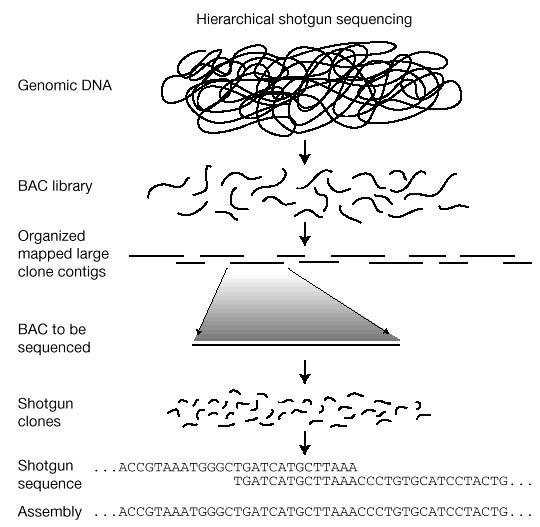
Now let us delve into some of the intricate techniques that played a major role in this journey and continue to play a role in genomics today. Hierarchical shotgun sequencing (Figure 1) is a DNA sequencing strategy that was introduced shortly after the invention of DNA sequencing itself (IHGSC, 2001[A]). Since then, it has become one of the most fundamental methods for large-scale genome sequencing.
This technique requires constructing a library by fragmenting target genomes and cloning these fragments into a large-fragment cloning vector (e.g. Bacterial Artificial Chromosome (BAC) vectors). Then, cloned randomly-fragmented DNA is organized into a physical map, after which individual BAC clones are selected and sequenced randomly. Lastly, assembly and reconstruction allow formation of entire letter-form clone sequences (IHGSC, 2001[A]).

Interestingly, the hierarchical shotgun sequencing technique was further developed by considering pairwise end-sequencing, commonly known as “double-barrel” shotgun sequencing (Anderson, 1981). Using linking information between sequence fragments, this strategy allows sequencing from both ends of double-stranded clones.
The marvels of the Human Genome Project have been documented extensively (National Human Genome Research Institute (NHGRI), 2015). Each development in the journey towards February of 2001 would not have been possible without the efforts of the countless research initiatives involved. The Human Genome Project has opened new avenues in genomics, human evolution, the biomedical field, and more. As research in these fields continues, it will be only a matter of time before we will each have a copy of our own genome.
References
Anderson, S., 1981. Shotgun DNA sequencing using cloned DNase I-generated fragments. Nucleic Acids Research, 9(13), pp.3015–3027.
International Human Genome Sequencing Consortium, 2001[A]. Initial sequencing and analysis of the human genome. Nature, 409(6822), p.860.
International Human Genome Sequencing Consortium, 2001[B]. Hierarchical Shotgun Sequencing. Available at: <https://www.nature.com/articles/35057062> [Accessed 29 Jan. 2018].
Lister Hill National Center for Biomedical Communications, 2018. What were some of the ethical, legal, and social implications addressed by the Human Genome Project? [online] Genetics Home Reference. Available at: <https://ghr.nlm.nih.gov/primer/hgp/elsi> [Accessed 4 Feb. 2018].
National Human Genome Research Institute (NHGRI), 2012. A Brief History of the Human Genome Project. [online] National Human Genome Research Institute (NHGRI). Available at: <https://www.genome.gov/12011239/A-Brief-History-of-the-Human-Genome-Project> [Accessed 29 Jan. 2018].
National Human Genome Research Institute (NHGRI), 2015. All About The Human Genome Project (HGP). [online] National Human Genome Research Institute (NHGRI). Available at: <https://www.genome.gov/10001772/All-About-The–Human-Genome-Project-HGP> [Accessed 29 Jan. 2018].
Venter, J.C., Adams, M.D., Myers, E.W., Li, P.W., Mural, R.J., Sutton, G.G., Smith, H.O., Yandell, M., Evans, C.A., Holt, R.A., Gocayne, J.D., Amanatides, P., Ballew, R.M., Huson, D.H., Wortman, J.R., Zhang, Q., Kodira, C.D., Zheng, X.H., Chen, L., Skupski, M., Subramanian, G., Thomas, P.D., Zhang, J., Miklos, G.L.G., Nelson, C., Broder, S., Clark, A.G., Nadeau, J., McKusick, V.A., Zinder, N., Levine, A.J., Roberts, R.J., Simon, M., Slayman, C., Hunkapiller, M., Bolanos, R., Delcher, A., Dew, I., Fasulo, D., Flanigan, M., Florea, L., Halpern, A., Hannenhalli, S., Kravitz, S., Levy, S., Mobarry, C., Reinert, K., Remington, K., Abu-Threideh, J., Beasley, E., Biddick, K., Bonazzi, V., Brandon, R., Cargill, M., Chandramouliswaran, I., Charlab, R., Chaturvedi, K., Deng, Z., Francesco, V.D., Dunn, P., Eilbeck, K., Evangelista, C., Gabrielian, A.E., Gan, W., Ge, W., Gong, F., Gu, Z., Guan, P., Heiman, T.J., Higgins, M.E., Ji, R.-R., Ke, Z., Ketchum, K.A., Lai, Z., Lei, Y., Li, Z., Li, J., Liang, Y., Lin, X., Lu, F., Merkulov, G.V., Milshina, N., Moore, H.M., Naik, A.K., Narayan, V.A., Neelam, B., Nusskern, D., Rusch, D.B., Salzberg, S., Shao, W., Shue, B., Sun, J., Wang, Z.Y., Wang, A., Wang, X., Wang, J., Wei, M.-H., Wides, R., Xiao, C., Yan, C., Yao, A., Ye, J., Zhan, M., Zhang, W., Zhang, H., Zhao, Q., Zheng, L., Zhong, F., Zhong, W., Zhu, S.C., Zhao, S., Gilbert, D., Baumhueter, S., Spier, G., Carter, C., Cravchik, A., Woodage, T., Ali, F., An, H., Awe, A., Baldwin, D., Baden, H., Barnstead, M., Barrow, I., Beeson, K., Busam, D., Carver, A., Center, A., Cheng, M.L., Curry, L., Danaher, S., Davenport, L., Desilets, R., Dietz, S., Dodson, K., Doup, L., Ferriera, S., Garg, N., Gluecksmann, A., Hart, B., Haynes, J., Haynes, C., Heiner, C., Hladun, S., Hostin, D., Houck, J., Howland, T., Ibegwam, C., Johnson, J., Kalush, F., Kline, L., Koduru, S., Love, A., Mann, F., May, D., McCawley, S., McIntosh, T., McMullen, I., Moy, M., Moy, L., Murphy, B., Nelson, K., Pfannkoch, C., Pratts, E., Puri, V., Qureshi, H., Reardon, M., Rodriguez, R., Rogers, Y.-H., Romblad, D., Ruhfel, B., Scott, R., Sitter, C., Smallwood, M., Stewart, E., Strong, R., Suh, E., Thomas, R., Tint, N.N., Tse, S., Vech, C., Wang, G., Wetter, J., Williams, S., Williams, M., Windsor, S., Winn-Deen, E., Wolfe, K., Zaveri, J., Zaveri, K., Abril, J.F., Guigó, R., Campbell, M.J., Sjolander, K.V., Karlak, B., Kejariwal, A., Mi, H., Lazareva, B., Hatton, T., Narechania, A., Diemer, K., Muruganujan, A., Guo, N., Sato, S., Bafna, V., Istrail, S., Lippert, R., Schwartz, R., Walenz, B., Yooseph, S., Allen, D., Basu, A., Baxendale, J., Blick, L., Caminha, M., Carnes-Stine, J., Caulk, P., Chiang, Y.-H., Coyne, M., Dahlke, C., Mays, A.D., Dombroski, M., Donnelly, M., Ely, D., Esparham, S., Fosler, C., Gire, H., Glanowski, S., Glasser, K., Glodek, A., Gorokhov, M., Graham, K., Gropman, B., Harris, M., Heil, J., Henderson, S., Hoover, J., Jennings, D., Jordan, C., Jordan, J., Kasha, J., Kagan, L., Kraft, C., Levitsky, A., Lewis, M., Liu, X., Lopez, J., Ma, D., Majoros, W., McDaniel, J., Murphy, S., Newman, M., Nguyen, T., Nguyen, N., Nodell, M., Pan, S., Peck, J., Peterson, M., Rowe, W., Sanders, R., Scott, J., Simpson, M., Smith, T., Sprague, A., Stockwell, T., Turner, R., Venter, E., Wang, M., Wen, M., Wu, D., Wu, M., Xia, A., Zandieh, A. and Zhu, X., 2001. The Sequence of the Human Genome. Science, 291(5507), pp.1304–1351.