Epidermolysis Bullosa (EB), is a rare genetic skin condition that renders the skin fragile and prone to blistering upon even mild agitation (National Institute of Health (NIH), 2023). EB affects external and internal epithelial cells (NIH, 2023). Blisters associated with EB can be equivalent to third-degree burns. It is often said that individuals with EB have skin as fragile as a butterfly’s wings. Some complications include fusion of the hands and feet, wheelchair usage, dental and eye problems, and skin cancer (NIH, 2023). The leading research organization for EB states that life expectancy for severe cases ranges from infancy to just 30 years old (EBRP, 2018). EB has been called “the worst disease you’ve never heard of” due to its severe effects and rarity.
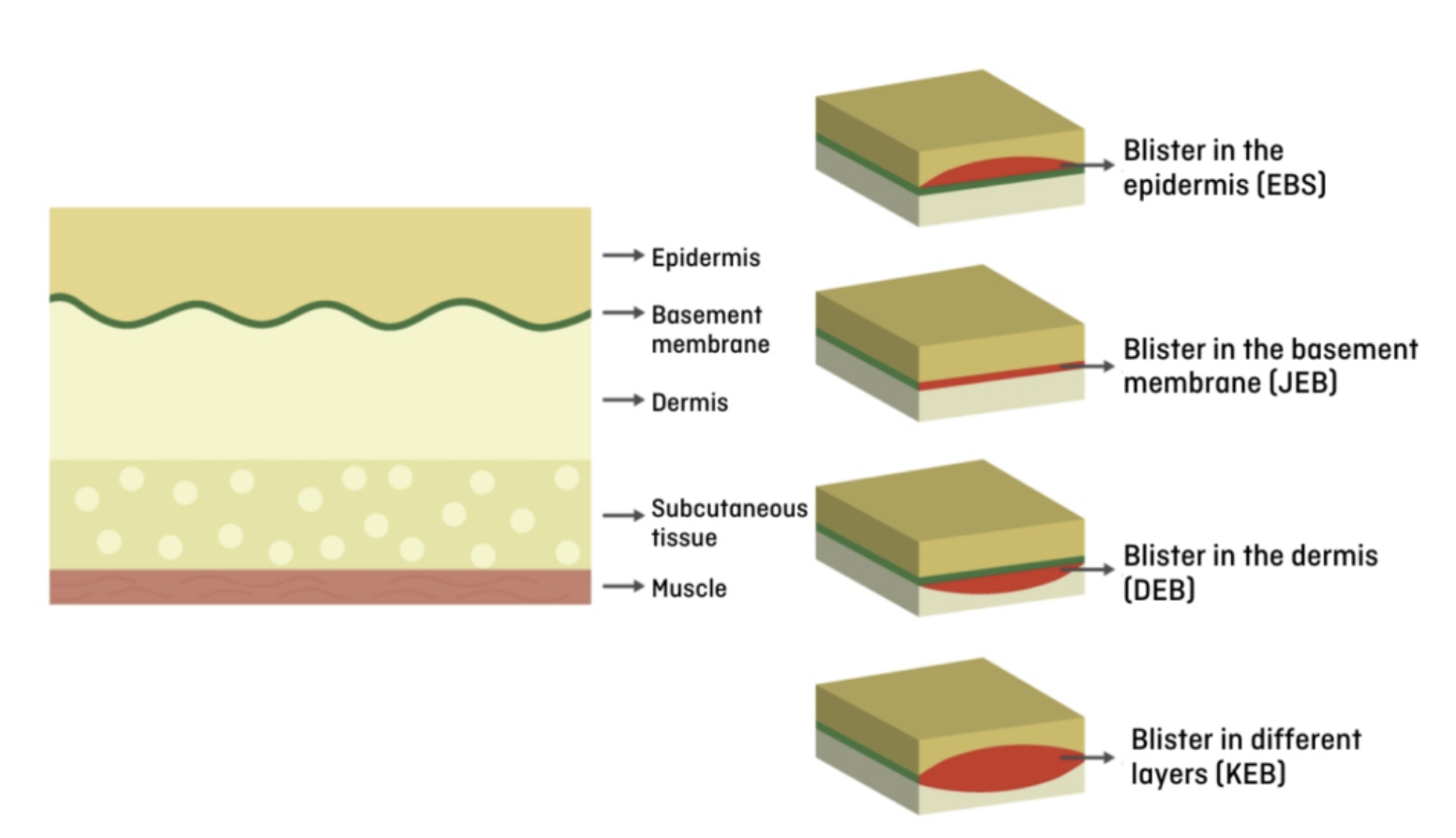
EB manifests due to issues with proteins that code for structural functions in the epidermis, basal lamina, or the upper part of the dermis, thus impacting adhesion and structural integrity (Bardhan, et al., 2020). There are four types, simplex, dystrophic, junctional, and Kindler syndrome (Figure 1). Simplex is primarily caused by mutation to keratin proteins, whereas dystrophic and junctional are caused by the mutation of collagen 7 and collagen 17 respectively, and also lamin proteins (Mariath, et al., 2020). In Kindler syndrome, the protein affected is fermitin, which is associated with integrins and focal adhesion.

Figure 1: The layers of skin affected by different types of EB are depicted (Share4Rare, 2023). The right depicts a simple view of skin layers, and the left depicts where blisters occur in different EB types. Simplex (EBS) blisters form in the epidermis, junctional (JEB) blisters occur in the basement membrane (basal lamina), and dystrophic (DEB) blisters occur in the dermis; blisters associated with Kindler’s Syndrome occur in different skin layers (Mariath, et al., 2020). The location of blister formation is dependent on which protein is altered, which also determines what type of EB the individual has (Bardhan, et al., 2020).
Currently, there is no cure for EB, however extensive care is necessary to maintain individuals’ well-being. Care treatments aim to protect the skin and prevent infection (Pope, et al., 2012). This may include non-adherent wound dressings, topical treatments, and blister popping.
In December 2023, the FDA approved filsuvez (oleogel-S10), a topical gel used to treat partial-thickness wounds in dystrophic and junctional EB patients (Chiesi Global Rare Diseases, 2023). In a clinical trial, 41.3% of individuals saw wound closure within 45 days using filsuvez, compared to only 28.9% using a placebo (Kern, et al., 2023). The active ingredient in filsuvez is birch triterpenes, which promote wound healing (Kern, et al., 2023). These include betulin, betulinic acid, erythrodiol, lupeol and oleanolic acid (Schwieger-Briel, et al., 2019).
Birch triterpenes are not widely used, but betulin specifically has been found to target the inflammation and tissue formation stages of wound healing (Schwieger-Briel, et al., 2019). The exact molecular mechanism of betulin is unknown, but it can target multiple inflammatory pathways, compared to traditional inflammatory drugs which have a single target (Adepoju, et al., 2023). Globally, betulin is found in warty, fluffy, and white birch trees (Demets, et al., 2022). The outer part of the tree’s bark consists of approximately 20-30% betulin. The most effective way to extract betulin from the bark is to separate acidic components of betulin extract using an alkali (Demets, et al., 2022). The bark is first treated with a water-alcohol alkali; alcohols used include methanol, ethanol, or isopropyl alcohol. Then the betulin extract is treated with an alkali solution in different concentrations. This method provides maximal extraction yield and removes impurities, which is ideal for medicinal use.
Filsuvez gives hope for EB patients. Living with EB is harsh and painful; any relief can be life-changing for individuals. Filsuvez is a benefical advancement but is not a cure. Ultimately, the goal is to turn EB from “the worst disease you’ve never heard of” to “the worst disease there is a cure for.”
References
Adepoju, F.O., Duru, K.C., Li, E., Kovaleva, E.G. and Tsurkan, M.V., 2023. Pharmacological Potential of Betulin as a Multitarget Compound. Biomolecules, 13(7), p.1105. https://doi.org/https://doi.org/10.3390/biom13071105.
Bardhan, A., Bruckner-Tuderman, L., Chapple, I.L.C., Fine, J.-D., Harper, N., Has, C., Magin, T.M., Marinkovich, M.P., Marshall, J.F., McGrath, J.A., Mellerio, J.E., Poson, R. and Heagerty, A.H., 2020. Epidermolysis Bullosa. Nature Reviews Disease Primers, 6(78). https://doi.org/https://doi.org/10.1038/s41572-020-0210-0.
Chiesi Global Rare Diseases, 2023. Chiesi Global Rare Diseases Receives FDA Approval for FILSUVEZ® (birch triterpenes) topical gel for the Treatment of Epidermolysis Bullosa. Chiesi Global Rare Diseases. [online] 19 Dec. Available at: <https://chiesirarediseases.com/media/fda-approval-for-filsuvez-topical-gel>.
Demets, O.V., Takibayeva, A.T., Kassenov, R.Z. and Aliyeva, M.R., 2022. Methods of Betulin Extraction from Birch Bark. Molecules, 27(11), p.3621. https://doi.org/https://doi.org/10.3390/molecules27113621.
EBRP, 2018 What is Eb? [online] EB Research Partnership. Available at: <https://www.ebresearch.org/what-is-eb.html>.
Kern, J.S., Sprecher, E., Florencia Fernandez, M., Schauer, F., Bodemer, C., Cunningham, T., Löwe, S., Davis, C., Sumeray, M., Bruckner, A.L. and Murrell, D.F., 2023. Efficacy and safety of Oleogel-S10 (birch triterpenes) for epidermolysis bullosa: results from the phase III randomized double-blind phase of the EASE study. British Journal of Dermatology, 188(1), pp.12–21. https://doi.org/https://doi.org/10.1093/bjd/ljac001.
Mariath, L.M., Tosetto Santin, J., Schuler-Faccini, L. and Kiszewski, A.E., 2020. Inherited epidermolysis bullosa: update on the clinical and genetic aspects. Anais Brasileiros de Dermatologia, 95(5), pp.551–569. https://doi.org/https://doi.org/10.1016/j.abd.2020.05.001.
National Institute of Health, 2023. Epidermolysis Bullosa. [online] National Institute of Arthritis and Musculoskeletal and Skin Diseases. Available at: <https://www.niams.nih.gov/health-topics/epidermolysis-bullosa>.
Pope, E., Lara-Corrales, I., Mellerio, J., Martinez, A., Schultz, G., Burrell, R., Goodman, L., Coutts, P., Wagner, J., Allen, U. and Sibbald, G., 2012. A consensus approach to wound care in epidermolysis bullosa. Journalof the America Academy of Dermatology, [online] 67(5), pp.904–917. https://doi.org/https://doi.org/10.1016/j.jaad.2012.01.016.
Schwieger-Briel, A., Ott, H., Kiritsi, D., Laszczyk-Lauer, M. and Bodemer, C., 2019. Mechanism of Oleogel‐S10: A triterpene preparation for the treatment of epidermolysis bullosa. Dermatologic Therapy, 32(4). https://doi.org/https://doi.org/10.1111/dth.12983.
Share4Rare, 2023. Epidermolysis bullosa. [online] Share4Rare. Available at: <https://www.share4rare.org/library/epidermolisis-bullosa/4-eb-types-and-classification>.