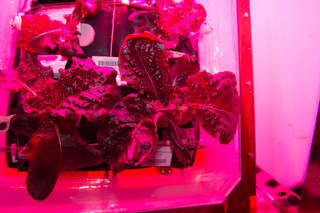
NASA plans to send humans to Mars by the mid-2030s (The White House, 2010). However, a mission to Mars using current propulsion technology could take around eight months just to arrive (Tafforin, 2013). The amount of supplies required to meet food, air, and water requirements would be unfeasibly great (Barta and Henninger, 1994). One solution being explored is growing food in space. In fact, astronauts on the International Space Station recently tried space-grown lettuce (Figure 1) for the first time (Herridge, 2015).

The challenges of growing vegetables in space are unique and have led to the development of various technologies. On spacecraft, energy and space are limited, so growing plants needs to be efficient. However, sunlight is not always available, especially for potential missions to distant locations, so plants have to be illuminated with electrical lighting (Poulet, et al. 2014). A solution to this has been found in light emitting diodes (LEDs). LEDs have improved greatly in efficiency over the past decade (Figure 2), with efficiencies rivalling those of other high efficiency light bulbs, but less heat production (Poulet, et al. 2014).

Additionally, because LEDs produce pure colours of all one wavelength, it is possible to tune the light for optimal plant growth. For example, the lettuce that was recently consumed was grown under light generated primarily by red and blue LEDs, with a low level of green light (Herridge, 2015). Why? Plants collect light for photosynthesis using a variety of pigments. These pigments each have different absorbance peaks, wavelengths at which they absorb best. The most photosynthetically efficient wavelength is in the red part of the spectrum, although blue wavelengths also play important roles in plant development (Dougher and Bugbee, 2001). Green light, on the other hand, is largely reflected (Figure 3), the reason we perceive plants to be green (Kent, 2000). Small amounts of green light, however, have also been shown to be beneficial to plant growth, as well as aiding in visual assessment of plant condition (Massa, et al. 2008). Thus, by using a bank of mostly red and blue LEDs supplemented with a little green, astronauts can further save energy by only producing wavelengths needed by plants.
So far, results on the lettuce are encouraging: lettuce is a relatively microbe-free crop, and astronauts only had to sanitize it with food-grade citric acid wipes before consumption, while the rest was sent back to Earth for analysis (Herridge, 2015). Technologies developed by these experiments can benefit more than just current and future astronauts, however. They can have applications back on Earth, where they could be applied to improving terrestrial agricultural efficiency, including in applications such a hydroponic agriculture, a form of controlled environment agriculture popular in countries like Asia, and gaining popularity elsewhere now (Massa, et al., 2008; Herridge, 2015).
Growing lettuce and eating it may seem a small feat, but it may one day lead to bigger things. Today: low Earth orbit. Tomorrow: Mars? Solving world hunger? Only time will tell.
References
Barta, D. J. and Henninger, D. L. Regenerative life support systems – why do we need them? Advances in Space Research, 14(11), pp.403-410.
Dougher, T. A. O. and Bugbee, B., 2001. Differences in the response of wheat, soybean and lettuce to reduced blue radiation. Photochemistry and Photobiology, 73(2), pp.199-207.
Herridge, L., 2015. Meals ready to eat: Expedition 44 crew members sample leafy greens grown on space station. [online] Available at: <https://www.nasa.gov/mission_pages/station/research/news/meals_ready_to_eat> [Accessed 20 September 2015].
Kent, M., 2000. Advanced biology. Oxford: Oxford University Press.
Massa, G. D., Kim, H.-H., Wheeler, R. M. and Mitchell, C. A., 2008. Plant productivity in response to LED lighting. HortScience, 43(7), pp.1951-1956.
Narukawa, Y., Ichikawa, M., Sanga, D., Sano, M. and Mukai, T., 2010. White light emitting diodes with super-high luminous efficacy. Journal of Physics D: Applied Physics, 43(35), pp.1-6.
Poulet, L., Massa, G. D., Morrow, R. C., Bourget, C. M., Wheeler, R. M. and Mitchell, C. A., 2014. Significant reduction in energy for plant-growth lighting in space using targeted LED lighting and spectral manipulation. Life Sciences in Space Research, 2, pp.43-53.
Tafforin, C., 2013. The Mars-500 crew in daily life activities: an ethological study. Acta Astronautica, 91, pp.69-76.
The White House, 2010. National Space Policy of the United States of America. Washington, D. C.: The White House.