Humans have X and Y sex chromosomes, with sex determination occurring through the random combination of these chromosomes when a sperm fertilizes an oocyte. An XX combination results in a female and an XY combination results in a male (Arnold 2017). However, not all species have sex chromosomes and rely on other systems for sex determination. Some reptilian species, such as turtles and crocodiles, have temperature dependent sex determination systems which are reliant on environmental conditions following fertilization (Gilbert 2000). Due to a rapidly changing climate, there are emerging population risks for these species with temperature-dependent sex determination systems.
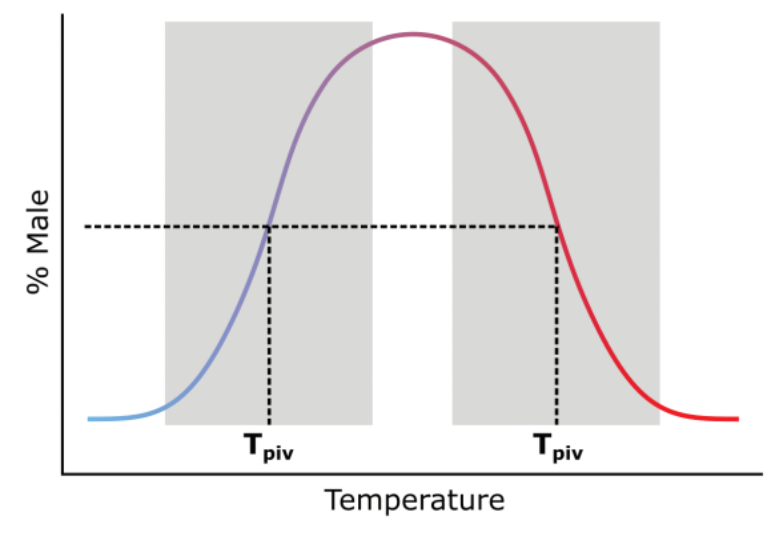
During nesting, female sea turtles come onto land to lay their eggs during the spring and early summer months. These eggs will incubate in the sand for approximately 45 to 70 days (Rusli 2022). The middle third stage of embryonic development is considered the temperature sensitive period where the incubation temperature of the eggs irreversibly determines turtle sex. Temperatures below 26°C produce males while temperatures above 31°C produce females, with intermediate temperatures producing a mix of sexes (Figure 1) (Gilbert 2000).
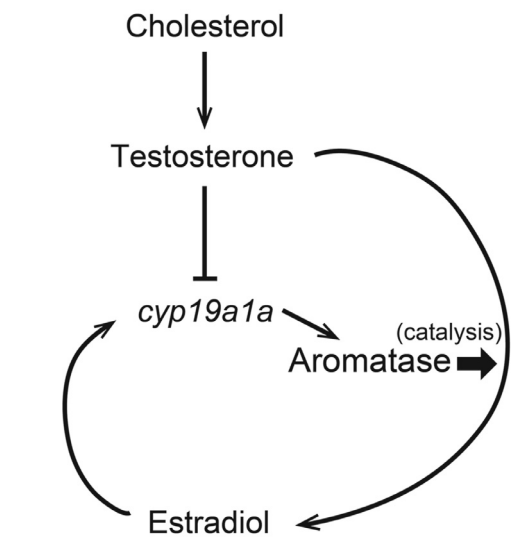
Sex differentiation in turtles is largely mediated by the gonadal steroid hormones testosterone and estradiol (Yamaguchi and Iwasa 2018). Testosterone, the male sex hormone, is synthesized from cholesterol at a fixed rate. The presence of the enzyme aromatase irreversibly converts testosterone into estradiol, the female sex hormone. The gene cyp19a1a, which codes for aromatase, is upregulated by the presence of estradiol, which in turn increases estradiol production, and is inhibited by testosterone (Figure 2). High temperatures during incubation decreases methylation of the cyp19a1a gene, opening the gene for transcription which increases aromatase expression, with the opposite occurring at lower, male producing temperatures (Matsumoto et al. 2013).
In the 20th century, global air temperatures have increased by 0.8°C and are projected to rise an additional 2-6°C during the 21st century (Boyle et al. 2016). In turtle populations with temperature dependent sex determination, even a 2°C increase in average incubation temperature can drastically skew the sex ratio toward females. A 4°C increase could effectively eliminate the local male production, since they are produced at lower incubation temperatures (Janzen 1994). Based on current climate predictions, these local impacts are likely to occur.
Evolutionary adaptation to environmental change occurs over a long time period through the gradual accumulation of beneficial mutations. With the rapid change in global temperatures, it is unlikely these species will adapt fast enough to alter their sex determination system in an effort to maintain a balanced sex ratio (Janzen 1994). While a change in the species-level sex determination system is unlikely, a feasible alternative is change in animal behaviour. Females may begin to nest earlier in the season or at higher latitudes to experience lower temperatures, allowing for the production of either sex and bringing the male-female ratio back into balance (Boyle et al. 2016).
Over the course of millenia, complex systems have evolved to ensure species’ survival. In times of rapid environmental change, behavioural flexibility may allow for populations to persist until evolutionary processes catch up.
References
Arnold, Arthur P. 2017. “A General Theory of Sexual Differentiation.” Journal of Neuroscience Research 95 (1–2): 291–300. https://doi.org/10.1002/jnr.23884.
Boyle, Maria, Lisa Schwanz, Jim Hone, and Arthur Georges. 2016. “Dispersal and Climate Warming Determine Range Shift in Model Reptile Populations.” Ecological Modelling 328 (May): 34–43. https://doi.org/10.1016/j.ecolmodel.2016.02.011.
Gilbert, SF. 2000. “Environmental Sex Determination.” In Developmental Biology, 6th ed. Sinauer Associates. https://www.ncbi.nlm.nih.gov/books/NBK9989/.
Janzen, F. J. 1994. “Climate Change and Temperature-Dependent Sex Determination in Reptiles.” Proceedings of the National Academy of Sciences 91 (16): 7487–90. https://doi.org/10.1073/pnas.91.16.7487.
Krueger, Caleb J., and Fredric J. Janzen. 2023. “On the Origin of Patterns of Temperature-Dependent Sex Determination.” Evolution 77 (4): 1091–100. https://doi.org/10.1093/evolut/qpad029.
Matsumoto, Yuiko, Alvin Buemio, Randy Chu, Mozhgon Vafaee, and David Crews. 2013. Epigenetic Control of Gonadal Aromatase (Cyp19a1) in Temperature-Dependent Sex Determination of Red-Eared Slider Turtles. https://doi.org/10.1371/journal.pone.0063599.
Rusli, Mohd. 2022. Nesting of Sea Turtles. https://doi.org/10.1007/978-3-319-55065-7_628.
Yamaguchi, Sachi, and Yoh Iwasa. 2018. “Temperature-Dependent Sex Determination, Realized by Hormonal Dynamics with Enzymatic Reactions Sensitive to Ambient Temperature.” Journal of Theoretical Biology 453 (September): 146–55. https://doi.org/10.1016/j.jtbi.2018.05.023.


Leave a Reply
You must be logged in to post a comment.