Vector Fields and Their Applications
In Calculus 3, students are taught to integrate vector fields, their surface areas and centres of mass. However, one might wonder what these actually represent in real life, and how they can be applied to careers today.
Vector fields are maps assigning vectors to any point in space. An example in physics is using vector fields to visualize electric fields (Shariati, 2023). Because electric fields possess magnitude and direction at every point in space, and these differ at each point, it is easier to visualize where the vectors are using vector fields. However, these vector fields also have applications to understanding many principles of everyday life.
To start, vector fields are used to model blood flow, notably in the aorta. A study done in 2019 was able to use vector fields to model the wall shear stress (WSS) in the aorta, which is the tangential force of the blood acting on the aortic walls. Modeling WSS is very useful because it has a magnitude and direction, like electric fields, and can help to visualize blood flow through the main blood vessels of the body. In visualizing the flow, we can investigate different flows through different blood diseases, such as atherosclerosis, aneurysms, thrombosis and aortic dilation. Since these diseases change blood vessels through different symptoms like inflammation, vessel remodeling and vessel damage,visualizing the vector field of blood flow can be very useful. The WSS vector field can be visualized by splitting the vector field into five components: gradient, co-gradient and three other harmonic fields (Razafindrazaka et al. 2019).
Other applications of vector fields include fluid mechanics concepts in engineering. This includes mimicking groundwater flow, heat flow and soil mechanics. To model these, we use the defining properties of vector fields such as divergence and curl, and also different theorems such as Stokes and Green theorem (Strack 2020). The velocity of a fluid, most notably, can be modeled as a vector field at each point of space and time. For example, the integral curve of the velocity field can model the path of a speck of dust (Rajeev 2018).
A final application of vector fields is measuring fluid, both in the air and in the ocean, as seen in Figure 1. In aviation and energy production, vector fields can be used to predict wind turbine production and wind velocity. Additionally, modeling the wind can help find local topographic effects (such as valleys or straits), or topographic coefficients for given wind directions. In the ocean, vector fields are used to approximate marine currents, which can help with discovering ecosystems and morphodynamics of coastal zones and navigation for boats or submarines (Khayretdinova and Gout 2024).
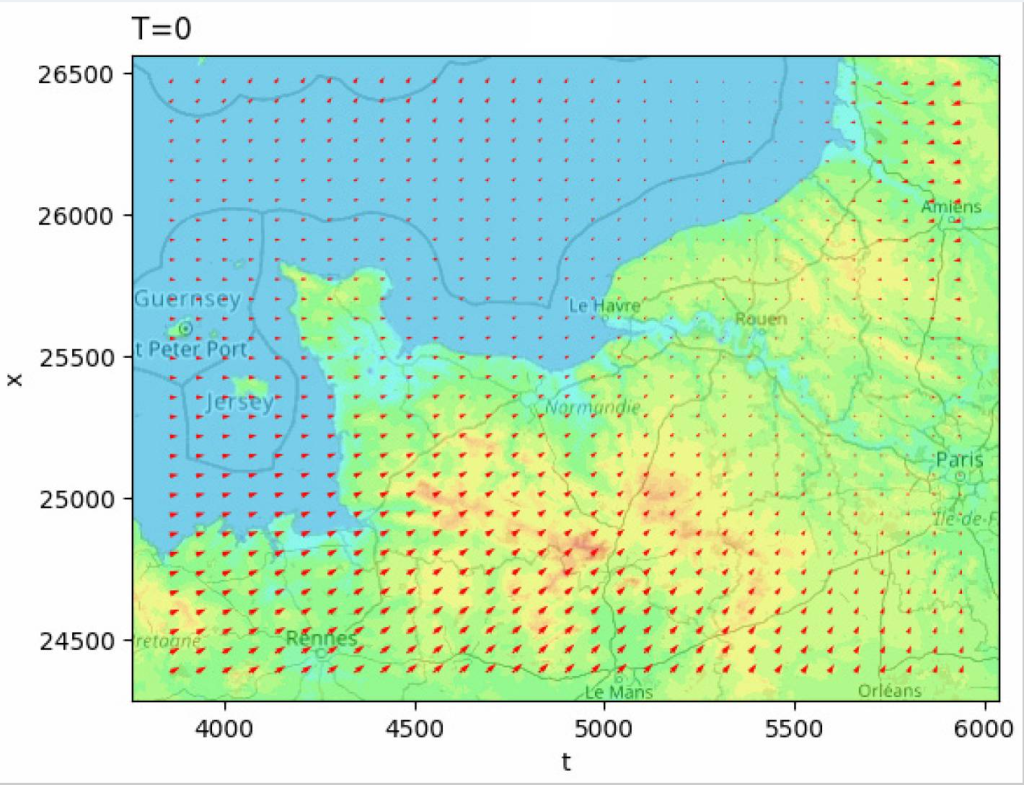
Figure 1. An example of vector fields being used to visualize wind vector fields in Normandy, France, with time on the x axis and velocity (represented by x) on the y axis. Adapted from Khayretdinova and Gout 2024.
Vector fields can be found in all areas of life, and in many careers. Though in school, mathematics seems to lack application and direction, the calculations mathematicians carry out are essential to the way we live.
References
Khayretdinova, Guzel, and Christian Gout. 2024. “A Mathematical Model for Wind Velocity Field Reconstruction and Visualization Taking into Account the Topography Influence.” Journal of Imaging 10 (11): 285. https://doi.org/10.3390/jimaging10110285.
Rajeev, S. G. 2018. “Vector Fields.” In Fluid Mechanics: A Geometrical Point of View, edited by S. G. Rajeev. Oxford University Press. https://doi.org/10.1093/oso/9780198805021.003.0001.
Razafindrazaka, Faniry H., Pavlo Yevtushenko, Konstantin Poelke, Konrad Polthier, and Leonid Goubergrits. 2019. “Hodge Decomposition of Wall Shear Stress Vector Fields Characterizing Biological Flows.” Royal Society Open Science 6 (2): 181970. https://doi.org/10.1098/rsos.181970.
Shariati, Ahmad. 2023. “A Mathematical Approach to Special Relativity.” ScienceDirect. http://www.sciencedirect.com:5070/book/monograph/9780323997089/a-mathematical-approach-to-special-relativity.
Strack, Otto D. L. 2020. Applications of Vector Analysis and Complex Variables in Engineering. Springer International Publishing. https://doi.org/10.1007/978-3-030-41168-8.


Leave a Reply
You must be logged in to post a comment.